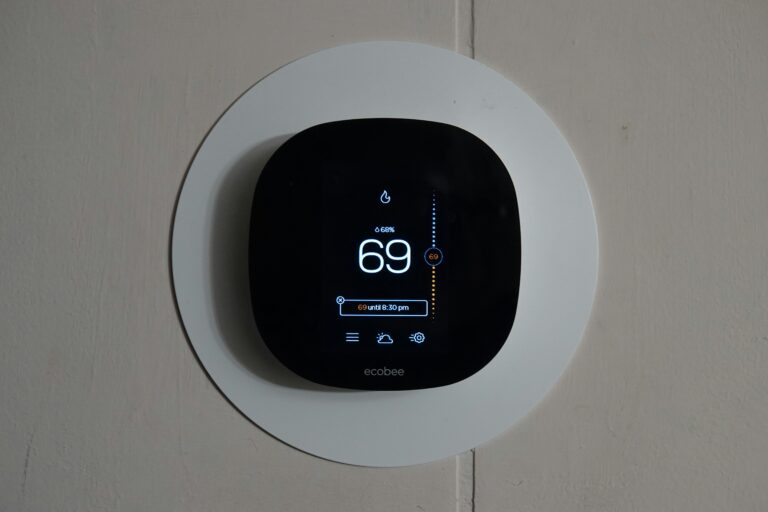

Yes, you can have multiple thermostats in one house, and it often makes sense for homes with uneven temperatures. The key distinction is between separate thermostats wired to independent HVAC systems and true zoned control that splits a single system into separately managed areas. Your equipment, floor plan, and how widely temperatures swing from room to room decide which path fits your situation.
This practical walkthrough breaks down how multi-thermostat setups actually function in real homes, helping you decide whether adding units or zoning your existing system is worth the wiring and equipment investment.
The Comfort Problem That Sparks the Idea
A two-story colonial in July tells the story clearly. The upstairs bedroom hits 78°F by midnight while the downstairs living room sits at a chilly 70°F. One thermostat on the main floor cannot read the second floor, so it has no way to know the bedrooms are still warm.
This pattern shows up in homes with additions, finished basements, bonus rooms over garages, and large sun-facing wings. Heat rises, sun loads push glass-heavy rooms past their neighbors, and ductwork that runs through an attic loses energy before it reaches the far end of the house. A single control point in the hallway cannot reconcile all of those conditions at once.
The intuitive fix is to put a second thermostat upstairs. Sometimes that instinct is exactly right. In other homes, it creates more problems than it solves because the underlying equipment was never designed to serve two control points at the same time.
What Comfort Balance Actually Means Across a Whole Home
Comfort balance means every occupied room stays within a narrow temperature band, roughly 70°F to 74°F in cooling season and 68°F to 72°F in heating season. Most homeowners tolerate a 2°F to 4°F swing between floors, but anything wider starts to feel like a draft in one room and a stuffy box in another.
The goal of any multi-control setup is to shrink that swing without driving up energy bills. That requires either independent equipment for each zone or a single piece of equipment that knows how to direct air to whichever zone currently needs it most.
How Multiple Thermostats and Zoning Actually Work
Two standalone thermostats on one shared HVAC system will fight each other. One calls for cooling while the other calls for heating, and the equipment has no way to satisfy both at the same time. A true zoned system resolves this conflict with a control board and motorized dampers that route air where it is needed.
Separate systems, like a first-floor furnace paired with a second-floor mini-split, can each carry their own thermostat cleanly because no equipment is shared. This is the simplest path to multi-zone control, and it is the most common setup in homes where one zone was added later as a renovation.
Standalone Thermostats vs True Zoning
| Feature | Two Standalone Thermostats | True Zoned System |
|---|---|---|
| Number of HVAC units | Two independent systems | One shared system |
| How zones are managed | Each unit runs on its own schedule | Control board opens and closes motorized dampers |
| Typical cost to add | $150 to $400 per thermostat | $1,500 to $3,500 retrofit, equipment dependent |
| Best fit for | Homes with additions or separate systems | Single-system homes with uneven floors |
| Conflict risk | None, equipment is separate | None, board arbitrates calls |
Inside a zoned system, a zone board reads every thermostat, decides which zones currently need conditioning, and opens the right dampers. Ductwork that serves the upstairs bedroom stays closed when only the downstairs living room is calling for heat, which keeps conditioned air from being wasted on rooms that are already at temperature.
That selective delivery only works, however, when the ductwork and control board are designed to handle separate calls from separate rooms.
When One HVAC System Can and Cannot Support More Than One Thermostat
Zone boards, motorized dampers, and a transformer with enough spare capacity let a single HVAC system run more than one thermostat. It cannot support them safely when it is a single-stage system with one transformer and no damper infrastructure, because two thermostats calling at once will short-cycle the equipment and confuse the safety controls.
Start by checking what is on the equipment. Open the furnace or air handler panel and look for a control board with terminals labeled for multiple thermostats or zone outputs. If you see only a single set of R, W, Y, and G terminals, the system is wired for one thermostat and one thermostat only.
How System Type Shapes the Answer
Single-stage systems, meaning equipment with only one cooling speed and one heating speed, are the hardest to zone. The shortest possible runtime is usually longer than a single zone needs, so temperatures overshoot in whichever zone reaches setpoint first.
Multi-stage equipment, variable-speed blowers, and inverter-driven heat pumps are far more zone-friendly. Modulation lets the system run at a lower capacity for longer periods, which matches the smaller load of a single zone without short-cycling. Many newer heat pumps also ship with multi-zone capability built into the indoor head units, so each room can carry its own wall control without retrofitting the ductwork.
Ductwork limitations aside, software-first thermostats now offer another path around the hardware ceiling entirely.
Tip: Look for a C-wire, the blue or black common wire, at your existing thermostat location. Smart thermostats and most zoning setups need it to draw continuous power. No C-wire usually means you will need to pull a new wire or add a common wire adapter.
Smart Thermostats Built for Multi-Unit Setups
The major smart thermostat brands have all released models that handle multi-zone logic in different ways. Ecobee’s Smart Thermostat with voice control and their Smart Thermostat Premium ship with built-in support for up to 32 remote sensors, letting one thermostat average readings across multiple rooms or prioritize whichever sensor is currently occupied. Nest thermostats from Google use a similar sensor-based approach for a single system, with one thermostat making decisions based on which room is in use.
Honeywell, Sensi, and Emerson each sell thermostats designed to drop into a true zoned system, with one thermostat per zone and a shared control board behind the wall. Across these brands, the real difference is software: how sensors are weighted, whether geofencing is supported, and how schedules interact with humidity readings.
| Brand and Model | Best Use Case | Sensor Support |
|---|---|---|
| Ecobee Smart Thermostat Premium | Single-system homes that want room-level averaging | Up to 32 remote sensors |
| Nest Learning Thermostat (4th gen) | Single-system homes focused on occupancy learning | Multiple Nest Temperature Sensors |
| Honeywell T10 Pro | True zoned systems with one stat per zone | Up to 20 RedLINK room sensors |
| Sensi Touch Wi-Fi | Two-system homes needing two independent stats | No remote sensors, per-stat scheduling |
| Emerson Sensi Wi-Fi | Budget-friendly replacement for legacy two-stat homes | No remote sensors, simple per-stat scheduling |
The Real Trade-Offs in Cost, Wiring, and Efficiency
Adding a second standalone thermostat costs about $150 to $400 in parts and a couple of hours of work. A full zoned retrofit on an existing single-system home runs $1,500 to $3,500 once you include damper motors, a new control board, and the labor to cut into the ductwork. Independent equipment, like a ductless mini-split for an upstairs addition, costs $2,000 to $5,000 installed per zone but eliminates the retrofit problem entirely.
Wiring complexity is where most DIY projects stall. Running a new cable from the indoor unit to a new thermostat location means fishing 18-gauge thermostat wire through closed walls, and most homes built before 2000 do not have a C-wire at the new location. Adding one means opening the wall or pulling a common-wire adapter at the furnace end.
Energy Savings and Equipment Health
Energy savings from zoning vary widely. Department of Energy guidance suggests that proper zoning can cut heating and cooling energy use by up to 30% in homes with strong temperature imbalances, but poorly designed zones can actually raise energy use by triggering short cycling. Short cycling happens when equipment starts, runs for a few minutes, shuts off, and starts again within ten minutes, which wears out compressors faster and never fully dehumidifies the air.
Maintenance is the last quiet cost. Two thermostats mean two sets of batteries, two firmware updates a year, and two schedules to keep aligned with daylight saving time. A single zoned system with one control board simplifies the maintenance side but adds one more piece of equipment, the damper motors, that can fail after 10 to 15 years.
Those long-term failure points are exactly why sizing a setup to the house, rather than to the latest gadget, matters most.
Warning: Two thermostats wired to a single shared system without a zone board will cause the equipment to short-cycle and may trigger the high-pressure safety limit. Always confirm with a multimeter that the system supports multiple control points before adding a second thermostat.
Choosing the Right Setup for Your Home
Your existing equipment, how your rooms are grouped by daily use, and your timeline for either spending on comfort or saving toward a replacement system drive the setup decision.
Start by mapping your home into two or three comfort zones. Most houses break naturally into upstairs and downstairs, or into a main living wing and a bedroom wing. Then check your equipment label and control board to see what your HVAC system is wired to support.
A Simple Decision Path
- One system, balanced temperatures: A single upgraded smart thermostat with remote sensors, like the Ecobee Premium, will solve most mild imbalances for $200 to $300.
- One system, strong imbalance: A true zoned retrofit with a new control board and motorized dampers in the existing ductwork delivers the most comfort per dollar.
- Two separate systems already: Each system gets its own thermostat, no retrofit needed, and the only decision is which smart model fits each location.
- One system, addition planned or recent: A ductless mini-split serving the new space with its own thermostat is often cleaner than tying a second stat into the original system.
- One system, no budget for retrofit: A smart thermostat with one or two remote sensors can close roughly 60% of the comfort gap without opening the ductwork.
Questions to Ask an HVAC Pro Before Committing
Ask whether your indoor unit supports multi-stage or variable-speed operation, because modulation is what makes a single system behave well across two zones. Ask how the existing transformer will handle an additional thermostat, since most 40VA transformers can power two thermostats but not three. Ask whether the ductwork has space for motorized dampers at every branch takeoff, and ask what the realistic payback period is for the proposed retrofit based on your last 12 months of energy bills.
If the pro says the answer is yes to multiple thermostats without first checking transformer capacity, control board inputs, and damper locations, find a second opinion.
Bottom Line
You can have more than one thermostat, but the equipment behind the wall decides whether a second thermostat gives you two comfort zones or two control points fighting each other. Start with a multimeter and an honest look at your HVAC system, then choose between a sensor-equipped smart stat, a full zoned retrofit, or a separate system for the stubborn zone. The comfort payoff is real when the equipment, the wiring, and the thermostat all line up.
FAQ
Can you have multiple thermostats in one house?
Homes with multiple thermostats work cleanly when each unit controls its own dedicated HVAC system. On a single shared system, the thermostats must connect through a zone board with motorized dampers to avoid equipment conflicts and short cycling.
Do I need more than one thermostat?
Homes with noticeably different temperatures across floors or wings, two separate HVAC systems already installed, or a planned zoned retrofit are the cases that justify more than one thermostat. You likely do not need one if a single smart thermostat with remote sensors already keeps your rooms within a 2°F to 3°F band.
How do multiple thermostats work?
Two distinct wiring and control approaches cover every multiple-thermostat installation. Each thermostat independently controls its own dedicated HVAC equipment, or all thermostats feed into a single zone board that decides which zones need conditioned air and routes it through motorized dampers. Standalone setups are simpler, and zoned setups share equipment across areas.
Is it better to have one thermostat or two?
Homes with mild temperature variation get full coverage from a single, well-placed smart stat paired with remote sensors, making a second thermostat unnecessary. Two thermostats are better when you have separate HVAC systems, a clear floor-level split in temperature, or a finished addition that needs independent control.
Can you have two thermostats for one AC unit?
A zoning setup with a zone board and motorized dampers is the only path to running two thermostats off one AC unit. Wiring two standalone thermostats to one shared unit without zoning will cause the system to short-cycle and may trip safety limits, so a pro should always confirm the equipment can support multiple control points first.
How many thermostats should a house have?
Most homes do well with one to two thermostats, and homes with three or more zones are rare unless the property is large, multi-generational, or built around separate systems. Each additional control point adds cost and complexity, so the right number is the smallest count that solves your real comfort gaps.