
Whether you’re replacing a wall unit that’s been stuck on the same temperature since the early 2000s, or wiring a workshop that finally deserves proper climate control, the right thermostat makes daily life noticeably smoother. The “pro series” label covers a wide spread, from no-frills analog-style digital controls to learning thermostats that map your routine on their own. The trick is matching system type and how you actually live to the model’s strengths. Below are ten options worth a serious look.
Your Options, Compared
PRO1 T725 Heat Pump/Conventional Programmable Wall Thermostat

PRO1 T771 Single Stage Non-Programmable Wall Thermostat
Honeywell TH1100DH1004 PRO 1000 Non-Programmable Thermostat
PRO1 T701 Single Stage Non-Programmable Wall Thermostat

PRO1 T715 Multi-Stage Programmable Gas Thermostat
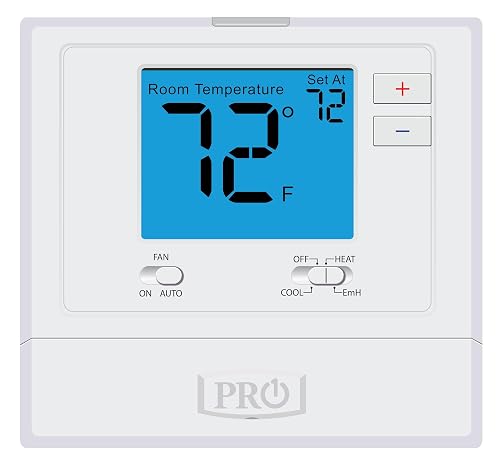
PRO1 T721 Non-Programmable Wall Thermostat

White-Rodgers Single Stage Non-Programmable Thermostat 1E78-144

PRO1 T805 Single Stage Programmable Wall Thermostat
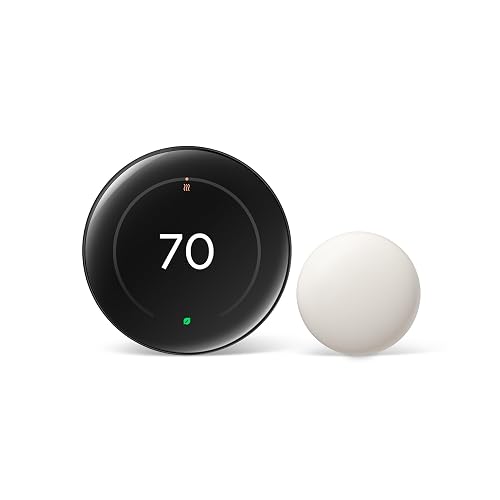
Google Nest Learning Thermostat (4th Gen) with Sensor (Obsidian)
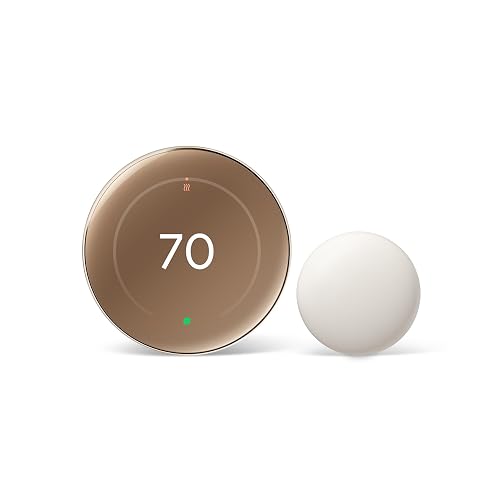
Google Nest Learning Thermostat (4th Gen) with Sensor (Polished Gold)
Why These Options Stand Out
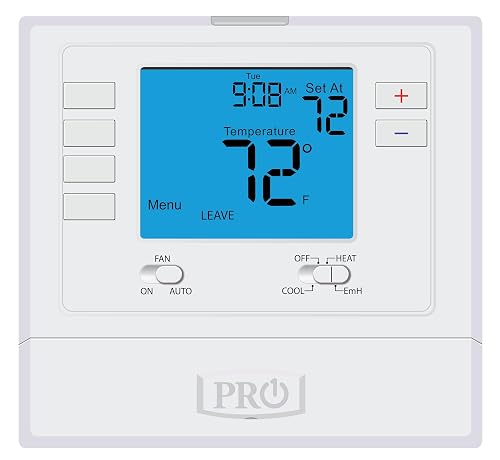
The PRO1 T725 sits at the top of the T700 platform lineup, and you feel it the moment you start programming. Built for 2 heat/1 cool heat pump systems as well as 1 heat/1 cool conventional setups, it offers 7-day or 5/1/1 scheduling on a 4 sq. in. blue backlit display. The schedule modes (wake, leave, return, sleep) cover the daily rhythm most households actually follow.
Homeowners with a heat pump who also want a conventional backup stage tend to find the T725 refreshingly flexible. Where simpler units like the PRO1 T701 below lock you into a single mode, this one adapts. For most dual-system households, the schedule depth alone justifies the step up.
The Good Stuff
- Handles both heat pump and conventional wiring from the same board
- 7-day and 5/1/1 scheduling with four daily periods
- Blue backlit 4 sq. in. screen readable from across a room
- Common-wire detection helps avoid low-power quirks
- Compatible with gas, electric, and heat pump equipment
Things To Consider
- Requires a C-wire or power-stealing setup on some systems
- Programming takes a few minutes the first time around
Who It Suits Best
Homeowners with a 2H/1C heat pump who want weekend-to-weekday scheduling without learning-thermostat complexity.
Where Another Pick Suits Better
Shoppers with only a basic 1H/1C conventional furnace and no need for scheduling should grab the simpler PRO1 T701.
The T771 leans into a niche that most living-room thermostats ignore: spaces that need to stay cool without freezing. Its setpoint range stretches down to 25°F, which makes it a natural fit for garages, sheds, and workshops where you might want a heater to kick on only when temps drop hard. Swing adjustment and calibration give you control over how often the system cycles.
Because it’s non-programmable, set it and walk away. In detached spaces where schedules don’t matter, that’s a feature, not a limitation. The 4 sq. in. blue backlit display stays readable in low light.
Points In Its Favor
- 25°F to 90°F range handles extreme low-temp heating
- Swing adjustment and calibration dials
- Simple up/down operation, no programming needed
- Backlit display visible in dim garages
Worth Noting
- Not designed for heat pump systems
- No scheduling, so daily setpoint changes are manual
- Limited aesthetic appeal for finished living spaces
Made For
Garages, workshops, and outbuildings running a single-stage conventional furnace or wall heater.
Not Your Match When
You want Wi-Fi or app control; the Nest Learning Thermostat serves that profile much better.
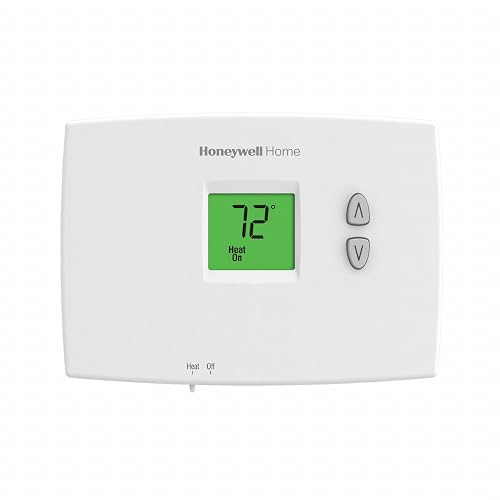
The Honeywell PRO 1000 has earned its reputation over many winters in older homes, additions, and accessory buildings. It’s heat-only, which makes the wiring simple, and dual-powered, meaning it accepts either battery or hardwire feed. The backlit horizontal display uses precise 1°F increments for straightforward comfort control.
Adjustable temperature scale lets you pick between a standard 40-90°F range or a garage-friendly 35-90°F range. For most single-zone baseboard or furnace setups, that’s all the flexibility you need.
Key Advantages
- Dual-powered design accepts battery or hardwire
- Adjustable scale for standard or garage applications
- Precise 1°F temperature increments
- Long-running PRO 1000 platform with widely available parts
Honest Caveats
- Heat-only, so cooling systems need a different unit
- Horizontal layout limits replacement on vertical wall openings
- No programmability means manual daily setpoint changes
Right Fit For
Owners of older homes or additions with heat-only systems who want an uncomplicated, dependable wall control.
Look Elsewhere When
You need cooling or a heat pump setup; the PRO1 T721 covers both conventional and heat pump wiring.
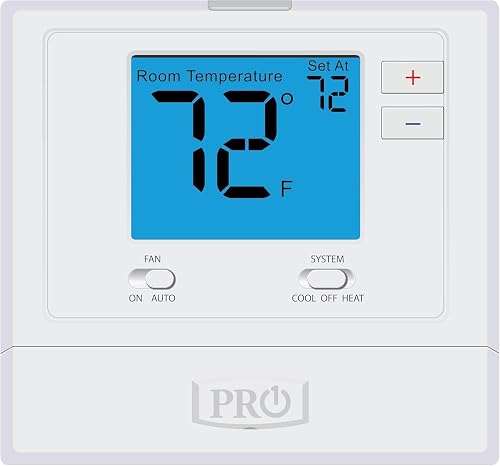
The T701 is the T700 platform stripped back to essentials, and that’s exactly the point. It runs 1 heat/1 cool conventional systems with a 4 sq. in. blue backlit screen and a glow-in-the-dark light button, so finding it in a dark hallway isn’t a problem. Gas or electric compatibility covers most common setups.
For a first-time swap, the T701 keeps wiring uncomplicated. Compared to the T725’s scheduling depth, this one trades features for simplicity. In most basic households, that’s a fair exchange.
The Value In It
- Glow-in-the-dark light button aids nighttime adjustments
- Large 4 sq. in. blue backlit display
- Gas or electric configuration support
- Quick to wire up for a basic 1H/1C system
Trade Offs
- No scheduling or learning features
- Battery-powered, which owners report requires AA swaps roughly yearly
Best Suited To
First-time installers and renters who want a clean digital upgrade over a basic mercury switch.
A Better Fit Elsewhere
Homeowners with a heat pump should consider the PRO1 T721, which accepts 2H/1C heat pump wiring.
The T715 targets the upper end of conventional HVAC: 2 heat/2 cool gas systems, the kind found in larger homes with two-stage furnaces. Programmable with 7-day, 5/1/1, or non-programmable modes, it lets you decide how much scheduling help you actually want. The 4 sq. in. blue backlit display sits on the same T700 platform, with the glow-in-the-dark light button carried over.
Two-stage systems run more efficiently when the thermostat knows how to stage them, and the T715 handles that sequencing properly. For most households with a two-stage gas furnace, the upgrade pays back in comfort.
A Strong Showing
- Supports full 2H/2C two-stage gas systems
- Three operating modes: 7-day, 5/1/1, or non-programmable
- Battery or hardwire power options
- Glow-in-the-dark light button for low-light rooms
Points To Keep In Mind
- Overkill for single-stage systems
- Wiring complexity requires a C-wire in many installations
Who Will Love This
Households with two-stage gas furnaces who want deeper scheduling without jumping to a smart thermostat.
Consider Something Else When
You have only a single-stage system; the PRO1 T701 covers that at a friendlier price point.
The T721 plays a useful role in the lineup: a non-programmable wall unit that accepts both 2H/1C heat pump and 1H/1C conventional wiring. The T700 platform foundation gives it the same 4 sq. in. blue backlit display and glow button as its siblings, and it can run on AA batteries or a hardwire feed.
For mixed-system homes where one zone runs a heat pump and another runs a conventional furnace, the T721 covers both. Compare that to the T701, which only handles conventional setups, and the value of that dual compatibility shows up fast.
What Earns Its Place
- Accepts 2H/1C heat pump or 1H/1C conventional wiring
- Glow button for nighttime visibility
- AA battery or hardwire power option
- Compact T700 platform footprint
Small Caveats
- No scheduling means manual setpoint changes
Perfect Match For
Households with mixed HVAC zones who want one non-programmable model that handles both wiring types.
Swap It Out When
You want scheduled setbacks through the week; the PRO1 T725 brings 7-day programming to the same dual-mode capability.
The White-Rodgers 1E78-144 has been a go-to replacement thermostat for years, and for good reason. It works with 24-volt and millivolt systems, which is unusual at this level, and handles single-stage heating, cooling, and heat pump (without aux) configurations. The backlit digital display keeps things readable in dim basements.
Millivolt compatibility makes it a solid fit for floor furnaces and some wall hydronic setups where most digital thermostats simply won’t work. For most older homes with non-standard wiring, that’s a quiet lifesaver.
Standout Benefits
- Works on 24V and millivolt systems
- Compatible with single-stage heating, cooling, and heat pump (no aux)
- Backlit digital display reads clearly in low light
- Long-standing model with widely available documentation
Room For Improvement
- Not compatible with electric baseboard heat
- No scheduling capability
Built With In Mind
Owners of older homes with millivolt floor or wall heating systems who need a no-fuss digital control.
Another Choice May Suit
Households with electric baseboard heat need a line-voltage specific model rather than the 1E78-144.
The T805 sits on the newer T800 platform, and the upgrade shows most clearly in the screen. The 7 sq. in. blue backlit display is noticeably larger than the 4 sq. in. screens on the T700 series, which matters for anyone who reads the temperature from across a long living room. Programming covers 7-day, 5/1/1, or non-programmable modes for 1H/1C conventional systems.
The glow-in-the-dark light button carries over from the T700 family. For most households, the larger display is the headline feature; the scheduling depth is the supporting act.
Real-World Strengths
- 7 sq. in. display, the largest in this roundup
- Three operating modes: 7-day, 5/1/1, or non-programmable
- Glow-in-the-dark light button for nighttime use
- T800 platform with modern control logic
Less Ideal Details
- Single-stage only, no multi-stage support
- Larger footprint may not fit older thermostat openings without a trim plate
Who Should Grab It
Homeowners with a 1H/1C conventional system who want a big, easy-to-read display and don’t need smart features.
Reach For A Different Pick When
You have a heat pump or two-stage system; the PRO1 T715 or T725 is the right call there.
The 4th-generation Nest Learning Thermostat in Obsidian is the smart-home end of the spectrum, and a sizable step up from anything on the T700 or T800 platforms. It learns your schedule, adjusting automatically as routines shift, and pairs with a Nest Temperature Sensor to manage hot and cold spots in individual rooms. The Obsidian finish blends into darker walls and modern interiors.
Setup is app-driven, and the system monitors heating and cooling equipment health alongside temperature. For most homeowners, the learning curve is front-loaded; once it understands your week, the daily fiddling goes away.
Strong Points
- Learning algorithm builds a schedule from real usage
- Included Nest Temperature Sensor addresses hot/cold rooms
- Obsidian finish suits modern interiors
- App control from anywhere with internet
Potential Drawbacks
- Requires a C-wire in most installations
- Heavier reliance on cloud connectivity for full features
The Right Fit
Smart-home households that want the thermostat to handle scheduling automatically and appreciate room-by-room sensing.
Where A Sibling Pick Shines
Homeowners with millivolt systems or strict no-Wi-Fi preferences should stick with the White-Rodgers 1E78-144.
The Polished Gold variant of the 4th-generation Nest brings the same learning thermostat internals as the Obsidian sibling, with a warmer metallic finish that reads more as decor than appliance. Compatibility spans Alexa, Apple HomeKit, and the Google Home app, so households running a mixed smart-home stack stay covered.
The included Nest Temperature Sensor handles room-specific readings the same way. For most homeowners shopping a smart upgrade, the choice between Obsidian and Polished Gold is purely aesthetic, which is exactly the point.
Bright Spots
- Polished Gold finish for warmer interior palettes
- Works with Alexa, Apple HomeKit, and Google Home
- Learning thermostat builds schedules from your routine
- Includes Nest Temperature Sensor for room-level control
Things To Weigh
- C-wire typically required for full operation
- Polished finish may show fingerprints more readily than matte options
Whose Shelf It Belongs On
Homeowners who want a smart thermostat and care about the visible finish blending with brass, gold, or warm-toned hardware.
Skip It When
You don’t need Wi-Fi or app control; the PRO1 T805 gives you a programmable schedule without the connected overhead.
Picking the Right Pro Series Thermostat for Your System
Start with the system, not the brand. The single biggest mismatch in thermostat shopping is wiring compatibility: a heat pump needs a thermostat rated for heat pump staging, while a conventional furnace only needs single-stage support. C-wire (common wire) availability matters too, since most modern units need steady 24V power to keep their displays and radios alive.
If you live in a home with a single 1H/1C conventional system and don’t want app notifications at 2 a.m., a non-programmable PRO1 model is plenty. For households that do want automated setbacks, a 7-day programmable like the T725 or T805 handles weekday/weekend shifts cleanly.
Multi-stage systems change the math. A two-stage furnace paired with a single-stage thermostat works, but you’ll lose the efficiency gains the second stage was designed to deliver. Match the staging, and the equipment can actually do what it was rated for.
Millivolt systems (common in older wall and floor furnaces) limit the field considerably. The White-Rodgers 1E78-144 explicitly covers millivolt, while most digital PRO1 units assume 24V. If you’re unsure, pull the existing thermostat face and check the wire count before shopping.
Finally, decide how much scheduling you actually want. Learning thermostats are a genuine improvement for people with shifting schedules, but for a fixed weekday routine, a basic 5/1/1 programmable runs the same schedule with less setup.
Common Slip Ups and Where the Extra Money Goes
Common Shopping Slip Ups
The most common mistake is buying a thermostat with more stages than the system supports. A 2H/2C unit on a single-stage furnace won’t damage anything, but it won’t add features either, and it adds wiring complexity during install. Match the thermostat to the equipment.
Another trap is ignoring the C-wire. Owners commonly report that their new thermostat keeps rebooting or the display dims after a few weeks because the system can’t supply steady power. Pulling a new wire through the wall solves it, but that’s a bigger project than a simple swap.
What The Higher Tier Buys
The step from a non-programmable PRO1 to a programmable T700 or T800 platform brings scheduling, a backlit display, and glow-in-the-dark buttons. The step from a programmable to a Nest Learning Thermostat adds Wi-Fi, app control, and a learning algorithm.
For most households with a fixed schedule, the middle tier (programmable but not smart) hits the sweet spot. For those with shifting routines, multi-zone homes, or a strong smart-home investment already in place, the higher tier earns its keep over time.
Frequently Asked Questions
Do I need a C-wire for a pro series thermostat?
Most modern digital thermostats, including the PRO1 T700 and T800 platforms, need a C-wire (common wire) for steady 24V power. Some units can run on AA batteries, but features like Wi-Fi and constant backlighting usually require the hardwire feed.
Can a programmable thermostat work with a heat pump?
Yes, as long as the thermostat lists heat pump support in its specifications. The PRO1 T725 and T721 both cover 2H/1C heat pump systems. Pairing a non-heat-pump thermostat with a heat pump will usually cause the auxiliary heat to behave incorrectly.
What does “single stage” mean for a thermostat?
A single-stage thermostat controls equipment that runs at one output level: the furnace is either on or off. Multi-stage thermostats manage equipment that can run at low and high output, which improves efficiency and comfort during mild weather.
Are learning thermostats worth it for small homes?
In a small, single-zone home with a fixed schedule, the day-to-day benefit of a learning thermostat is modest. The case gets stronger in multi-story homes, homes with hot or cold rooms, and households with shifting weekly routines.
How long do wall-mounted thermostats typically last?
Most quality wall thermostats run for 10 years or more without issue. The first component to wear out is usually the backlight, followed by the relay contacts inside the thermostat that switch the heating or cooling on. Battery-powered units typically need fresh batteries once a year.
Closing Remarks
The pro series thermostat that fits your home comes down to three honest questions: what system is on the wall, what schedule do you actually keep, and how connected do you want your home to be. Match those answers to the right platform, and the upgrade is one of the quieter improvements a home can get. Take your time with the wiring check before you order, and the rest of the install is usually an afternoon well spent.