
Picking a wall thermostat for a two-heat, one-cool system is rarely as simple as the box makes it look. Compatibility gaps, confusing terminals, and screens that wash out in afternoon sun all show up the moment the old unit comes off the wall. This shortlist focuses on thermostats that genuinely support 2H/1C wiring, with a few conventional 1H/1C options and an RV-friendly single-stage model mixed in for context. Every pick below lists its real system fit, display size, and power options so the match to your setup is obvious before you buy.
The Picks In Brief
White-Rodgers Emerson 80 Series Programmable Heat Pump Thermostat
PRO1 T725 Programmable Heat Pump/Conventional Wall Thermostat

PRO1 T771 Single Stage Non-Programmable Wall Thermostat

Airxcel 8330-3862 T-Stat Wall Digital Heat/Cool Thermostat
PRO1 T701 Single Stage Non-Programmable Wall Thermostat

PRO1 T715 Multi-Stage Programmable Gas Wall Thermostat
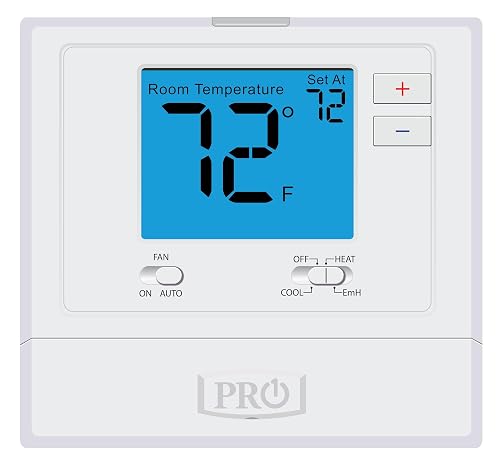
PRO1 T721 Non-Programmable Heat Pump/Conventional Wall Thermostat
White-Rodgers 70 Series Classic Programmable Thermostat 1F78-151

PRO1 T805 Single Stage Programmable Wall Thermostat
Taking A Closer Look At The Options
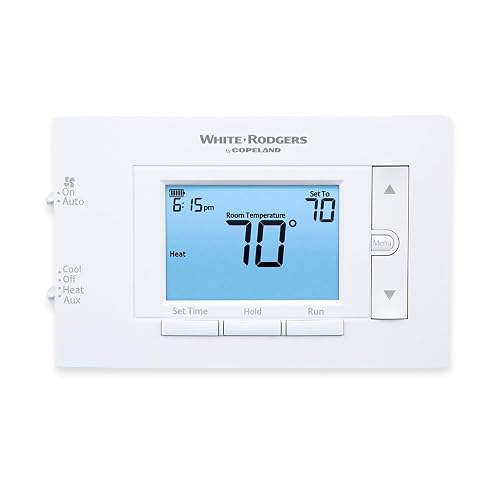
This Emerson 80 Series unit earns the first slot because it covers the most common 2H/1C wiring configurations a heat pump home is likely to have, including a dual fuel option that lets a gas furnace pair with a heat pump compressor. The 4.5-inch backlit screen is the largest in this lineup, which matters in hallways where the thermostat sits at eye level rather than right by the door.
Programming is flexible: 7-day, 5+1+1, or a non-programmable mode for anyone who just wants to set a temperature and leave it alone. Keypad lockout and adjustable temperature limits help in rentals, and dual power from either a common wire or AA batteries gives an installer options when the wall cavity has no C-wire.
Advantages To Know
- Wide 45°F to 99°F setpoint range covers nearly every residential comfort setting
- System switch supports Heat, Off, Cool, Aux/Emer, with a separate Auto/On fan switch
- Dual fuel option integrates a backup gas furnace with the heat pump compressor automatically
- Keypad lockout prevents guests or kids from changing programmed schedules
- Large display reads cleanly from across a typical living room
Honest Caveats
- Not compatible with electric baseboard heating, which limits it in some older homes
- Terminal layout (R, C, W2, E, Y, O/B, G, L) requires confirming the existing wiring before installation
Right Fit For
Homeowners with a 2H/1C heat pump, optional dual fuel furnace, and anyone who wants a large, easy-to-read display in a central hallway.
Look Elsewhere When
You need a simple conventional 1H/1C thermostat with no heat pump circuitry, in which case the PRO1 T701 is a more focused match.
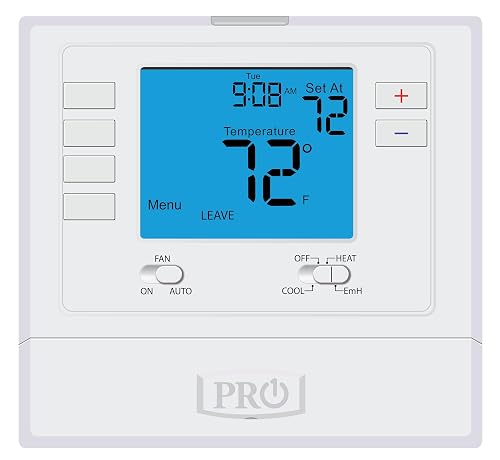
The PRO1 T725 lives on the T700 platform, which is a real advantage for anyone who wants one thermostat that handles both a 2H/1C heat pump and a 1H/1C conventional system during a future equipment swap. Compared to the Emerson 80 Series above, the display is smaller at 4 square inches, but the blue backlight reads cleanly in low light and the schedule icons for wake, leave, return, and sleep are easy to learn.
Programming supports 7-day or 5/1/1 schedules, with a non-programmable option for renters who want fewer buttons to press. Owners typically describe installation as straightforward on standard 24V systems, and the unit can run on either a hardwired common or batteries, so an older wall box without a C-wire won’t block the upgrade.
Strong Points
- Works on both 2H/1C heat pump and 1H/1C conventional equipment
- Blue backlit display with clear wake, leave, return, and sleep schedule labels
- Choice of battery or hardwired C-wire power
- T700 platform design supports straightforward menu navigation
Small Caveats
- Smaller display than the Emerson 80 Series, which may matter in wide hallways
- Manual swing adjustment and calibration require entering the installer menu, which can feel opaque at first
Feature Snapshot
Best Suited To
Households that may switch between a heat pump and a conventional system over the next decade, or anyone with mixed HVAC gear on different floors.
Swap It Out When
You need a much larger display for low-vision family members, in which case the PRO1 T805 is the better fit.
The T771 earns its spot for a specific reason: a setpoint range that drops down to 25°F and climbs to 90°F, which is unusual among residential wall units. Garages, workshops, sheds, and three-season rooms often need a thermostat that can hold a space near freezing without short-cycling, and this one handles that span without special wiring.
It’s a non-programmable single-stage unit, so you set the temperature and it maintains it, which keeps the button layout simple. The 4 square inch blue backlit display is the same family as the T725 above, and swing adjustment plus calibration live in the installer menu for fine-tuning on a ductless or unusual HVAC setup.
Reasons It Performs
- 25°F to 90°F range reaches unheated spaces where a standard home stat bottoms out too high
- Non-programmable interface removes schedule confusion for occasional-use rooms
- Backlit screen stays visible in dim garages and basements
Some Limits To Know
- Single stage only, so it won’t run a multi-speed fan or two-stage furnace efficiently
- Lacks the glow-in-the-dark light button found on the T701 and T721 models
Made For
Owners of detached garages, sheds, workshops, or any space where the temperature swings well below typical home comfort ranges.
A Better Fit Elsewhere
Anyone running a 2H/1C heat pump indoors will want the White-Rodgers Emerson 80 Series instead, since the T771 is a single-stage conventional unit.
The Airxcel 8330-3862 sits in a different lane from the rest of this shortlist. It’s a wall-mounted digital heat/cool thermostat built specifically for RV and camper systems, where 12V or low-voltage DC power rules out a lot of residential stats. Single-stage operation keeps the wiring minimal, and the black housing blends with most RV interior panels better than a white residential unit would.
Unlike the PRO1 T771 above, this isn’t designed for a wide setpoint range, but for mobile applications where dependable single-stage control matters more than programming depth. The brand has a long history in RV heating and cooling components, which tends to translate into straightforward installation on common RV furnace and air conditioner pairs.
What Stands Out
- Built for RV wall mounting, where vibration and DC power rule out many home stats
- Single-stage digital control keeps the interface simple for weekend trips
- Black finish matches typical RV interior panels
Where It May Fall Short
- Not designed for residential 2H/1C heat pump systems, despite the 2H/1C title phrasing of the broader category
- Limited scheduling features compared with programmable residential picks like the PRO1 T725
Whose Shelf It Belongs On
RV owners, van-lifers, and anyone running a single-stage rooftop AC and furnace combo on a coach or trailer.
Reach For A Different Pick When
You’re wiring a residential heat pump at home, in which case the PRO1 T721 or White-Rodgers 80 Series is the more capable match.
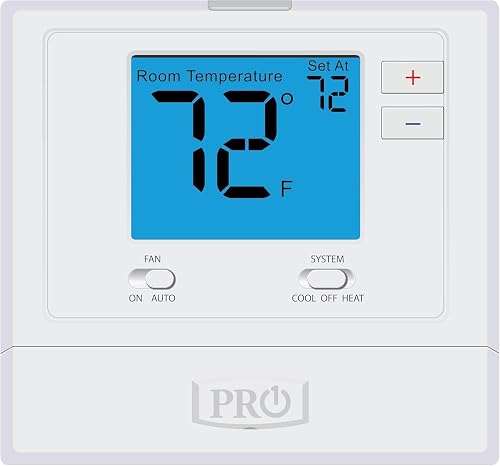
The T701 is a no-nonsense replacement for an aging conventional 1H/1C thermostat. It runs on the larger T700 platform chassis, so the 4 square inch blue backlit screen has room to show setpoint and room temperature side by side without crowding. A glow-in-the-dark light button is the kind of small detail that makes a difference on a 2 a.m. bathroom visit, and it’s not always present on competing basic models.
Unlike the T725 above, you don’t get 7-day scheduling, so this is firmly a set-and-forget pick. Gas or electric configuration is selected in the installer menu, which keeps the front face of the unit uncluttered for everyday use.
A Few Strong Suits
- Glow-in-the-dark light button remains visible after a power blip
- Works on 1H/1C gas or electric conventional systems
- T700 platform chassis gives the screen more breathing room than older T200-class units
Practical Considerations
- No programming, so weekday and weekend schedules are not an option
- Single-stage only, not a match for multi-stage furnaces like the PRO1 T715
Who Should Grab It
Anyone replacing a worn-out conventional 1H/1C thermostat who wants a clean screen and a low learning curve for every household member.
Not Your Match When
You want a 7-day programmable schedule, in which case the PRO1 T805 sits in the same PRO1 family with that flexibility included.
The T715 is the multi-stage answer in this roundup, designed for 2H/2C gas furnace systems where a single-stage stat would short-cycle the equipment and waste fuel. It uses the same T700 platform display as the T725 and T701, with the same glow-in-the-dark light button, but adds 2H/2C support that the lower-numbered models can’t deliver. Programming can run 7-day, 5/1/1, or stay non-programmable, depending on how much schedule tuning you want.
Power can be either batteries or a hardwired common, which is helpful when replacing an older thermostat that didn’t need a C-wire. For a household upgrading from a single-stage to a two-stage furnace, this unit is the natural pairing without jumping to a smart thermostat platform.
Everyday Wins
- 2H/2C multi-stage support prevents short-cycling on a two-stage gas furnace
- Programmable or non-programmable modes in one unit
- Battery or hardwired C-wire power for flexible installation
Things To Weigh
- Multi-stage wiring adds terminals, so the install takes longer than a single-stage swap
- Display sits in the same 4 sq. in. size as other T700 picks, not the larger T805 panel
Technical Highlights
Perfect Match For
Households with a two-stage gas furnace and central AC who want staged heating without moving to a connected smart thermostat.
Skip It When
Your system is single-stage conventional, in which case the PRO1 T701 is a simpler and more affordable match.
The T721 covers the same 2H/1C heat pump or 1H/1C conventional wiring as the T725 above, but strips out programming in favor of a simpler front panel. For households where nobody ever adjusts the schedule anyway, removing 7-day programming removes the most common source of thermostat confusion: a guest changing settings on Friday that the homeowner has to reset on Sunday.
The 4 square inch blue backlit display and glow-in-the-dark light button are familiar from the T700 family, and AA battery or hardwired C-wire power gives the same flexible install. Compared to the White-Rodgers 80 Series, you give up the 4.5-inch screen and the dual fuel option, but the wiring is more forgiving for a DIY install.
Standout Benefits
- Supports 2H/1C heat pump or 1H/1C conventional systems on one wall plate
- Non-programmable interface means fewer accidental schedule changes
- Glow-in-the-dark light button helps during nighttime or power outages
A Few Limitations
- No scheduling, so weekday setbacks aren’t automatic
- Smaller display than the Emerson 80 Series
Who Will Love This
Renters, guest houses, and any home where the thermostat tends to get bumped and adjusted by multiple people during the week.
Where Another Pick Suits Better
You want 7-day programmable scheduling on the same 2H/1C platform, in which case the PRO1 T725 is the sibling to choose.
The 1F78-151 from the 70 Series is a long-running single-stage programmable thermostat that handles both 24V and millivolt systems, which opens it up to older wall heaters and floor-standing gas fireplaces that some smart thermostats refuse to touch. A 5/2 day schedule splits the programming into weekday and weekend blocks, which is enough granularity for most homes and easier to teach to a less tech-oriented household member.
The display is a backlit digital screen, smaller than the 4.5-inch Emerson 80 Series but readable at arm’s length. It’s the right kind of “boring” thermostat for a vacation property, a basement suite, or anywhere you want dependable staging without a learning curve.
Useful Touches
- Compatible with both 24V and millivolt systems, including some older gas fireplaces
- 5/2 day programming covers weekday and weekend schedules separately
- Long-running model with widely available documentation and installer familiarity
Points To Note
- Not compatible with electric baseboard heat, which limits it in some older homes
- Single stage only, so multi-stage furnaces will underutilize their staging with this unit
Feature Card
Who Will Love This
Owners of older homes with millivolt heating systems, plus anyone who values a long-proven model over the newest feature set.
Consider Something Else When
You have a 2H/1C heat pump system, in which case the White-Rodgers 80 Series is the more capable sibling from the same brand family.
The T805 closes out the shortlist with the largest display in the PRO1 family: a 7 square inch blue backlit screen on the T800 platform, which reads from across a long living room where the T701’s 4-square-inch screen starts to feel small. Programming covers 7-day, 5/1/1, or non-programmable modes, so you can grow into scheduling instead of committing up front. The glow-in-the-dark light button is the same familiar placement as the smaller T700 picks.
For households where low-vision family members, frequent Airbnb guests, or simply a long sightline to the thermostat makes a big readout worth more than extra stages, this is the easy upgrade. Power can be battery or hardwired, which keeps older walls in play without fishing a new C-wire.
Practical Pluses
- 7 sq. in. display is the largest in this PRO1 lineup, readable from across a room
- Programmable or non-programmable modes share the same installer menu
- Glow-in-the-dark light button is locatable in low light
- Battery or hardwired power fits older wall boxes
Where It Is Less Suited
- Single stage only, so two-stage furnaces will need the PRO1 T715
- Larger footprint than the T701 may not cover the existing wall paint outline
Built With In Mind
Households where readability matters more than multi-stage support, including rentals, in-law suites, and homes with aging eyes at the thermostat.
Where A Sibling Pick Shines
You need multi-stage support alongside the larger screen, in which case pairing a future PRO1 T815 with this same platform could be the next step.
Matching The Thermostat To Your System Type
A 2H/1C thermostat label refers to two heating stages and one cooling stage. In a heat pump setup, the two heating stages usually mean the compressor plus a backup electric or gas strip, while in a conventional setup, two stages means a two-stage gas furnace. Confirm the staging before you buy, because a single-stage stat will short-cycle a two-stage furnace and leave comfort on the table.
Display size matters more than most shoppers expect. A 4 square inch screen is fine at arm’s length, but in a hallway you cross quickly, the 4.5-inch Emerson 80 Series or the 7 square inch PRO1 T805 read at a glance. Power wiring is the next checkpoint. Many older homes lack a C-wire (the common wire that delivers continuous 24V power), and the picks above split into two camps: units that run on AA batteries alone, and units that need a hardwired C-wire for full functionality. Battery-only operation is fine for most residential swaps, but a C-wire gives a more stable readout over time.
Programming flexibility is the third filter. Households with predictable weekday and weekend patterns usually find 5/2 day schedules, like the White-Rodgers 70 Series above, more than enough. Homes with rotating shifts, remote work, or multiple occupants benefit from full 7-day programming on the PRO1 T725, T715, or T805. Special spaces like garages, sheds, and workshops call for the wider 25°F to 90°F range of the PRO1 T771, since standard residential stats often bottom out at 45°F, which is too warm to protect plumbing in an unheated outbuilding.
Key Considerations Across These Picks
Wrong Turns To Avoid
The most common mistake is buying a thermostat without opening the existing wall plate to count wires. A 2H/1C heat pump system typically needs terminals R, C, W2, E, Y, O/B, G, and L, and a model that lacks the L terminal won’t pick up service indicators from some heat pump boards. The second mistake is assuming any programmable thermostat supports 7-day scheduling, when many basic models lock you into a 5/2 day split. The third is overpaying for smart features that you won’t use, when a non-programmable unit like the PRO1 T721 will do the job for half the routine fiddling.
What The Higher Tier Buys
Stepping up from a single-stage conventional stat to a multi-stage or heat pump model gets you finer temperature control, fewer cold drafts between cycles, and compatibility with modern two-stage furnaces and heat pump compressors. The PRO1 T715 and Emerson 80 Series sit in that tier, and the upgrade tends to pay for itself in fuel savings over several winters. The extra cost also buys a larger display, a glow-in-the-dark light button, and installer-level options like swing adjustment, which most basic models hide. For homes that already have multi-stage HVAC equipment, the higher tier is a fit, not a luxury, since a single-stage stat won’t run a two-stage furnace the way it was designed.
Frequently Asked Questions
What does 2H/1C mean on a thermostat?
2H/1C stands for two stages of heating and one stage of cooling. The heating stages are the steps a heat pump or furnace uses to reach the setpoint efficiently, and the cooling stage is your air conditioner. A 2H/1C thermostat can coordinate both stages of heating without short-cycling the equipment.
Can a 2H/1C thermostat work on a single-stage system?
Yes, most 2H/1C thermostats are backward compatible with single-stage systems, since they simply leave the second heating stage unused. The White-Rodgers Emerson 80 Series and the PRO1 T725 both work this way and let you grow into a multi-stage system later.
Do I need a C-wire for these thermostats?
Several picks in this list, including the PRO1 T725, T715, and T805, support battery power as an alternative to a C-wire. If you have only R, W, and Y wires at the wall, battery operation lets you install without running a new common wire, though a C-wire generally gives a more stable backlight over time.
Is a programmable thermostat worth it for a 2H/1C heat pump?
Programmable setback schedules tend to save more energy on heat pumps than on conventional systems, since the heat pump runs for longer cycles and benefits from a stable setpoint. A 7-day model like the PRO1 T725 or T805 lets you set weekday and weekend routines that match your household without manual adjustments.
Can I install one of these thermostats myself?
Most homeowners with basic electrical comfort can swap a wall thermostat in under an hour by labeling wires, photographing the old wiring, and matching terminals to the new plate. The multi-stage PRO1 T715 and the Emerson 80 Series have more terminals and benefit from a careful label pass before any wire is moved.
Wrap Up
The right thermostat for a 2H/1C setup is the one that matches the actual staging on your wall, the wiring you already have, and the screen size you can read from across the room. Heat pump households with a backup furnace will lean toward the White-Rodgers Emerson 80 Series, while conventional homes with a single stage get a clean fit from the PRO1 T701 or T805. Garages, sheds, and RV systems have their own niche picks in the T771 and Airxcel 8330. Match the system first, then choose the display and programming that fit how the household actually lives with it.