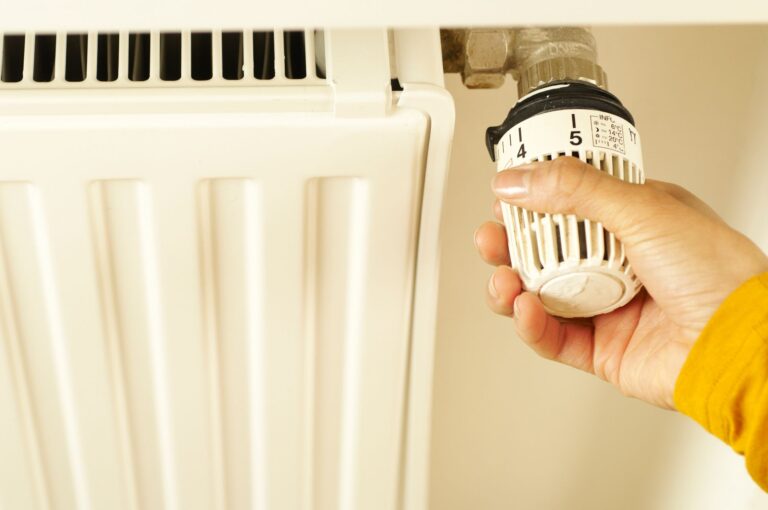

Picking the right thermostat for your baseboard or radiant setup comes down to matching voltage, wiring, and habits to the right control. You want predictable warmth in a chilly bedroom, a bathroom that warms up before you wake, or a workshop that doesn’t run nonstop. The ten options below cover wall-mounted baseboard controls, programmable floor-heat thermostats, and water-heater upperstats, so you can zero in on the one that actually fits your home’s wiring and your daily routine.
Your Options, Compared
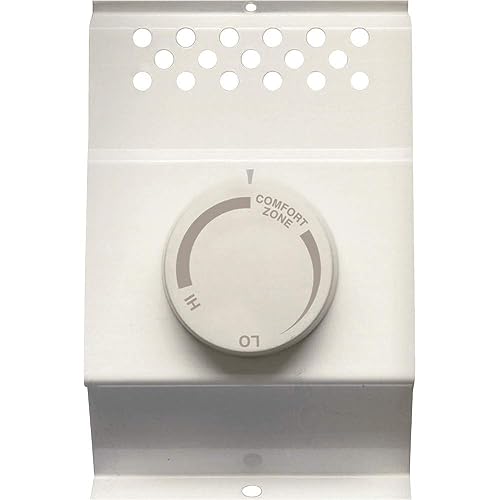
Cadet BTF1W Single-Pole Baseboard Thermostat
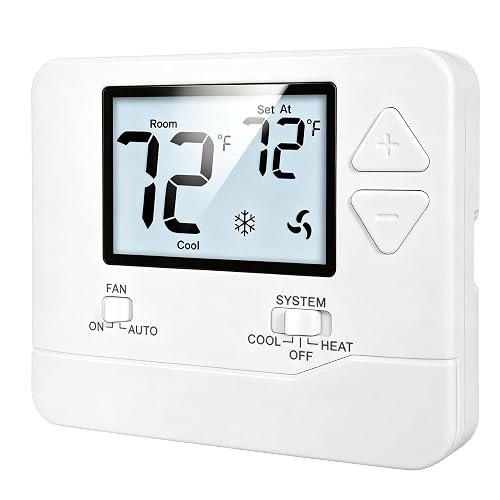
Heagstat 1H/1C Non-Programmable Thermostat
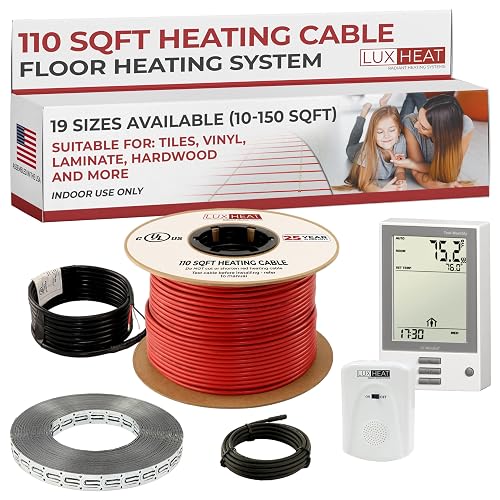
LuxHeat 110 sqft Floor Heating Cable Kit

LuxHeat 120 sqft Floor Heating Cable Kit

YeloDeer 4-Wire Baseboard Thermostat
YeloDeer 4-Wire Baseboard Thermostat (2-Pack)
YeloDeer 4-Wire Baseboard Thermostat (4-Pack)

Zero KST203 Water Heater Upper Thermostat

OJ Microline UTN4 Radiant Floor Thermostat
LuxHeat 140 sqft Radiant Floor System
What Each Pick Brings To The Table
When your old baseboard thermostat finally gives up, the Cadet BTF1W steps in as a no-drama wall replacement. It lives in the same compact housing that countless baseboard heaters have used for years, so swapping it out rarely means touching the wiring beyond the existing terminals.
You’ll find this one fits best in a single room where a basic dial and reliable on/off action is plenty. It also pairs naturally with the higher-voltage YeloDeer models later in this list if you’re standardizing controls across a home.
Why It Works Well
- Single-pole design keeps the swap straightforward for older baseboard circuits.
- Compact wall footprint suits tight hallways and small bedrooms.
- Mechanical dial style means no menus, no programming, and nothing to break in a power blip.
- Commonly chosen when matching an existing Cadet heater, which keeps the visual fit consistent.
Things To Weigh Up
- Single-pole wiring means the heater still receives power at one end, so there’s no true off state at the heater.
- Mechanical dials drift over time and tend to need recalibration every few years in dusty utility rooms.
- Without a temperature readout, dialing in a precise room setting is a matter of feel rather than a number.
Who Should Grab It
Homeowners with a single failing baseboard stat who want a familiar mechanical replacement without rewiring the wall box.
Where A Sibling Pick Shines
Rooms with 240V wiring and a desire for tighter electronic control are a better match for the YeloDeer 4-Wire Baseboard Thermostat.
The Heagstat 1H/1C is built for low-voltage HVAC work, not line-voltage baseboards. It runs on the 24VAC common to most forced-air furnaces, and it expects a 2-to-5 wire setup rather than the heavier 4-wire layout of electric baseboard circuits.
Think of it as a control for a gas, oil, or electric furnace paired with a separate air-conditioning condenser. Where the Cadet and YeloDeer thermostats in this roundup work directly on 120V or 240V heating circuits, the Heagstat sits in a different category entirely. It belongs on a wall near your ductwork, with the correct low-voltage wire bundle feeding it.
Points In Its Favor
- White backlight keeps the readout readable in dim hallways and basements.
- Designed for conventional 1H/1C systems, the most common residential HVAC setup.
- Non-programmable design avoids schedule headaches for renters and seniors.
- Comes in handy when a mercury-bulb stat finally fails and you want a clean digital swap.
Worth Noting
- Not compatible with line-voltage baseboard heaters, which is a common point of confusion at checkout.
- The 2-to-5 wire limit rules out homes with six or more conductors at the stat location.
- You give up scheduling, so anyone hoping for setback routines will need to look at a programmable model.
Key Specs
Right Fit For
Households with a 24VAC forced-air furnace and a separate AC condenser that want a simple wall swap.
Skip It When
Line-voltage electric baseboard owners should reach for the Cadet BTF1W or a YeloDeer 4-Wire model instead.
Bathroom remodels are where radiant floor heat earns its keep, and the LuxHeat 110 sqft kit is set up for that exact job. It includes a 120V heating cable, a programmable UDG thermostat, a floor sensor, plus cable strapping and an alarm that helps you spot a nick in the wire before you lay tile.
The 110 sqft rating is a sensible size for a primary bath or small kitchen, and the included GFCI thermostat (a ground-fault circuit interrupter that cuts power if it detects a fault) is the safety feature local codes typically require for in-floor installations. Compare that to the Heagstat above, which is a wall stat for forced air rather than a floor sensor reading surface temperature.
Advantages To Know
- Programmable schedule lets you warm the floor before your morning shower.
- Floor sensor reads actual surface temperature, not just ambient air.
- Cable alarm gives early warning if a fastener nicks the wire during install.
- GFCI is built into the thermostat, simplifying the breaker-side wiring.
Trade Offs
- Cable layout takes patience: spacing and strapping drive uniform heat.
- Programmable interface adds a learning curve for first-time floor-heat owners.
- Single-room footprint means larger basements will need a bigger kit.
Whose Shelf It Belongs On
DIYers tiling a small bathroom or entryway who want a complete floor-heat kit in one box.
Consider Something Else When
Larger open spaces around 140 sqft or more pair better with the LuxHeat 140 sqft Radiant Floor System later in this list.
Step up roughly ten square feet of coverage and you land on the LuxHeat 120 sqft kit, which trades the older UDG stat for the UDG4 touchscreen model. That screen is the headline change, and for many homeowners it’s the difference between fiddling with buttons and tapping a target temperature.
The 120V cable and floor sensor work the same way as the 110 sqft version, and you still get the cable monitor for early damage alerts. The one thing this kit does not include is cable strapping, so you’ll need to source that separately if your subfloor layout calls for it.
Everyday Wins
- Touchscreen interface feels modern and reduces the menu-layer confusion common to floor-heat stats.
- 10 extra square feet of cable covers slightly larger bathrooms or mudroom entries.
- Same GFCI-equipped, programmable platform as the smaller LuxHeat kit, so you learn one interface across rooms.
Honest Caveats
- Cable guides and strapping are not included, so budget for a small add-on if your subfloor needs them.
- Touchscreens occasionally need a dry cloth wipe to stay responsive in steamy bathrooms.
- Single 120V feed means very large rooms will need a second circuit and stat.
Made For
Remodelers who want a touchscreen upgrade and slightly more floor coverage than the 110 sqft kit offers.
Look Elsewhere When
You’d rather have mat-style installation over cable strapping, in which case the LuxHeat 140 sqft Radiant Floor System is a better fit.
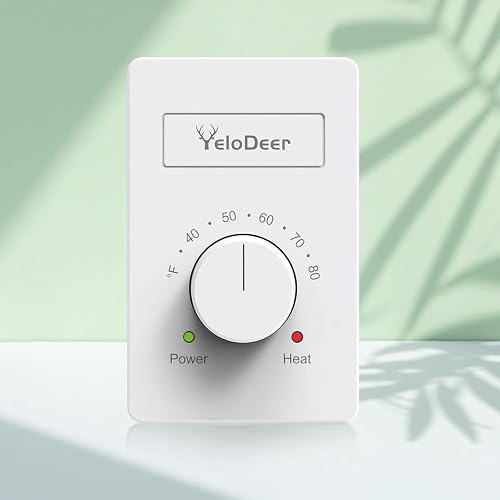
The single-pack YeloDeer is the entry point into 4-wire electronic baseboard control. It accepts anywhere from 110V to 265V on the input side and tolerates 12AWG wire at its terminals, which covers both 120V and 240V baseboard circuits common in North American homes.
Unlike the mechanical Cadet at the top of this list, this one uses electronic sensing and a 40°F to 80°F control range, so you dial a specific number rather than a vague “warmer or cooler.” It also handles loads up to 2400W on 120V or 4800W on 240V, which is plenty for most room-sized baseboards.
Noteworthy Benefits
- Wide voltage tolerance (110V to 265V) means one SKU covers both common residential circuits.
- Electronic sensor typically holds tighter temperature targets than a bimetallic dial.
- 4-wire setup provides true line-voltage switching, unlike the single-pole Cadet.
Possible Compromises
- No scheduling, so daily routines require manual adjustment.
- Single unit means you’ll buy multiples for whole-home projects, which is where the 2-pack and 4-pack versions earn their keep.
- Compatibility check is on you: confirm 4-wire access at the existing box before you remove the old stat.
Feature Snapshot
Best Suited To
One-room baseboard upgrades where you want electronic accuracy and true line-voltage switching without a schedule.
Swap It Out When
Whole-home conversions save money and effort with the YeloDeer 4-Wire Baseboard Thermostat (4-Pack) instead.
Adding a second room? The 2-pack version of the YeloDeer 4-wire thermostat gives you identical controls for two spaces without re-spec’ing the same part. Both stats run on the same 110V to 265V input and share the same 20-amp / 4800W ceiling, so a bedroom-and-office refit stays consistent.
This is also the sweet spot for split-level homes where two rooms share a hallway wall and you want matching faceplates. You’ll wire each one independently, but the part numbers, the look, and the install steps all stay the same.
What Stands Out
- Two matching stats keep a small renovation visually consistent room to room.
- Same 110V to 265V compatibility as the single-pack YeloDeer, so the SKU scales.
- Helpful when one thermostat fails in an old install and you want a like-for-like replacement on hand.
Some Limits To Know
- Two units still don’t cover three-room projects, so plan ahead before ordering.
- Each stat operates independently, with no whole-home coordination.
- Spare inventory means one unit may sit on the shelf if your project scope shrinks.
Perfect Match For
Homeowners upgrading two adjacent baseboard zones who want matching controls and a slightly better per-unit value.
Reach For A Different Pick When
Three or four zones make the YeloDeer 4-Wire Baseboard Thermostat (4-Pack) the more practical bundle.
Whole-home conversions land at the 4-pack version of the YeloDeer thermostat. Four zones cover most small houses or the main level of a larger one, and ordering them together means a single delivery, a single part number, and consistent controls from the master bedroom to the home office.
Each stat carries the same 110V to 265V input range and 40°F to 80°F control window. You still wire each one on its own 20-amp circuit, but the bundle format removes the guesswork of matching the second or third purchase to the first.
Notable Gains
- Four matching stats give a whole small home a unified look and feel.
- Single bulk order simplifies budgeting and reduces per-unit shipping.
- Same wide voltage compatibility means mixed 120V and 240V circuits stay on one SKU.
Worth Bearing In Mind
- Overkill for one or two rooms; the 2-pack or single unit is the better fit there.
- Four stats still don’t talk to each other, so true zoned coordination requires a smarter platform.
- Storage of unused units needs a dry spot away from dust until the next install.
Who Will Love This
Owners planning a whole-home baseboard refit who want to order once and standardize on one electronic control.
Not Your Match When
Single-room projects suit the YeloDeer 4-Wire Baseboard Thermostat (single unit) much more cleanly.
The Zero KST203 is a different beast entirely, designed for electric water heaters rather than living-space baseboards. It’s a double-throw, 120/480 VAC upper thermostat for dual-element tanks, and it carries a built-in safety switch to help prevent overheating on the upper element.
You’ll reach for this when an existing water-heater upperstat goes bad and you need a direct cross-reference replacement. The 59T SPDT and 66T cross-reference hints make it a useful search target for owners diagnosing a tank that runs cold or scalding.
Bright Spots
- Built-in safety switch adds a layer of protection against runaway heating.
- Energy-saving range setting lets you dial back tank temperature for standby savings.
- Double-throw design covers dual-element tanks up to 480VAC configurations.
Points To Note
- Specific to water heaters, so it doesn’t apply to baseboard or floor-heat circuits.
- Replacement requires shutting off power at the breaker and pulling the tank access panels, which most homeowners leave to a pro.
- Cross-reference check is on you, since tank stat models vary by manufacturer.
Built With In Mind
Anyone with an aging electric water heater that needs an upperstat swap rather than a full tank replacement.
A Better Fit Elsewhere
Living-area heating calls for one of the LuxHeat floor kits or a YeloDeer baseboard stat instead.
The OJ Microline UTN4 is a non-programmable stat built for in-floor radiant heat, and it leans heavily on safety. A Class A GFCI is built right into the unit, which is the type of protection local code typically demands for any underfloor heating system, so you may not need a separate GFCI breaker.
It also uses dual sensing, meaning it reads both the ambient air and the floor sensor that ships in the box. That combo helps the system shut off before the slab overheats, which is a useful guard for tile over wood subfloor or for homeowners with curious pets.
The Case For It
- Class A GFCI is integrated, simplifying code compliance for new radiant installs.
- Dual sensing protects the floor surface while still managing room air temperature.
- Listed for use in both the U.S. and Canada, so cross-border shoppers have a familiar spec sheet.
- Non-programmable layout keeps daily operation to a single dial and a few buttons.
Room For Improvement
- No scheduling means you walk over to the stat for any setback.
- Listed for USA and Canada, but specific warranty terms vary; check the listing before purchase.
- Floor sensor placement is on the installer, and a poorly placed probe can cause sluggish response.
Feature Card
Who It Suits Best
Homeowners wiring radiant heat in a bathroom or kitchen who want code-grade GFCI without a separate breaker.
Where Another Pick Suits Better
Anyone wanting scheduled warm-ups should look at the LuxHeat 110 sqft Floor Heating Cable Kit with its UDG programmable stat.
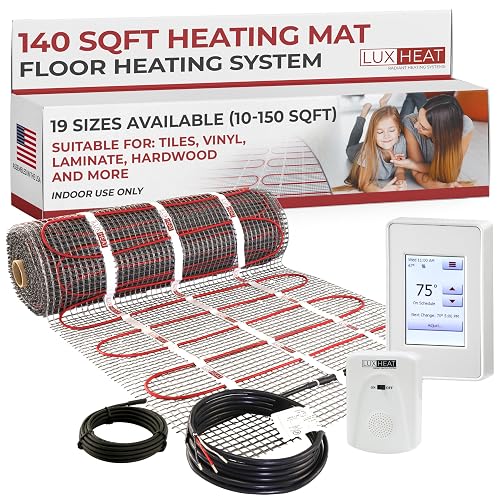
Step up to a 140 sqft room and the floor-heat math changes: cable kits turn into mat kits. The LuxHeat 140 sqft system ships two self-adhesive heating mats, two cable monitors, and the OJ Microline UDG4-4999 programmable thermostat with a floor sensor and built-in GFCI.
Mat layout is faster than cable strapping for big rectangular rooms, and the programmable stat brings weekday and weekend schedules into play. It also pairs well with the OJ Microline UTN4 reviewed above when you want non-programmable simplicity, but here the schedule is the main attraction for busy families.
The Helpful Details
- Self-adhesive mats cover a 140 sqft room in a single kit, no extra strapping needed.
- Programmable touchscreen stat supports multiple daily schedules.
- Built-in GFCI removes the need for a separate floor-heat breaker in many installs.
What To Weigh
- Two-mat layout requires careful planning around corners, vanities, and drains.
- Heavier boxes and more floor area lengthen the install time considerably.
- Two cable monitors means more parts to track, and losing one is a real hassle on a multi-mat job.
The Right Fit
Remodelers tackling a large bathroom, finished basement, or open kitchen where 140 sqft of warm floor changes the room.
Another Choice May Suit
Compact single-room projects around 110 to 120 sqft pair more naturally with the smaller LuxHeat cable kits reviewed earlier.
What To Match Before You Pick a baseboard heater thermostat
Voltage and wiring are the first checkpoint. Line-voltage baseboards run on 120V or 240V at the stat, so a YeloDeer 4-wire or a single-pole Cadet is the family you want. Low-voltage furnaces instead run on 24VAC, which is where the Heagstat 1H/1C belongs. Water-heater swaps live in their own lane, with parts like the Zero KST203 built for tank service, not living space.
Floor-heat projects add a few more variables. For tile and stone, a programmable GFCI stat like the LuxHeat UDG or the OJ Microline UTN4 keeps the install code-compliant and the schedule useful. Mat kits cover wide rectangular rooms faster, while cable kits shine around drains, curves, and small bathrooms where mat rolls would waste material.
Right-sizing your area matters more than oversizing. A 140 sqft kit in a 90 sqft bathroom either goes unused or forces a tighter cable spacing that can overheat the slab. Measure the open floor area, subtract permanent fixtures, and pick a kit that matches within 10 percent of that number.
Key Considerations Across These Picks
Wrong Turns To Avoid
Buying a 24VAC stat for a line-voltage baseboard is the classic mistake, and the Heagstat 1H/1C in this roundup is a clear example of the wrong category for that job. Always confirm the voltage and wire count at the existing box before you order. Skipping the floor sensor install on radiant projects is another common miss, and a misplaced sensor leads to sluggish response and uneven slab temperatures.
Where The Extra Money Goes
Higher-tier floor-heat kits like the LuxHeat 140 sqft system and the OJ Microline UTN4 add a built-in GFCI, a floor sensor, and either scheduling or dual-sensing logic. Those features pay off in code compliance, slab protection, and hands-off daily operation, and they’re worth the step up for primary baths and finished basements where comfort and safety carry more weight.
Frequently Asked Questions
Are line-voltage thermostats interchangeable with low-voltage ones?
No. A line-voltage baseboard stat like the YeloDeer 4-wire carries 120V or 240V at its terminals, while a low-voltage model like the Heagstat 1H/1C works on 24VAC from a furnace transformer. Wiring one to the other is a safety hazard, so always match the thermostat category to the system type before you order.
Do radiant floor systems need a GFCI?
In most U.S. and Canadian jurisdictions, yes. The OJ Microline UTN4 and the LuxHeat kits in this roundup integrate a Class A GFCI into the thermostat, which typically satisfies the local code requirement for floor-heat circuits. Confirm the exact code wording with your local inspector before final wiring.
Can I use a programmable floor stat in a non-programmable install?
Yes, but the schedule features go unused. The OJ Microline UTN4 reviewed here is non-programmable for owners who want a simple dial, while the LuxHeat kits with the UDG and UDG4 stats add scheduling for households that want setback routines during the workday.
How do I know if my baseboard needs a 4-wire thermostat?
Count the conductors at the existing wall box. A 4-wire setup typically includes two hot legs, a neutral, and a ground, which lets the stat truly switch both sides of the line for safer service. The YeloDeer 4-wire options and the single-pole Cadet cover the two most common configurations you’ll find in older homes.
Will a water-heater thermostat like the Zero KST203 work on a baseboard heater?
No. The KST203 is a double-throw, dual-element tank stat with a built-in safety switch rated for 120/480 VAC water-heater service. For living-space baseboards, reach for a Cadet, YeloDeer, or LuxHeat model that matches the actual heater circuit.
Wrap Up
The right baseboard heater thermostat comes down to matching your system type, voltage, and daily habits. A single-pole Cadet or a YeloDeer 4-wire stat covers most room-by-room baseboard work, while a LuxHeat or OJ Microline stat handles radiant floors. If you measure twice and confirm the wiring before you order, the install usually goes smoothly, and your rooms will feel the difference the next cold morning.