
Some HVAC upgrades look fancier than a simple wall thermostat, yet the trusty button thermostat still earns its place. It runs on a clear set of physical controls, gets the job done without a learning curve, and keeps working during a Wi-Fi outage. For homes, garages, and rental units, button thermostats remain a sensible choice when reliability matters more than app notifications.
The list below pulls together ten wall-mounted models spanning single-stage, multi-stage, and heat pump setups. You’ll find a mix of programmable and non-programmable units, with a few specialty options for unheated spaces. Each one has been considered for compatibility, screen readability, and how it handles a typical American HVAC system.
An Overview Of The Picks
PRO1 T725 Programmable Heat Pump Thermostat

PRO1 T771 Single Stage Non-Programmable Thermostat
Honeywell TH1100DH1004 PRO 1000 Heat Only
PRO1 T701 Single Stage Non-Programmable Thermostat

PRO1 T715 Multi-Stage Programmable Gas Thermostat
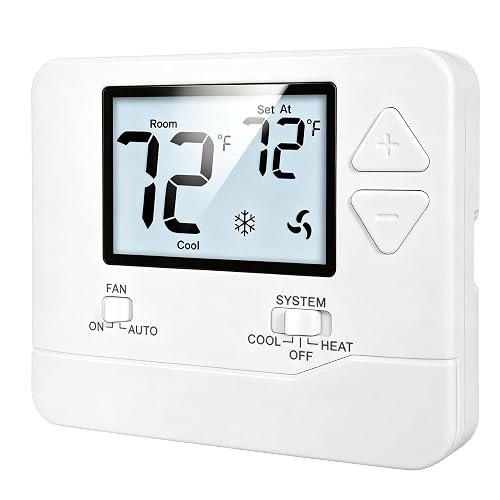
Heagstat 1 Heat/1 Cool Conventional Thermostat
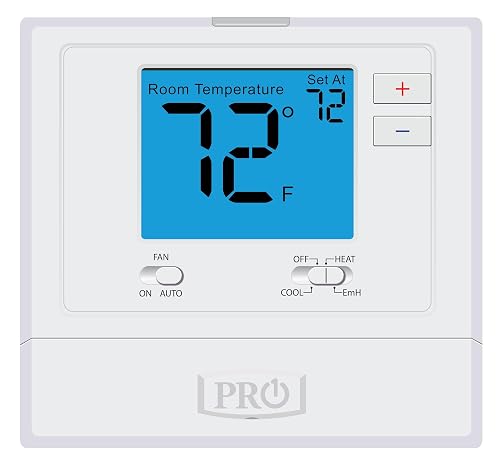
PRO1 T721 Non-Programmable Heat Pump Thermostat

White-Rodgers 1E78-144 Single Stage Thermostat
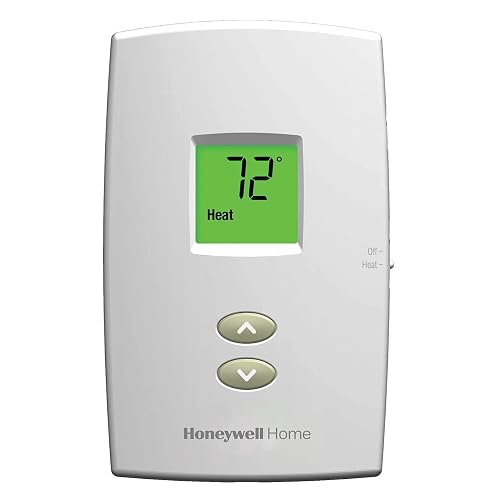
Honeywell TH1100DV1000 Pro-Digital Heat Only

PRO1 T805 Single Stage Programmable Thermostat
More On The Choices That Made The List
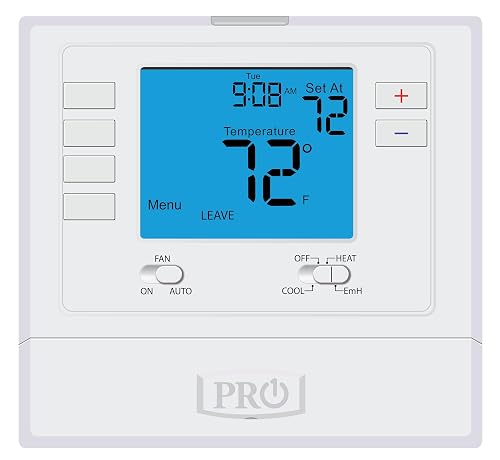
The PRO1 T725 handles a setup that throws off plenty of simpler thermostats: 2 heat/1 cool heat pump systems on one side, 1 heat/1 cool conventional on the other. It runs on the T700 platform, which means the controls feel familiar if you’ve used other PRO1 wall units, and the 4 sq. in. blue backlit screen is large enough to read from across a hallway. In homes where someone finally upgraded from an aging mercury unit, this model steps in without forcing a complete HVAC overhaul.
Schedulers will appreciate the 7-day and 5/1/1 options (a layout that lets weekdays share one routine while Saturday and Sunday get their own), while set-and-forget households can run it as a basic digital thermostat. Compared to the non-programmable picks later in this list, the T725 earns its keep when schedules actually shift between workdays and weekends.
The Good Stuff
- Dual compatibility covers 2H/1C heat pump and 1H/1C conventional, so it works in homes with mixed equipment or recent conversions.
- 7-day and 5/1/1 programming, with four daily periods (wake, leave, return, sleep), gives you weekday-versus-weekend control without daily fuss.
- Large 4 sq. in. blue backlit display stays readable in low light, which matters in hallways and basements.
- Programmable operation can be skipped entirely, so anyone intimidated by schedules can still use it as a basic digital wall unit.
Things To Consider
- Programming takes a few sessions to learn, especially the first time you set up a 5/1/1 weekday-weekend routine.
- Not a fit for systems needing more than 2 heat stages or homes with multi-stage cooling.
Key Specs
Who It Suits Best
Homeowners with a heat pump system who also want the option to run a conventional backup, especially in regions where shoulder seasons blur the two.
Where Another Pick Suits Better
Run a 2H/2C gas furnace setup and the PRO1 T715 Multi-Stage Programmable Gas Thermostat covers those extra stages without compromise.
Most wall thermostats refuse to dip below the high 30s, which is a problem in unheated garages and outbuildings where you need to keep pipes or paint from freezing. The PRO1 T771 stretches the setpoint range from 25°F all the way to 90°F, a spread wide enough to manage a chilly workshop without sounding alarms. It stays in single-stage territory, which is exactly what most 1H/1C conventional garage setups need.
The 4 sq. in. blue backlit display and swing adjustment options make it forgiving to install and tune, even when you’re working in a dim space. For specialty rooms and outbuildings, this model earns the spot over the standard household-focused PRO1 T701 by doing one thing differently: it goes colder.
The Practical Payoff
- 25°F to 90°F setpoint range handles low-temperature protection for garages, sheds, and similar spaces.
- Single-stage 1H/1C compatibility fits straightforward conventional systems without forcing a model upgrade.
- Blue backlit display with swing adjustment and calibration support smooths the install process.
- Non-programmable layout keeps controls simple for spaces that don’t need a weekly schedule.
Trade Offs
- Lacks any programming, so daily adjustments are manual in homes that prefer set-and-forget routines.
- Built for specialty applications, not the polished UI you’d want in a primary living area.
Who It Suits Best
Owners of detached garages, workshops, and sheds who need freeze protection without the cost of a full smart thermostat.
Look Elsewhere When
You want a similar non-programmable feel for a main living space, in which case the PRO1 T701 Single Stage Non-Programmable Thermostat fits more naturally.
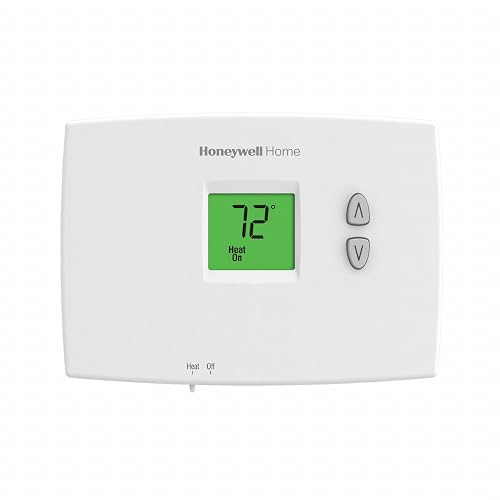
The Honeywell TH1100DH1004 keeps things uncomplicated, and that’s the point. It’s a horizontal-layout, non-programmable heat-only thermostat with a backlit display, dual power, and a temperature scale that adjusts between a standard 40 to 90°F range and a garage 35 to 90°F range. The horizontal form factor is a subtle but real advantage when you’re replacing an older unit and don’t want to repaint around a different mounting footprint.
Dual power (battery or hardwired) means the install is forgiving, and the backlit display is easy to read during late-night comfort tweaks. For heat-only baseboard or furnace setups without cooling, this PRO 1000 model covers the basics without piling on extras.
Why It Works Well
- Adjustable temperature scale, from 40 to 90°F standard or 35 to 90°F garage mode, adds flexibility for colder rooms.
- Horizontal mounting layout works well as a direct replacement for older thermostats with that footprint.
- Backlit display stays readable in low light without glare.
- Dual power (battery or hardwired) simplifies the wiring step during a swap.
Honest Caveats
- Heat-only by design, so it won’t work for central air or heat pump homes that also need cooling control.
- No scheduling means manual adjustment for any daytime temperature change.
Feature Snapshot
Best Suited To
Heat-only homes with a horizontal wall cutout, where a non-programmable, set-and-forget solution is all that’s needed.
Swap It Out When
You need cooling control too, since the Honeywell TH1100DV1000 Pro-Digital 2-Wire Heat Only is a closer match for two-wire heat-only retrofits and millivolt systems.
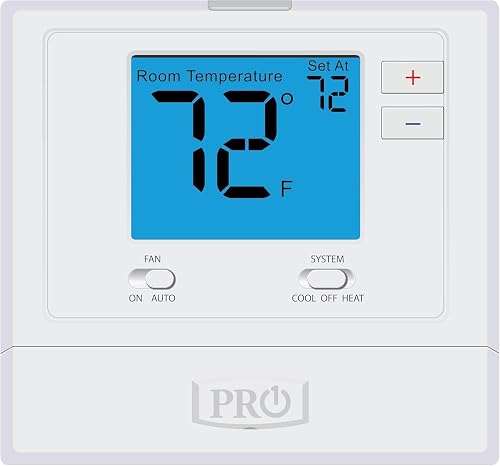
The PRO1 T701 sits in a comfortable middle for the average U.S. household with central air. It’s built for 1H/1C conventional systems, runs on the T700 platform, and pairs a 4 sq. in. blue backlit screen with a glow-in-the-dark light button. That last detail is the kind of small thing that becomes a big deal when you walk down a dark hallway at 2 a.m. and need to nudge the temperature.
Because it doesn’t try to program, owners of rental properties and guest rooms often find the T701 refreshingly simple. It accepts battery or hardwired power and offers gas or electric configurability, which keeps the install menu short. Compared to the more capable T725, the T701 trades programmability for an even more stripped-back user experience.
Real Benefits
- Glow-in-the-dark light button is genuinely useful in dark hallways and bedrooms.
- 4 sq. in. blue backlit display is easy on the eyes during late-night adjustments.
- Battery or hardwired power gives installers flexibility, especially during replacements.
- Gas or electric configurability supports most common 1H/1C conventional setups.
Worth Noting
- No scheduling, so each shift in routine means a manual temperature change.
- Limited to single-stage conventional systems, ruling out multi-stage and heat pump homes.
Who Will Love This
Rental property owners, landlords, and homeowners who want a reliable non-programmable wall unit in a guest room or addition.
Reach For A Different Pick When
You have a 2H/1C heat pump system instead of a 1H/1C conventional setup, in which case the PRO1 T721 Non-Programmable Heat Pump Thermostat fits more closely.
The PRO1 T715 takes the T700 platform and stretches it across multi-stage territory, supporting 2 heat/2 cool gas systems with 7-day, 5/1/1, or non-programmable modes. That’s the configuration you’d find in a two-story home with a two-stage gas furnace and a two-stage air conditioner, where a single-stage thermostat simply can’t manage the equipment. The 4 sq. in. blue backlit display and glow-in-the-dark light button are familiar touches from the T701, but the internal staging is the upgrade.
For homeowners who want schedules on weekdays and weekends but don’t want to commit to app control, this model fills the gap. Battery or hardwired power keeps installation flexible, and the non-programmable fallback means you can ignore the scheduling side entirely if your routine stays consistent.
Strengths Worth Knowing
- 2H/2C multi-stage support handles two-stage gas furnaces and air conditioners without skipping a beat.
- Three operating modes (7-day, 5/1/1, non-programmable) cover schedules from structured to hands-off.
- Glow-in-the-dark light button is a small but appreciated touch during nighttime adjustments.
- Battery or hardwired power streamlines the swap from an older wall thermostat.
Room For Improvement
- Multi-stage programming adds setup time that single-stage users don’t face.
- Only gas furnace systems are supported, so heat pump homes need a different model.
Quick Facts
Right Fit For
Owners of two-stage gas furnace homes who want a programmable wall thermostat without venturing into Wi-Fi territory.
Skip It When
Your home runs a single-stage conventional system, because the PRO1 T701 Single Stage Non-Programmable Thermostat is a more straightforward, less expensive fit.
The Heagstat non-programmable thermostat covers the basics for 1H/1C conventional forced-air systems, which includes most gas, oil, and electric furnaces matched with a separate outdoor AC condenser. The white backlight is a small but noticeable upgrade in darker rooms, and the unit is built around a 2-to-5 wire base, an important wiring detail that catches a lot of first-time installers off guard.
Landlords and light commercial spaces often gravitate toward this model because the install is straightforward and the controls are intentionally limited. Where it differs from the PRO1 T701 is in wire count: anything beyond 5 wires won’t fit this base, so homes with extensive accessories like humidifiers should look elsewhere.
What Helps Most
- Compatible with 24VAC conventional 1H/1C forced-air systems, including gas, oil, and electric furnaces paired with a separate AC condenser.
- White backlight improves visibility in dim utility rooms and basements.
- Two-to-five wire base fits a common wiring footprint, making the swap from a similar older unit easy.
- Non-programmable controls keep the user experience minimal and predictable.
Points To Note
- Not compatible with systems requiring 6 to 8 wires, which rules out some setups with accessories like dehumidifiers.
- Heat pump and high-voltage systems are not supported.
- Manual temperature changes only, with no built-in scheduling.
Perfect Match For
Light commercial spaces, rental units, and homeowners on a tighter budget who just need a working 1H/1C conventional wall thermostat.
Consider Something Else When
Your system requires more than 5 wires or has accessory equipment, since the PRO1 T701 Single Stage Non-Programmable Thermostat offers similar simplicity with broader conventional support.
The PRO1 T721 sits in a useful middle ground for households that need either 2H/1C heat pump or 1H/1C conventional support, but don’t want a programmable schedule. It’s part of the T700 family, so you get the familiar 4 sq. in. blue backlit display and a glow-in-the-dark light button. The dual system support is the real differentiator: this thermostat can move between equipment types during a furnace-to-heat-pump conversion without needing a different model.
For homeowners who set their temperature once and walk away, the T721 keeps the menu short. Compared to the programmable T725 that opens the article, the T721 strips out the scheduling complexity while keeping the system flexibility intact.
Positive Takeaways
- Heat pump (2H/1C) and conventional (1H/1C) compatibility in one unit, useful during system changes or mixed setups.
- 4 sq. in. blue backlit display with a glow-in-the-dark light button handles low-light hallways well.
- Battery or hardwired power accommodates different wiring situations during a replacement install.
- Non-programmable operation keeps the interface approachable for guests, renters, and set-and-forget households.
Less-Strong Areas
- No scheduling means manual changes for any shift in daily routine.
- Limited to 2H/1C heat pump configurations, so homes with aux heat strips may need a different model.
Whose Shelf It Belongs On
Homeowners with a 2H/1C heat pump who prefer a no-schedule wall thermostat over a programmable unit.
Where A Sibling Pick Shines
You want similar dual-system support with scheduling, in which case the PRO1 T725 Programmable Heat Pump Thermostat adds 7-day and 5/1/1 modes without giving up the heat pump compatibility.
The White-Rodgers 1E78-144 is the kind of thermostat you find in older homes where the original equipment is still chugging along. It’s a non-programmable unit designed for single-stage heating and cooling, and it also works with single-stage heat pump systems without auxiliary heat. The backlit digital display and 24-volt / millivolt compatibility are the practical features that make this model a sensible retrofit choice.
Compared to the PRO1 T701 in this list, the 1E78-144 leans toward a more utilitarian appearance but covers an older wiring niche that the T701 doesn’t explicitly call out. For homes with millivolt floor furnaces or legacy baseboard systems, that compatibility is the deciding factor.
Positive Points
- Millivolt and 24-volt compatibility covers both modern low-voltage systems and older millivolt setups.
- Backlit digital display is easy to read in low light without a complicated menu.
- Single-stage heat, cooling, and heat pump (without aux) support covers many retrofit scenarios.
- Non-programmable controls keep the user experience simple for older homeowners and rental properties.
Some Limits To Know
- Not compatible with electric baseboard heat and a handful of other system types, so always check before swapping.
- Single-stage only, ruling out multi-stage and dual-fuel equipment.
- No scheduling, so any temperature change is manual.
Made For
Older homes with millivolt or 24-volt systems that need a straightforward, no-frills wall thermostat replacement.
A Better Fit Elsewhere
You have a heat-only system on a two-wire setup, where the Honeywell TH1100DV1000 Pro-Digital 2-Wire Heat Only is purpose-built for that wiring scenario.
The Honeywell TH1100DV1000 is one of the few heat-only thermostats built specifically for two-wire installations. That’s a niche but meaningful fit: older homes with millivolt gas floor furnaces, wall heaters, and even some gas fireplaces often only have two wires running to the wall, and most modern thermostats need more. The backlit display, ambient temperature read-out, and one-touch setpoint access make the everyday interaction easier than a basic dial thermostat.
Built-in compressor protection rounds out the safety side, even on heat-only installs, which is unusual for this category. The temperature range spans 40 to 90°F, a comfortable band for most living spaces, and the non-programmable layout keeps the controls approachable.
Points In Its Favor
- Two-wire compatibility works with millivolt systems and other legacy heat-only wiring configurations.
- Backlit display is easy to read in low light and shows ambient temperature at all times.
- One-touch access to setpoint temperature simplifies adjustments compared to a basic dial thermostat.
- Built-in compressor protection adds a layer of safety on the cooling side when applicable.
Potential Drawbacks
- Heat-only by design, so homes with central cooling need a separate control or a different thermostat.
- No scheduling means manual temperature shifts for any routine change.
Quick Technical Notes
The Right Fit
Owners of older homes with two-wire heat-only systems who need a digital upgrade that fits the existing wiring footprint.
Not Your Match When
You need single-stage cooling control too, because the PRO1 T701 Single Stage Non-Programmable Thermostat covers 1H/1C conventional systems in a more standard install.
The PRO1 T805 closes the list by leaning into a feature that matters more than people expect: screen size. Built on the T800 platform, it pairs a 7 sq. in. blue backlit display with a glow-in-the-dark light button and supports 1H/1C conventional systems in 7-day, 5/1/1, or non-programmable modes. That extra screen real estate is genuinely useful in larger rooms, hallways, and homes where the thermostat sits further from where you typically stand.
Schedulers will find the three operating modes flexible, while set-and-forget households can leave it in non-programmable mode. Compared to the T701 earlier in the list, the T805 trades the smaller T700 screen for a noticeably larger display and adds scheduling.
Good Reasons To Consider
- Extra-large 7 sq. in. blue backlit display is the largest in this list, helpful in bigger rooms and hallways.
- Glow-in-the-dark light button keeps the controls findable in dark bedrooms and basements.
- Three operating modes (7-day, 5/1/1, non-programmable) match a range of household routines.
- 1H/1C conventional compatibility covers the most common residential HVAC setup.
What To Weigh
- Larger display means a larger wall footprint, which can stand out in small rooms with tight décor.
- Single-stage only, so multi-stage and heat pump homes need a different model.
Built With In Mind
Homeowners with 1H/1C conventional systems who want a programmable wall thermostat with a generously sized screen.
Another Choice May Suit
You have a heat pump system instead, because the PRO1 T721 Non-Programmable Heat Pump Thermostat supports 2H/1C heat pump setups in a smaller wall footprint.
What To Know Before Swapping Your Wall Thermostat
Compatibility sits at the top of every checklist for button thermostats. The single most important detail is the system type: heat-only, 1H/1C conventional, multi-stage gas, or heat pump. Heat-only homes with two-wire wiring rule out most modern units; multi-stage gas furnace homes rule out single-stage models. Matching the thermostat to the equipment is what prevents wiring headaches and protects the HVAC system.
The wire count is the second practical concern. Count the wires currently running from the wall before choosing a new thermostat. Units like the Heagstat 1 Heat/1 Cool Conventional Thermostat explicitly cap at five wires, while the Honeywell TH1100DV1000 Pro-Digital 2-Wire Heat Only is purpose-built for two-wire installs. The PRO1 T700 family generally supports standard wiring footprints for residential systems, but always confirm before mounting.
Programmability is the third decision point. Programmable models like the PRO1 T725, T715, and T805 add scheduling, which is helpful when your week shifts between workdays and weekends. Non-programmable units like the PRO1 T701 and T771 keep the controls simple, which works well in rentals, guest rooms, and specialty spaces. The right answer depends on how often your routine actually changes; a programmable model sitting on the same schedule every week is wasted complexity.
The fourth factor is the environment. Garages, sheds, and outbuildings need a wider setpoint range (the minimum and maximum temperatures the thermostat can be set to) to handle freeze protection, which is where the PRO1 T771 stands out. Bedrooms and hallways benefit from a glow-in-the-dark light button or a larger display, which is where the PRO1 T805 earns its keep. For older homes with millivolt systems, the White-Rodgers 1E78-144 and the Honeywell TH1100DV1000 cover wiring footprints newer models often skip.
Key Considerations Across These Picks
Common Shopping Slip Ups
The most frequent mistake in this category is matching by feature instead of by system type. A multi-stage programmable model looks attractive on paper, but it won’t function correctly on a single-stage conventional system, and a heat pump thermostat can confuse a furnace-only setup. Before browsing, confirm the system label on the indoor unit or the original installer documentation.
The second slip is ignoring the wire count. Homeowners count wires by looking inside the wall plate, not the labeling on the back of the old thermostat. The Heagstat unit’s 2-to-5 wire limit is a good reminder that the actual count matters more than the equipment type. When in doubt, take a photo of the existing wiring before unmounting anything.
What The Higher Tier Buys
Programmable models in this list cost more, mostly because the scheduling hardware and the multi-stage support are built in. The PRO1 T715 Multi-Stage Programmable Gas Thermostat adds 2H/2C support and three operating modes that single-stage units can’t match. The PRO1 T805 Single Stage Programmable Thermostat pairs a 7-day scheduler with a 7 sq. in. display, which is genuinely useful in larger rooms.
The upgrade pays off in homes with shifting schedules or multi-stage equipment. In a single-occupant studio with a consistent routine, the scheduling side often goes unused, and a non-programmable unit like the PRO1 T701 covers the same wall with a lower price tag. The honest read is to pay more when your equipment or routine actually benefits from the extra capability.
Frequently Asked Questions
What is a button thermostat?
A button thermostat is a wall-mounted climate control with physical buttons for adjusting temperature and mode, often paired with a backlit digital display. It covers the same HVAC functions as a touchscreen model, just with a tactile interface.
Can button thermostats work without Wi-Fi?
Yes, every model in this list runs on physical button controls and a wired or battery connection. No Wi-Fi is required, which is part of why these units stay useful during internet outages and in properties where network access is limited.
How do I know which system type I have?
Check the indoor unit label or the original installer documentation. A heat-only system runs just a furnace or boiler; 1H/1C conventional systems run a furnace plus a separate AC; multi-stage gas systems have two-stage heating and cooling equipment; heat pump systems use a refrigerant-based outdoor unit year-round.
Do button thermostats need batteries?
Many models run on either battery or hardwired power, which gives the installer flexibility. The Honeywell TH1100DV1000 and the PRO1 T700 family both offer battery or hardwired operation, while the Honeywell TH1100DH1004 PRO 1000 is dual-powered. Always check the model page for the specific power configuration.
Are non-programmable button thermostats harder to use?
Non-programmable models are usually easier, since the controls stay focused on temperature, mode, and fan. They work well in rentals, guest rooms, and any home where the schedule doesn’t change enough to justify a programmable unit.
The Takeaway
Button thermostats cover a wide range of residential HVAC setups, from single-stage conventional to multi-stage gas and heat pump systems, without leaning on Wi-Fi. Match the unit to your system type and wire count first, then weigh programmability and display size based on your routine. The right pick is the one that fits the equipment you actually own, not the one with the most features on paper.