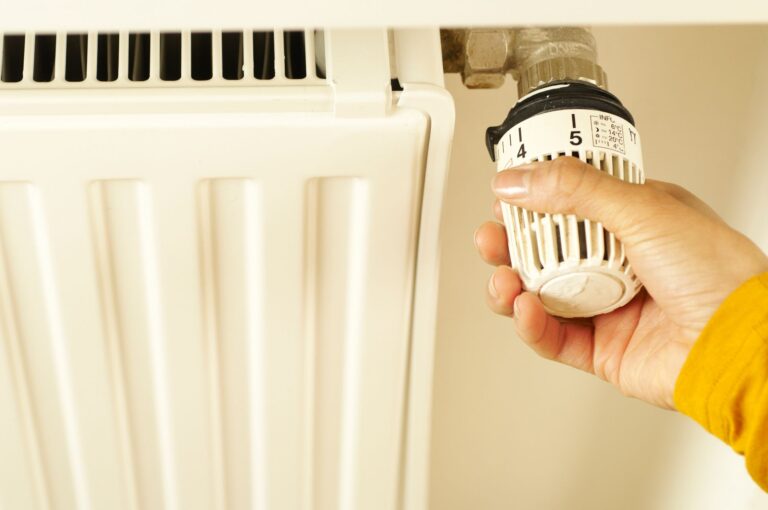

Finding the right thermostat for a workshop, warehouse, garage, or utility space means thinking about voltage, switch type, and how much abuse the unit will see. The picks below cover electromechanical room models, programmable wall units, and dedicated industrial controls with extended sensors, so you can match a control to the load it actually manages. Whether you need a simple on/off dial or a multi-stage digital panel, this list narrows down the field to the nine worth comparing.
The Choices Worth Comparing

RAA21 Electromechanical Room Thermostat 0-50°C
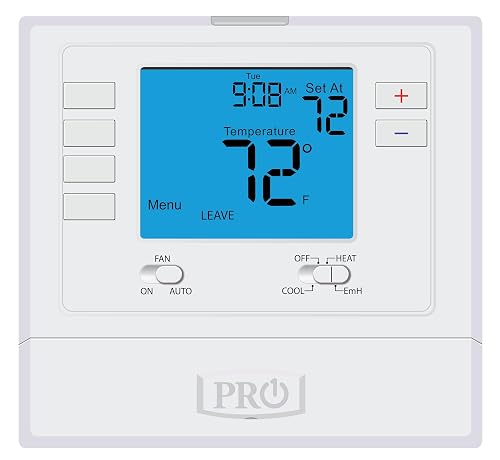
PRO1 T725 Heat Pump/Conventional Programmable Thermostat

PRO1 T771 Single Stage Non-Programmable Thermostat
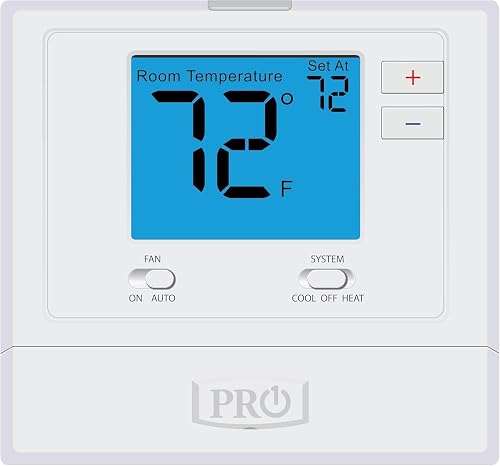
PRO1 T701 Single Stage Non-Programmable Thermostat

PRO1 T715 Multi-Stage Programmable Gas Thermostat
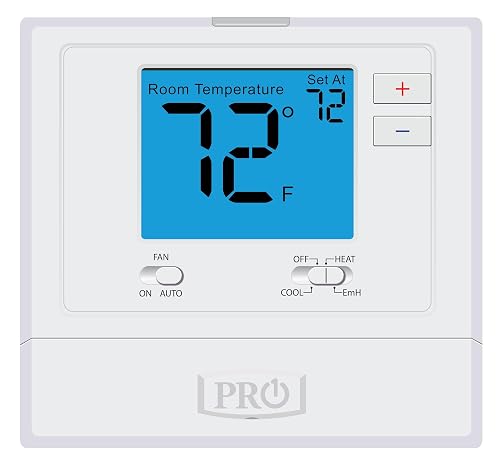
PRO1 T721 Non-Programmable Heat Pump/Conventional Thermostat
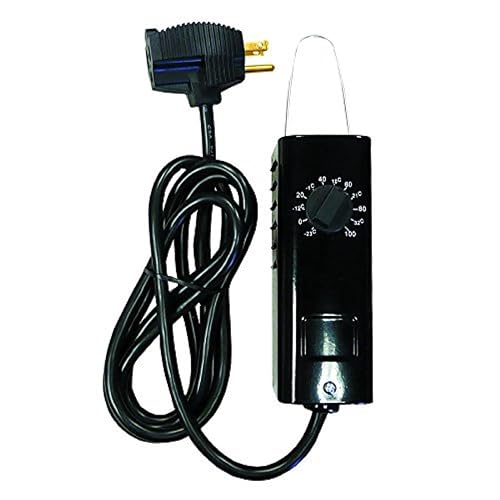
TPI KT121 Industrial Series Thermostat SPST Heat Only

Tempro TP506 Line Voltage Thermostat 60″ Extended Bulb SPDT

PRO1 T805 Single Stage Programmable Thermostat
More Details On Our Top Picks
Analog thermostats earn their keep in places where digital screens just get in the way. The RAA21 electromechanical room thermostat uses a gas-filled diaphragm (a sealed metal bellows that expands and contracts with temperature) to drive a simple two-position switch, with no firmware to update and no batteries to swap. Mounted on a wall with screws, it handles 24 to 250 VAC at currents between 0.2 and 6 amps, which covers most residential and light commercial control circuits.
Setpoint limiters hide under the cover, so once you set the allowed range, tenants or curious hands cannot crank things past safe bounds. The 0 to 50°C window suits most conditioned spaces. Unlike the digital wall units later in this list, there is no scheduling and no backlit display. The honest read is that the gas-filled mechanism feels old-school, but for utility rooms, mechanical rooms, or any location where reliability matters more than features, that is the point.
Bright Spots
- Wide voltage tolerance (24-250 VAC) covers nearly any standard control loop
- Maintenance-free gas-filled diaphragm that outlasts many electronic alternatives
- Hidden setpoint limiters stop accidental high or low adjustments
- Screw-mounted body handles vibration and rough environments
Worth Noting
- No display means you walk up to the wall to see the current setpoint
- Two-position control is not precise enough for systems needing proportional staging
Key Specs
Who It Suits Best
Maintenance supervisors and facility managers who want a no-fuss control for mechanical rooms, storage areas, or backup heating circuits.
Where Another Pick Suits Better
Homeowners wanting seven-day scheduling and a readable screen should reach for the PRO1 T725 instead.
Programmable thermostats earn their reputation by actually letting you set a schedule and forget it. The PRO1 T725 supports 2 heat/1 cool heat pump systems and 1 heat/1 cool conventional systems, with 7-day or 5/1/1 (5 weekdays plus separate Saturday and Sunday blocks) programmability so you can match wake, leave, return, and sleep routines. The 4 sq. in. blue backlit screen stays readable in dim hallways, and the unit runs on the T700 platform, which is a known, supported control board family.
Compared with the RAA21’s analog dial, this model trades mechanical simplicity for scheduling flexibility. You get a clear digital readout, mode indicators, and the option to leave it in non-programmable mode if you prefer manual control. Depending on your wiring, installation may take longer than a basic two-wire hookup, but for homeowners wanting to automate setback temperatures, that effort pays back in comfort and lower runtime.
What Pays Off
- Dual compatibility with heat pump and conventional HVAC equipment
- Four-period daily scheduling for wake, leave, return, and sleep
- Backlit display readable in low light
- Optional non-programmable mode for simple use
Trade Offs
- Requires a C-wire (common wire) or proper power-stealing setup in many installations
- Programming interface has a learning curve for first-time schedulers
Best Suited To
Heat pump homeowners who want scheduled setbacks without upgrading to a learning thermostat.
Skip It When
You only run a single-stage furnace and would rather skip scheduling; the PRO1 T701 covers that need with less setup.
Outbuildings and workshops often do not need a full programmable brain. The PRO1 T771 single stage non-programmable wall thermostat keeps things simple with a wide setpoint range from 25°F to 90°F, which reaches low enough for spaces that should not freeze. The 4 sq. in. blue backlit display shows the current reading clearly, and swing adjustment plus calibration let you fine-tune the trigger point.
Compared with the T725, this model drops scheduling entirely. That makes setup faster, the button layout less crowded, and everyday operation about as easy as it gets. The honest read is that you give up automation, but for a garage, shed, or barn, that is rarely a loss. The single-stage design only works with one heating and one cooling source, so multi-zone or two-stage systems will need a different pick.
What It Does Well
- Low-end 25°F setpoint protects pipes in unheated outbuildings
- Backlit display is readable in dim corners
- Swing and calibration adjustments improve accuracy over a stock install
Points To Note
- No scheduling means manual adjustment for seasonal changes
- Single-stage only, so two-stage furnaces will lose efficiency
Feature Snapshot
Made For
Workshop owners, hobby farmers, and anyone running a furnace in a detached garage or storage building.
Not Your Match When
You need heat pump compatibility; the PRO1 T721 handles both 2H/1C heat pumps and conventional systems in one non-programmable package.
The PRO1 T701 sits on the larger T700 platform, giving you a roomier 4 sq. in. blue backlit display than earlier compact models. A glow-in-the-dark light button helps you find the controls during a midnight check without flipping on the overhead. It handles 1 heat/1 cool conventional systems and accepts either gas or electric configurations, covering the most common residential hookups.
Next to the T771, the T701 trades a slightly higher low-end setpoint for a more polished on-wall appearance and a steadier button feel. The tradeoff shows up in really cold garages, where the T771’s deeper range wins out. For most indoor living spaces, the T701 hits the sweet spot of legibility, simple operation, and broad compatibility. Owners commonly report that the larger display is the standout upgrade over older dial thermostats.
What Works In Its Favor
- Glow-in-the-dark light button for quick nighttime checks
- Gas or electric compatibility covers most standard HVAC setups
- Larger display improves readability for aging eyes
Small Caveats
- Low-end setpoint is not as deep as the T771, limiting unheated outbuilding use
- No scheduling, so weekend routines require manual tweaks
Feature Card
Right Fit For
Households replacing an aging dial thermostat who want a bigger screen without learning a programmable interface.
A Better Fit Elsewhere
Cold-climate garage owners needing a sub-30°F setpoint should look at the PRO1 T771 instead.
Two-stage heating and cooling equipment deserves a thermostat that can talk to both stages. The PRO1 T715 multi-stage programmable gas thermostat manages 2 heat/2 cool gas systems and lets you choose between 7-day, 5/1/1, or non-programmable operation depending on how hands-on you want to be. The 4 sq. in. blue backlit display with a glow-in-the-dark light button is borrowed from the broader T700 family, so the user experience matches what you might already know.
You can run the T715 on batteries or hardwired power, which simplifies retrofit installs where pulling a C-wire through finished walls is impractical. Compared to the single-stage T701, this model engages the second stage of heating or cooling only when needed, which can reduce temperature swings and short-cycle wear on the equipment. For most homes with a two-stage furnace and central AC, that stage management is the whole reason to upgrade.
Everyday Perks
- True 2H/2C staging for two-stage furnaces and AC compressors
- Three operating modes (7-day, 5/1/1, non-programmable) match any comfort level
- Battery or hardwired power for flexible install
Honest Caveats
- Requires a compatible multi-stage HVAC system to use all the staging logic
Key Product Details
Perfect Match For
Homeowners with a two-stage gas furnace and central AC who want full staging control and weekly scheduling.
Reach For A Different Pick When
You only have a single-stage system; the PRO1 T805 handles that setup with a bigger display and scheduling.
Heat pumps and conventional systems share a lot of wiring logic, and the PRO1 T721 handles both without forcing you to pick a side at checkout. It supports 2 heat/1 cool heat pump configurations or 1 heat/1 cool conventional setups, which is helpful if you are mid-renovation and the equipment might change. The 4 sq. in. blue backlit display and glow-in-the-dark light button match the rest of the T700 line.
Power comes from AA batteries or a hardwired hookup, so installs in older homes without a C-wire stay manageable. The non-programmable nature means fewer buttons and less menu-diving, which is a real plus for short-term rentals or guest spaces. Compared to the T725, you give up scheduling and the second stage of cooling, but for straightforward two-stage heat pump or single-stage conventional use, the T721 covers the bases without overcomplicating the wall.
A Few Strong Suits
- Heat pump and conventional compatibility in one unit
- Battery or hardwired power for retrofit installs
- Glow-in-the-dark button aids nighttime adjustments
A Few Limitations
- No scheduling, so setback routines require manual changes
- Only one cool stage, so multi-stage AC loses efficiency
Whose Shelf It Belongs On
Owners of heat pump homes who want manual control without weekly programming overhead.
Where A Sibling Pick Shines
Conventional single-stage homeowners wanting scheduling should pick the PRO1 T805 for its bigger display and seven-day programmability.
Plug-in thermostats turn portable heaters into zoned comfort tools, and the TPI KT121 industrial series thermostat is built specifically for that job. It uses a Single-Pole, Single-Throw (SPST) switch, which is the simplest possible control: on or off, with no off-position memory. The 6-foot cord and plug let you place the control where you stand, not where the heater mounts, which is a real advantage in shops with high ceilings or odd layouts.
Heat-only operation rules out central AC integration, but that is the point. This unit lives next to a portable space heater, a unit heater, or a fan-forced heater in a garage, warehouse, or job-site trailer. You may find the all-or-nothing switching leads to wider temperature swings than proportional controls, though, so consider the heater’s thermal mass when choosing. The industrial-grade build tends to shrug off the dust and bumps common in working spaces.
The Upside
- 6-foot cord places the control at standing height, not at the heater
- Plug-in design skips hardwiring entirely
- SPST switch is the simplest, most reliable control type
Practical Considerations
- Heat only, so no cooling integration
- On/off switching can swing room temperature more than staged controls
Technical Highlights
Who Should Grab It
Shop owners, warehouse supervisors, and contractors controlling portable electric heaters in tough environments.
Look Elsewhere When
You need to sense temperature in a duct or remote location; the Tempro TP506 line voltage thermostat handles that with its extended bulb.
Sometimes the control needs to live away from where temperature matters. The Tempro TP506 line voltage thermostat pairs a polymeric housing with a 60-inch extended bulb sensor, so you can mount the switch on a wall while reading temperature inside a duct, tank, or remote chamber. The 30°F to 110°F range covers everything from freeze protection to process heating, and the SPDT (Single-Pole, Double-Throw) switch handles both heating and cooling circuits.
Voltage flexibility from 24V to 600V means the same unit works in low-voltage control panels and line-voltage equipment. Compared to the TPI KT121’s plug-in simplicity, the TP506 requires hardwiring and a careful mounting plan for the bulb, which is more involved but unlocks remote sensing. The NEMA 4X rating (a standard for enclosures that resist water, dust, and corrosion) hints at the intended environment: washdown areas, agricultural buildings, and outdoor equipment cabinets where dust and moisture would defeat a standard wall thermostat.
Real-World Strengths
- 60-inch extended bulb reads temperature in ducts or remote chambers
- 24V to 600V range covers control and line-voltage loads
- SPDT switch supports heat and cool circuits
Points To Keep In Mind
- Hardwired install takes more planning than a plug-in thermostat
- Bulb routing requires care to avoid kinks or sharp bends that damage the capillary
Built With In Mind
Facility technicians and agricultural operators who need accurate remote sensing in harsh or wet environments.
Swap It Out When
You only need to control a portable space heater in a workshop; the TPI KT121 keeps install to plugging in a cord.
Big screens make a real difference for everyday use, and the PRO1 T805 delivers a 7 sq. in. blue backlit display, nearly double the real estate of the T700 series. It runs 1 heat/1 cool conventional systems with 7-day, 5/1/1, or non-programmable operation, so you decide how much scheduling you want. The glow-in-the-dark light button comes along for the ride, matching the rest of the modern T800 platform.
Compared to the T701, the T805 adds programmability and a much larger display while staying in single-stage territory. The tradeoff is a higher price, and you only get full value if you actually use the weekly schedule. For homeowners who want a clear readout from across the room and a flexible schedule, the oversized screen is the standout feature and a real quality-of-life upgrade.
The Helpful Details
- Oversized 7 sq. in. display readable from across a large room
- Three scheduling modes (7-day, 5/1/1, non-programmable) cover any preference
- Glow-in-the-dark button for low-light adjustments
Where It Is Less Suited
- Single-stage only, so multi-stage HVAC loses its second stage
- Larger footprint may not fit older decorator cover plates
Who Will Love This
Homeowners with conventional single-stage HVAC who want a big, clear display and the option to program a weekly schedule.
Consider Something Else When
You have a two-stage gas system; the PRO1 T715 engages both stages and uses the same platform language.
Choosing the Right Thermostat for Your Equipment and Space
Matching a thermostat to its load starts with voltage. Low-voltage wall units (typically 24 VAC) run most residential HVAC, while line-voltage thermostats (120 to 600 V) control baseboard heaters, unit heaters, and similar direct-load equipment. The Tempro TP506 and TPI KT121 are line-voltage options, while the PRO1 T-series models are 24 VAC wall units. Picking the wrong family is the fastest way to fry a board or simply fail to turn on the equipment.
Switch type matters next. SPST (single-pole, single-throw) is the simplest on/off switch, common in heat-only portable applications. SPDT (single-pole, double-throw) routes a signal to one of two outputs, so the same control can drive heating or cooling. Multi-stage thermostats like the PRO1 T715 handle 2H/2C systems, which engage a second stage of heating or cooling when the first stage cannot keep up. For most single-stage homes, a 1H/1C control is plenty.
Sensor placement and environment close the gap between specs and reality. A wall-mounted sensor reads room temperature, while an extended bulb (like the TP506’s 60-inch capillary, a thin tube filled with fluid that expands and contracts with temperature) reads duct, tank, or remote-chamber temperature for process or freeze-protection use. Dusty, wet, or outdoor environments call for NEMA-rated enclosures and sealed buttons. For workshop and garage use, plan for a thermostat you can read at a glance and a housing that survives a stray elbow.
Common Shopping Slip Ups
The most frequent mistake is mismatching the thermostat’s voltage to the equipment it controls. A 24 VAC wall unit cannot switch a 240 V baseboard heater, and a 600 V line-voltage thermostat wired to a low-voltage control board will not behave as expected. Always confirm the voltage and amperage rating before ordering.
A second slip is ignoring staging. Buying a single-stage thermostat for a two-stage furnace locks the system into low-fire operation, which hurts comfort and efficiency. Check the furnace data plate first, and match the thermostat’s stage count to the equipment. For heat pumps, the heat/cool stage count is equally important to avoid nuisance auxiliary heat kicks.
Where The Extra Money Goes
Higher-tier thermostats in this category buy larger displays, glow-in-the-dark buttons, multi-stage logic, and weekly scheduling. The PRO1 T805’s 7 sq. in. screen, for example, is a real quality-of-life upgrade for anyone who squints at a 2 sq. in. readout today. Multi-stage programmability, like the PRO1 T715, lets the furnace run on low fire most of the time and only ramp to high fire on the coldest mornings, which can reduce wear and improve temperature stability.
The upgrade is worth it for homes with multi-stage HVAC, big open living areas, or anyone who actually uses a setback schedule. For a garage or shed that holds steady, the simpler PRO1 T701 or PRO1 T771 covers the bases without the extra cost. Industrial picks like the Tempro TP506 carry a premium because of the extended bulb, NEMA-rated housing, and 24V to 600V flexibility. If you do not need remote sensing or harsh-environment protection, that money is better spent elsewhere.
Frequently Asked Questions
What voltage do I need for an industrial thermostat? Low-voltage thermostats (24 VAC) run most residential and light commercial HVAC. Line-voltage thermostats (120 to 600 V) control baseboard heaters, unit heaters, and similar direct loads. Check your equipment’s data plate before choosing.
Can I use a programmable thermostat with a heat pump? Yes, as long as the thermostat supports heat pump staging. The PRO1 T725 handles 2 heat/1 cool heat pumps, and the PRO1 T721 covers 2H/1C heat pumps or 1H/1C conventional systems in a non-programmable package.
What is an extended bulb sensor used for? An extended bulb sensor reads temperature away from the thermostat body, often inside a duct, tank, or remote chamber. The Tempro TP506’s 60-inch bulb is useful for freeze protection, process heating, or any space where the wall location does not represent actual conditions.
Do I need a C-wire for these thermostats? Many digital thermostats need a C-wire (common wire) for continuous power. Models like the PRO1 T701 and T721 can run on AA batteries as an alternative, which helps in older homes without a C-wire already pulled.
What does NEMA 4X mean for a thermostat? NEMA 4X is an enclosure rating for water resistance, dust resistance, and corrosion protection. Thermostats with this rating suit washdown areas, agricultural buildings, and outdoor equipment cabinets where moisture and grime would damage a standard wall unit.
The Takeaway
A good thermostat match comes down to voltage, switch type, staging, and where the sensor actually reads. Use this list to match each control to its environment: a wall unit for living spaces, a plug-in for portable heaters, and an extended-bulb model for remote or harsh locations. The right pick should fade into the background and just keep the temperature where you set it.