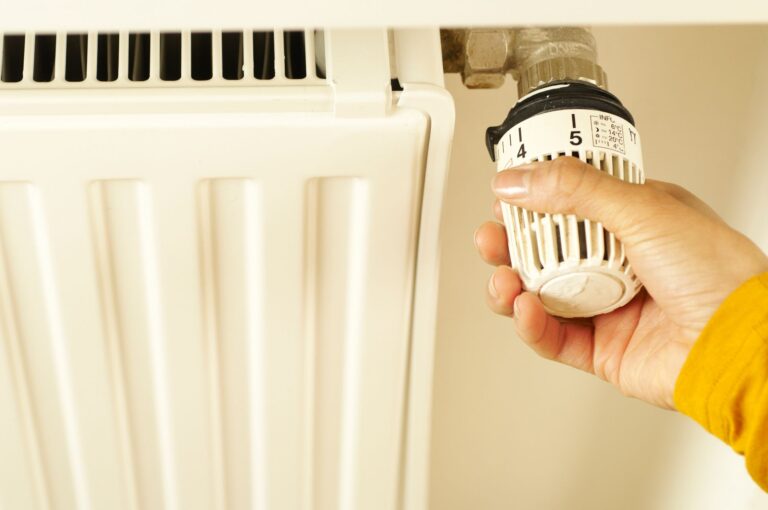

A reliable inline thermostat quietly does the heavy lifting in spaces most people never think about. Whether you’re dialing in a fermentation fridge, regulating a reptile enclosure, swapping a baseboard heater, or keeping a greenhouse mat on schedule, the right controller turns a finicky setup into something you can leave alone for hours. The picks below cover plug-in controllers, wall-mounted home units, line-voltage baseboard options, a vehicle cooling thermostat, and a water-heater replacement, so you can match hardware to the exact job in front of you.
The Essentials At A Glance
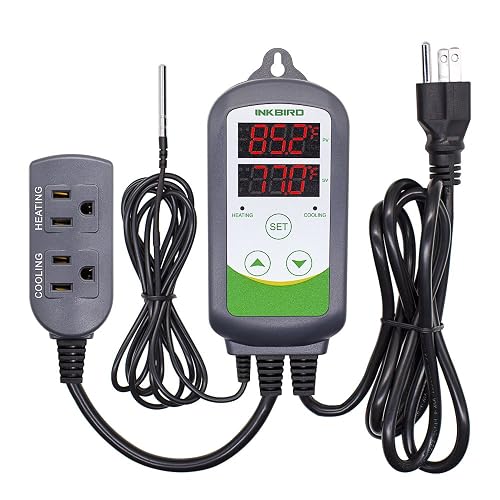
Inkbird ITC-308 Digital Temperature Controller Thermostat
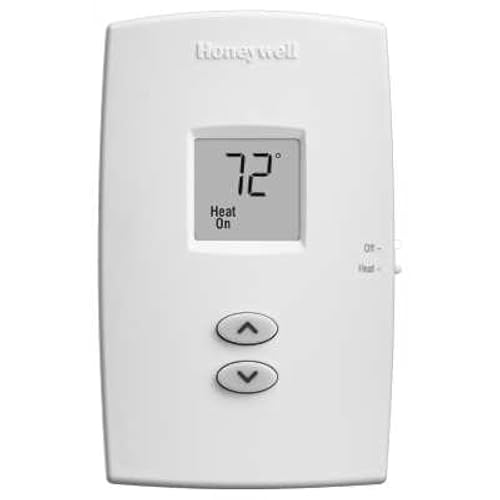
Honeywell TH1100DV1000 PRO 1000 Single-Stage Thermostat
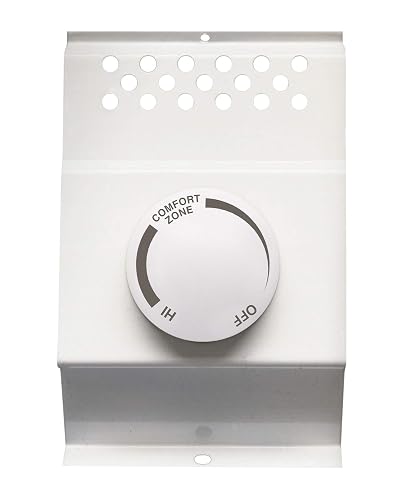
Cadet F Series Double Pole Baseboard Thermostat (BTF2W)
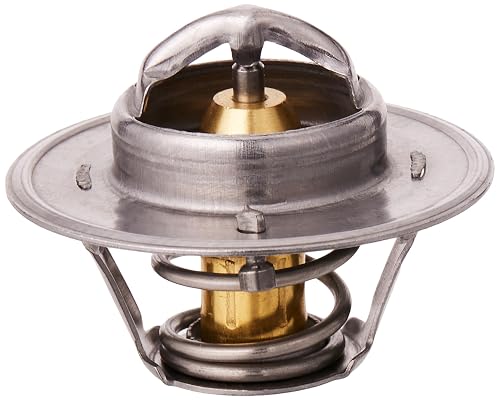
Edelbrock 8604 High Flow Thermostat 180 Degree
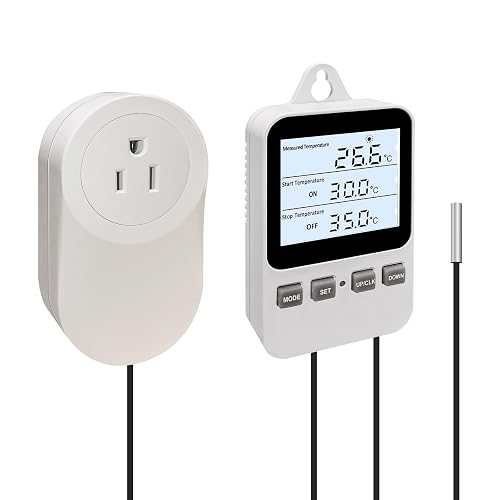
HIADA 120V 15A Plug-in Heating Cooling Thermostat
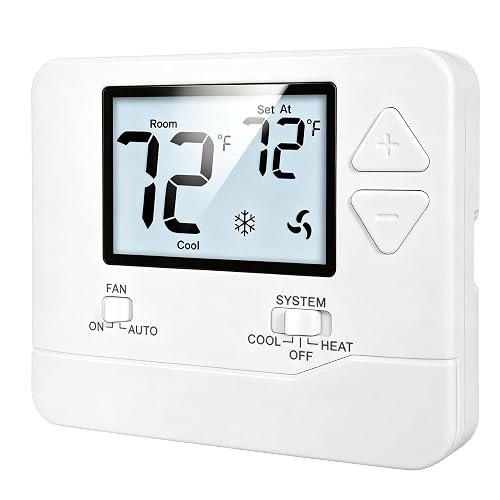
Heagstat Non-Programmable 1H/1C Thermostat
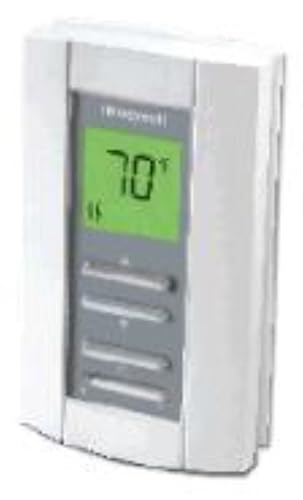
Honeywell TL7235A1003 Line Volt Pro 240V Thermostat

Zero KST203 Water Heater Upper Thermostat
Inkbird ITC-308 Outlet Thermostat 2-Stage 1100W
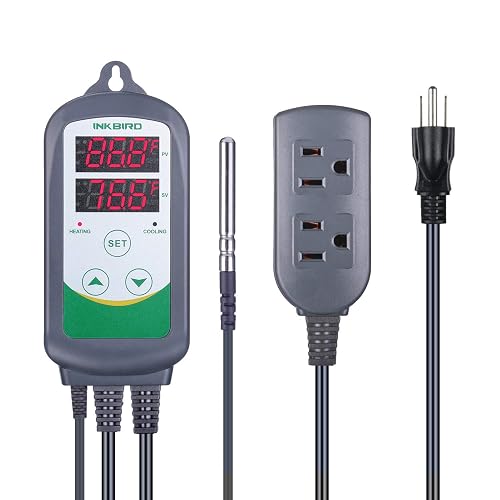
Inkbird ITC308 Freezer Thermostat 110V 1200W
What Each Pick Brings To The Table
The Inkbird ITC-308 is the plug-and-play workhorse that turned home fermentation and reptile keeping into a hands-off hobby for thousands of people. Two outlets sit on the front, one to drive a heater and one to drive a cooler, so a single box can swing a fridge between lager and ale temperatures or keep a basking lamp from cooking a gecko.
Compared with the simpler Honeywell wall units covered later, this one is built for projects that need a wired probe, not a household HVAC swap. For most homebrewers and herp keepers, that mix of precision and accessibility is exactly the right shape.
Points In Its Favor
- Two-outlet design handles heating and cooling equipment from one controller, useful for fridges paired with heat tape.
- Dual display shows both your target and the actual probe reading at the same time, cutting the guesswork during setup.
- Switchable Celsius and Fahrenheit readout helps if your brewing notes are in one unit and your room chart is in another.
- High and low temperature alarms add a safety net when a chest freezer decides to stop cooling overnight.
Things To Consider
- The rated 1100W output at 110V is comfortable for most hobby loads, though heavy-duty space heaters can push past that limit.
- Owners commonly report that the probe cable wants to be routed away from the compressor to keep readings stable.
Who It Suits Best
Homebrewers, reptile keepers, and anyone building a fermentation or incubation chamber who wants one controller to do both jobs.
Where Another Pick Suits Better
For pure year-round climate control in a forced-air home, the Heagstat Non-Programmable 1H/1C Thermostat fits a wall box more naturally than a plug-in style controller.
Honeywell’s PRO 1000 is the kind of thermostat that disappears into a hallway and never gets touched. There are no menus, no scheduling screens, just a vertical slider that points at the temperature you want. That simplicity is the point, and it works well in rentals, guest suites, and baseboard-only homes where programmable features would go unused.
Where the Inkbird ITC-308 handles refrigeration projects with a probe, this one sits on the wall and talks to your heating system directly. For a single-stage heat-only setup, the trade-off is refreshingly small.
What Works In Its Favor
- Mechanical-style dial means anyone walking past can adjust the room temperature without reading a manual first.
- Compact 4 11/16 in. tall by 2 7/8 in. wide footprint covers a standard single-gang wall opening cleanly.
- Premier white finish blends with most trim, an underrated detail in older homes with cream walls.
- Heat-only design avoids the wiring complexity that trips up first-time installers on dual-stage units.
Worth Noting
- No cooling control, so homes with central air need a separate thermostat for the air handler.
- The lack of a backlit display can make low-light adjustments annoying in hallways and basements.
- Non-programmable means the temperature drift at night is whatever you left it set to, which costs a little on the utility bill.
Made For
Homeowners with a straightforward heat-only furnace or boiler who want a basic, dependable wall thermostat without screens or apps.
Consider Something Else When
If you need both heating and cooling through one wall unit, the Heagstat Non-Programmable 1H/1C Thermostat is the better fit for a conventional forced-air system.
Baseboard heating has its own thermostat language, and the Cadet BTF2W speaks it fluently. The unit mounts to either end of a Cadet F series heater, which removes the need to pull extra wire through the wall. A large twist dial sets the room temperature anywhere from 45 to 80 degrees Fahrenheit, which covers everything from a chilly basement to a toasty nursery.
This is a very different animal from the plug-in Inkbird controllers reviewed above. It is rated for 22 amps at 120, 208, or 240 volts, so it sits on the same circuit as the heater it controls. The white finish blends in with most baseboard profiles, a small but real detail in older living rooms.
A Favorable Mix
- End-mount design eliminates the in-wall wiring step that puts off most DIY installers.
- 22A rating handles larger rooms with longer baseboard runs without tripping at full demand.
- Multi-volt compatibility covers 120, 208, and 240V service for both residential and light commercial installs.
- Wide 45 to 80F range covers mild sunrooms and cold workshops in the same dial.
Trade Offs
- Only fits Cadet F series baseboards, so it is not a universal swap for other heater brands.
- Double-pole design fully cuts power when off, which is safer but means a longer warm-up cycle in the morning.
Best Suited To
Homeowners upgrading or replacing a failed end-cap thermostat on a Cadet F series baseboard heater in a bedroom or addition.
Look Elsewhere When
For a wall-mounted thermostat that controls a line-voltage baseboard circuit without end mounting, the Honeywell TL7235A1003 Line Volt Pro 240V Thermostat is the smarter pick.
Inline thermostats are not only a household thing. The Edelbrock 8604 lives in the cooling system of a small-block or big-block V8 and quietly decides when coolant starts flowing through the radiator. The 53mm high-flow design opens at 180 degrees, the operating temperature most performance builders target for consistent air-fuel ratios.
Unlike the wall-mounted Honeywell PRO 1000 covered above, this thermostat does its work hidden behind a water pump housing. Vehicle-specific fitment means the cross-reference list is the first stop, since a wrong diameter turns a Saturday project into a parts shuffle.
Useful Strengths
- High-flow geometry supports performance camshafts and high-rpm coolant demand better than stock units.
- 180F opening temperature aligns with most performance tuning targets for street-driven builds.
- Made in the United States, which matters for enthusiasts chasing consistent part quality across rebuilds.
- 53mm diameter covers many American V8 applications, including common Chevy and Edelbrock intake setups.
Honest Caveats
- Vehicle-specific fit means a return trip to the parts counter is common if the engine has been previously modified.
- Installation requires draining the cooling system, so plan a full coolant refresh at the same time.
Who Will Love This
Garage builders and restorers refreshing the cooling system on a classic American V8 where a higher flow ceiling matters.
A Better Fit Elsewhere
If the project is a home aquarium chiller rather than an engine bay, the Inkbird ITC-308 is the controller for that job.
The HIADA plug-in controller covers the side of the hobby market that wants temperature control without rewiring a wall outlet. Drop a heat mat or a small fan into the controlled socket, set the threshold, and walk away. For a snake room in summer or a seedling rack in winter, that is the whole job.
Where the Inkbird ITC-308 offers two separate heating and cooling outlets, this one routes everything through a single controlled outlet. That keeps the wiring tidy for smaller enclosures, though it does ask you to choose which appliance connects at a time.
Notable Upsides
- 15A capacity at 120V covers most ceramic heat emitters and small fans without strain.
- Year-round heating and cooling modes suit seasonal swings in a garage or basement setup.
- Plug form factor skips the installation step, so renters and dorm dwellers can use it freely.
Points To Keep In Mind
- Single controlled outlet means a separate timer or splitter is needed if you want both a heater and a fan on independent schedules.
- Probe placement affects accuracy, so the sensor should sit where the animal or seedling actually lives, not behind the unit.
The Right Fit
Reptile keepers, hobbyist greenhouse growers, and anyone running a seedling mat who needs one plug-in controller to handle both heating and cooling.
Skip It When
For a dual-zone fermentation chamber with separate cooling and heating plugs, the Inkbird ITC-308 is the stronger tool.
The Heagstat 1H/1C fits the kind of household that has a gas furnace, a separate air conditioner, and a thermostat wire with two to five conductors. The white backlit display lights up the temperature the moment you tap the panel, which is the small touch that makes late-night adjustments painless.
Unlike the Honeywell PRO 1000 covered earlier, this unit handles both heating and cooling in a single wall box, so it can replace a dead thermostat in a conventional forced-air system without a second control on another wall. For most people, that consolidation is the entire reason to upgrade.
The Case For It
- White backlight display keeps the temperature readable in dim hallways and bedrooms at night.
- 1 heat and 1 cool capacity covers the common gas furnace plus separate AC setup found in most U.S. homes.
- 24VAC compatibility matches the standard low-voltage control circuit used by most residential HVAC equipment.
Some Limits To Know
- Conventional systems only, so heat-pump or multi-stage equipment is outside its scope.
- Wiring is limited to 2 to 5 conductors, which rules out some older homes with 6 to 8 wire setups.
- Non-programmable, so a smart upgrade would be a better fit for anyone chasing energy savings from schedules.
Right Fit For
Homeowners with a standard 24VAC single-stage furnace and AC who want a clear, simple wall thermostat for everyday use.
Another Choice May Suit
For 240V electric baseboard heat that needs a wall-mounted control, the Honeywell TL7235A1003 is the correct category match.
Electric baseboard heat is louder than people remember, mostly because of the relay click in older mechanical thermostats. The Honeywell Line Volt Pro replaces that click with silent electronic switching, so the only sound in the room is the soft hum of the heater itself. An on-demand backlight pops on when you reach for the control, which keeps the display readable without lighting up the whole hallway.
For a 240V baseboard circuit, this is the wall-mounted cousin to the Cadet BTF2W reviewed above. Where the Cadet unit mounts to the end of the heater, this one lives in a standard wall box and carries the full line voltage to the load, a better match for retrofits where running new wire would be a deal-breaker.
Practical Pluses
- Electronic temperature control removes the relay clicking common in mechanical line-voltage thermostats.
- Heating indicator at a glance confirms power is reaching the baseboard, useful when a breaker has tripped.
- On-demand backlight keeps the display readable without a constantly glowing screen in a dark bedroom.
- 240V rating covers the most common residential electric baseboard circuits in North America.
Possible Compromises
- Single-pole wiring means the heater still receives some power when off, so true zero power requires a separate disconnect.
- Installation should be on a dedicated circuit, and that often means a quick call to confirm the breaker sizing before swapping.
Whose Shelf It Belongs On
Anyone replacing a noisy mechanical thermostat on a 240V electric baseboard circuit and wanting a quieter, more modern wall control.
Reach For A Different Pick When
If the heater is a Cadet F series baseboard and the existing wire ends at the unit, the Cadet BTF2W is a cleaner end-mount replacement.
The Zero KST203 is the kind of part that shows up in a basement utility closet, hiding under the metal cover of an electric water heater. As the upper thermostat on a dual-element tank, it controls the top heating element and signals the lower thermostat to do its job. When a water heater starts delivering lukewarm showers, this is often the suspect part.
Like the other inline-style controls in this list, the KST203 sits in the line of the system rather than on a wall. It carries 120 to 480 VAC across a double-throw contact arrangement, which is why cross-referencing the existing part number before ordering saves a return trip.
Reasons It Performs
- Double-throw design supports dual-element tanks, the most common residential electric water heater layout.
- 120 to 480 VAC range covers both light residential and heavier commercial replacement jobs.
- Built-in safety switch helps prevent the tank from running away to scalding temperatures if the main control fails.
- Cross-references common part numbers 59T and 66T, which covers a lot of older residential tanks.
Less-Strong Areas
- Installation requires shutting off power to the water heater and pulling the access panels, so this is a comfort-level task for some homeowners.
- Without a model-matched cross-reference, ordering the wrong voltage rating is a real possibility on older tanks.
Who Should Grab It
DIY homeowners and repair techs replacing a faulty upper thermostat on a residential dual-element electric water heater.
Swap It Out When
If the project is controlling room temperature rather than hot water delivery, the Honeywell TH1100DV1000 belongs in the cart instead.
The ITC-308 from Inkbird is the outlet version of the wall-mount unit, with two clearly labeled sockets on the back. One runs heating equipment, the other runs cooling, and both swing on or off depending on what the probe reads. For a kegerator that needs to hold 38F in summer and stay above 34F in a cold garage, that two-stage behavior is the entire point.
Compared with the first ITC-308 covered above, the differences live mostly in how the listings are merchandised, but the core function matches. If the listing shows a probe and a 2-stage outlet configuration, the experience on the bench is the same, which makes choosing between Inkbird models mostly about which color or retailer you prefer.
A Strong Showing
- 1100W maximum output at 110V covers most small fridges, heat mats, and reptile fixtures on the same controller.
- Dual relay design lets a heating and a cooling appliance run from the same box without manual swaps.
- Centigrade and Fahrenheit readouts keep brewing and herping notes readable in either unit.
Worth Bearing In Mind
- Only the heating or the cooling outlet can run at once, so a 2-stage swing is the norm rather than simultaneous operation.
- The probe wire wants a stable home away from drafts, and a few owners note the included cable runs shorter than expected.
Built With In Mind
Homebrewers and cured-meat hobbyists running a kegerator or fermentation chamber where the temperature swings with the seasons.
Where A Sibling Pick Shines
For slightly higher output headroom on a greenhouse fan, the Inkbird ITC308 Freezer Thermostat 110V 1200W is a close cousin worth a look.
The ITC308 from Inkbird rounds out the list with the same plug-and-play pattern as the other Inkbird models, but with a slightly higher 1200W ceiling on the output. For a greenhouse tube heater or a chest freezer dedicated to a fermentation project, that extra headroom matters when the appliance has a hard-start compressor or a long duty cycle.
Like the earlier Inkbird controllers, this one reads in Celsius or Fahrenheit, calibrates the probe to a known reference, and displays both the setpoint and the live reading on a single screen. For a greenhouse or a kombucha corner that runs around the clock, that combination keeps the maintenance to a glance.
Noteworthy Benefits
- 1200W maximum output headroom supports slightly hungrier appliances than a 1100W model.
- Calibration feature lets you dial the probe against an independent thermometer for tighter accuracy.
- Dual display shows setpoint and current reading at the same time, useful when chasing a tight fermentation band.
- Heating and cooling relay support covers a wide range of hobby and small greenhouse projects.
Trade-Offs To Consider
- Owners commonly mention that the relay click is audible in a quiet room, so placement away from a bedroom wall helps.
- Higher wattage ceiling is still a soft limit, not a license to plug in a portable space heater, which most home shops warn against.
Perfect Match For
Greenhouse growers and fermentation hobbyists who run a controller around the clock and want a little extra output headroom.
Not Your Match When
For a single small reptile enclosure, the HIADA 120V 15A Plug-in Thermostat is a simpler fit that costs less.
Picking The Right Inline Thermostat For Your Project
A few attributes carry more weight than the marketing copy suggests. Match them to the room, the appliance, and the wiring before adding a controller to the cart.
Voltage And Load Ratings
Wall thermostats for forced-air homes run on low voltage, typically 24VAC, while line-voltage models like the Honeywell TL7235A1003 carry 120V or 240V directly to a baseboard heater. Plug-in controllers such as the Inkbird and HIADA models output through a standard 110V or 120V socket, so the appliance you plug in has to stay inside the controller’s watt rating. Mismatched voltage is the fastest path to a returned unit, so reading the spec sheet first saves the trip.
Probe Quality And Display Readability
A controller is only as good as its probe. Inline models that handle reptile, fermentation, or greenhouse work depend on a temperature sensor that holds calibration over months of duty cycles. A dual display that shows the setpoint and the actual reading at the same time is a small but real help, since it removes the mental math of switching menus to compare values.
Single-Stage Versus Two-Stage Control
Single-stage controls switch one appliance on or off. Two-stage designs, like the Inkbird ITC-308 family, run a heating outlet and a cooling outlet at the same time, which is what fermentation chambers and reptile rooms need. The trade-off is cost, since the extra relay and second socket add to the price, but for anything that swings with the seasons, two-stage control is the right tool.
Key Considerations Across These Picks
Common Shopping Slip Ups
The most frequent mistake is choosing a controller before confirming the load. A 1100W Inkbird model cannot safely run a 1500W portable heater, and a wall-mount Honeywell PRO 1000 will not cool a home without a separate AC circuit. Cross-check voltage, amperage, and probe type against the appliance before ordering. Probe placement is the next pitfall, since a sensor tucked behind a heat source gives a reading that does not match the air you actually want to control.
Where The Extra Money Goes
Premium inline thermostats tend to add quiet solid-state relays, dual displays, and calibration controls. The Honeywell Line Volt Pro 240V Thermostat is a good example, since the silent switching alone justifies the price for a bedroom. For hobby projects, the upgrade is worth it when the controller runs around the clock, and the cost tends to pay back in fewer probe swaps and more stable readings.
Frequently Asked Questions
What Is An Inline Thermostat?
An inline thermostat sits in the signal path between a power source and a temperature-sensitive appliance, switching the load on or off based on a probe or bimetal sensor. Unlike a wall thermostat that controls a household HVAC system, an inline controller is usually built into a plug, a water heater, or a vehicle cooling system.
Can One Thermostat Run Both A Heater And A Cooler?
Two-stage inline controllers like the Inkbird ITC-308 family can, since they include separate heating and cooling outlets that swing based on the setpoint. Single-stage units can only switch one appliance, so a separate timer or controller is needed for the second device.
How Do I Know If My Home Needs A Low-Voltage Or Line-Voltage Thermostat?
Low-voltage thermostats, typically 24VAC, control central forced-air systems through a thin thermostat wire. Line-voltage thermostats, usually 120V or 240V, sit in the same circuit as electric baseboard heaters. Check the wire count and the breaker rating before buying, since the two are not interchangeable.
Do Plug-In Thermostats Need Any Wiring?
No wiring is needed beyond plugging the controller into a wall outlet and the appliance into the controlled socket. The included probe is the only sensor to position, and most units accept the probe cable directly without tools. This is why plug-in controllers are popular for renters and temporary setups.
Are Water Heater Thermostats The Same As Wall Thermostats?
Water heater thermostats are not interchangeable with wall models. The Zero KST203 carries line voltage directly to a heating element and includes a built-in safety switch, while a wall thermostat like the Honeywell PRO 1000 is designed for low-voltage signaling through a control board. Always match the part to the appliance.
Closing Remarks
The right inline thermostat is the one that matches the appliance, the voltage, and the room you actually live in. Start with the load, confirm the wiring, and let the use case drive the rest. Browse the picks above, compare the feature cards, and pick the controller that fits the project in front of you.