
Most people don’t think about their thermostat until something goes wrong: a chilly basement office in February, a workshop that won’t cool down in July, or a baseboard heater stuck on one setting. Picking the right controller, whether it’s a wall-mount digital unit or an internal heater accessory, turns a nagging comfort problem into something you stop noticing. This roundup covers ten options across Marley’s baseboard heater line and the PRO1 IAQ wall-thermostat family, so you can match the control style to the system you actually own.
An Overview Of The Picks

Marley TA2AW Qmark Baseboard Heater Thermostat
PRO1 T725 Heat Pump/Conventional Programmable Wall Thermostat

PRO1 T771 Single Stage Non-Programmable Wall Thermostat
PRO1 T701 Single Stage Non-Programmable Wall Thermostat

PRO1 T715 Multi-Stage Programmable Gas Thermostat
Qmark SPST Replacement Thermostat
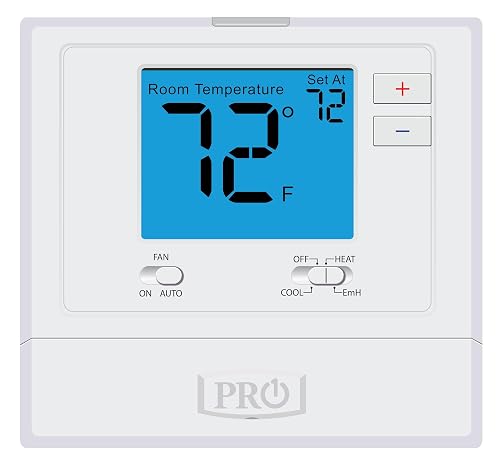
PRO1 T721 Non-Programmable Heat Pump/Conventional Thermostat

Marley UHMT2 Internal 2-Pole Thermostat
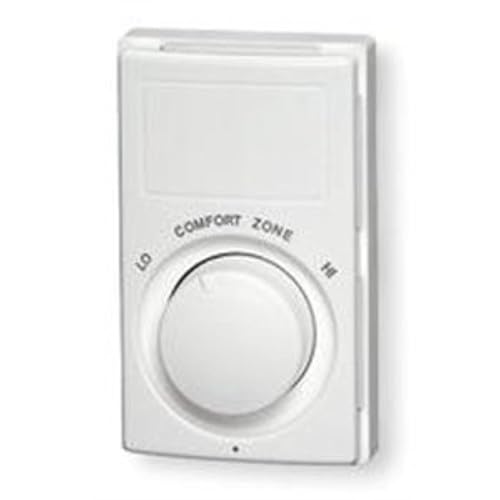
Marley MD26 Qmark Line Voltage Wall Thermostat

PRO1 T805 Single Stage Programmable Wall Thermostat
Why These Options Stand Out
If your home still runs on a Marley 2500 or QMKC series baseboard heater, the TA2AW thermostat is the factory-fit companion that keeps everything in one ecosystem. It’s a double-pole control, meaning it can fully disconnect line voltage when switched off, which electric baseboard heaters appreciate for safety and service work.
Because the unit mounts inside the heater’s junction box, you avoid the cluttered wall look of an aftermarket control, and the wiring stays tidy. For homeowners with multiple rooms on the same baseboard line, that built-in integration removes the guesswork of matching aftermarket stats to high-draw circuits.
The Case For It
- Direct compatibility with 2500 and QMKC series baseboard heaters
- Double-pole design offers true off-state line disconnection
- Junction-box mounting keeps wiring hidden and protected
- Maintains a single-brand system for cleaner service records
Trade Offs
- Limited to the Marley baseboard product line, so it won’t help a central HVAC retrofit
- No digital scheduling, so daily routines must be set manually at the wall
Made For
Owners of Marley 2500 or QMKC baseboard heaters who want a thermostat that fits the original junction box without rewiring guesswork.
Skip It When
You need a programmable wall control for central HVAC, since the PRO1 T725 covers that scenario with far more scheduling flexibility.
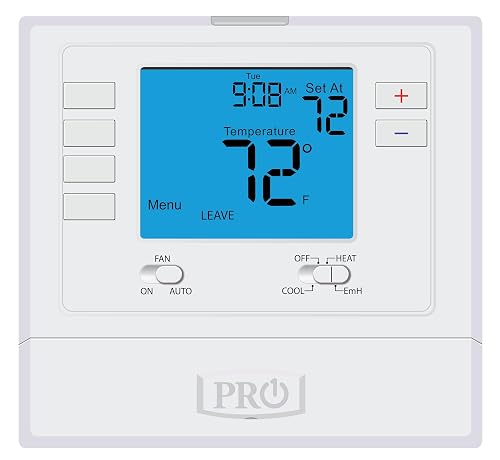
The T725 stands out because it doesn’t force you to choose between heat-pump logic and conventional HVAC control. It supports 2 heat/1 cool heat-pump configurations and falls back to 1 heat/1 cool conventional wiring, which is useful in homes with a mixed furnace-plus-heat-pump setup or a system still being upgraded.
Programming runs on a 7-day or 5/1/1 schedule (five weekdays plus separate Saturday and Sunday blocks), letting you set different routines for workdays and weekends. The 4 sq. in. blue backlit display is readable from across a hallway, and the schedule icons for wake, leave, return, and sleep keep the interface intuitive without burying settings in menus.
Everyday Perks
- Dual-mode support handles heat-pump and conventional systems on one wall unit
- 7-day or 5/1/1 scheduling fits real work-and-home routines
- Blue backlit display reads clearly in low light, helpful for hallway thermostats
- T700 platform build gives a familiar install pattern for pros and DIYers alike
Points To Keep In Mind
- Multi-stage cooling isn’t supported, so two-stage AC systems need a higher-tier model
- The interface, while clear, takes a short learning curve if you’ve never programmed a thermostat before
Feature Snapshot
Right Fit For
Households with a heat pump or a mixed HVAC setup that want a programmable wall unit without paying for full multi-stage cooling.
Look Elsewhere When
Your home runs a 2 heat/2 cool gas system, because the PRO1 T715 is built specifically for that configuration.
Not every space needs a seven-day schedule. The T771 is a non-programmable wall thermostat aimed at single-stage conventional systems, with a setpoint range that stretches down to 25°F, which is unusual for residential stats and useful in unheated garages, sheds, and workshops where freeze protection matters.
Its wider tolerance makes it a good match for spaces you don’t visit every day. Set it low in winter, and you don’t have to worry about frozen pipes or a dead battery in a rarely used building. The same backlit 4 sq. in. display used across the T700 family keeps readings legible in dim shops.
Strengths Worth Knowing
- Setpoint range starting at 25°F supports cold-storage and freeze-protection spaces
- Non-programmable layout keeps wall controls simple for guests or seasonal use
- Single-stage wiring suits most basic furnace or AC systems
Honest Caveats
- No scheduling, so daily adjustments happen manually at the wall
- Not designed for heat-pump systems, so it can’t replace the T721 or T725 in that role
- Higher-end multi-stage HVAC equipment requires a more capable unit
Best Suited To
Garages, sheds, and outbuildings where freeze protection matters more than daily scheduling flexibility.
Consider Something Else When
You want a programmed weekly routine in living space, because the PRO1 T805 handles that scenario with a larger display.
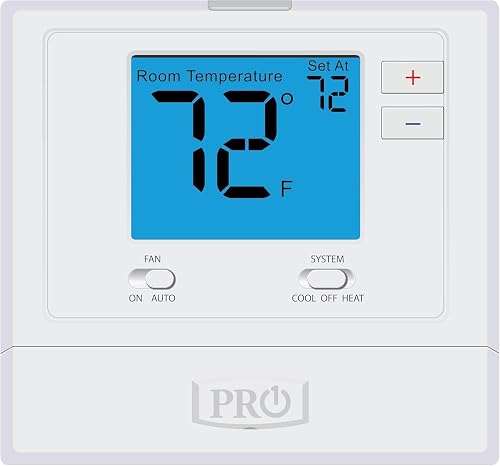
The T701 focuses on the basics: a single-stage non-programmable wall thermostat for 1 heat/1 cool conventional systems, but with the same larger T700 platform and a glow-in-the-dark light button. That last detail matters more than it sounds, since fumbling for a wall control in a dark hallway is a small daily friction that adds up.
It’s a sensible pick for a first thermostat swap where the homeowner wants reliability without app pairing or scheduling menus. Gas or electric compatibility broadens where it installs, and the 4 sq. in. blue backlit display carries the same legibility as the programmable T700 siblings.
Features That Help
- Glow-in-the-dark light button helps locate the unit in dark hallways
- Compatible with both gas and electric conventional systems
- T700 platform install pattern simplifies replacement of older PRO1 units
- Backlit display stays readable in low light
Things To Consider
- No scheduling means manual setpoint changes for day and night
- Single-stage only, so it won’t drive multi-stage heating or cooling equipment
Who Will Love This
First-time thermostat swappers who want a simple wall control with reliable gas or electric support and no learning curve.
Where Another Pick Suits Better
Households that want weekday/weekend programming should reach for the PRO1 T805, which offers 7-day or 5/1/1 scheduling on a larger display.
The T715 steps up to 2 heat/2 cool gas system support, which matters in homes with a two-stage furnace and a matched two-stage AC. Two-stage equipment ramps gradually rather than blasting full output, so a thermostat that understands both stages keeps comfort steadier and the equipment quieter.
You can run it as 7-day, 5/1/1, or simply non-programmable, depending on how much control you want. The 4 sq. in. backlit display and glow-in-the-dark light button are familiar T700 traits, and battery or hardwire power gives installers a choice based on the existing wall wiring.
Good Reasons To Consider
- True 2 heat/2 cool support matches modern two-stage gas furnace and AC setups
- Three operating modes: 7-day, 5/1/1, or non-programmable, in one unit
- Flexible power options simplify retrofits in older wall boxes
Less Ideal Details
- Overkill for single-stage homes, where the T701 or T805 will do the job at lower complexity
- Wiring a 2 heat/2 cool system requires more conductors at the wall, so the install takes longer than a basic swap
Quick Facts
Whose Shelf It Belongs On
Homeowners with a two-stage gas furnace and AC who want a programmable wall thermostat that fully supports multi-stage operation.
Reach For A Different Pick When
Your system is single-stage, since the PRO1 T701 handles that wiring with less configuration overhead.
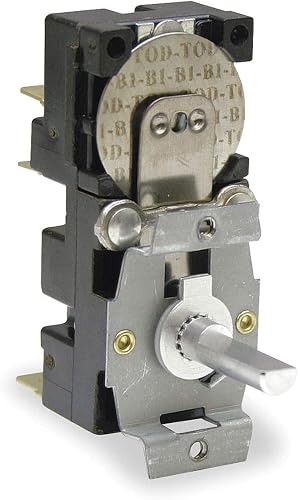
The Qmark SPST thermostat isn’t a wall control for daily use. It’s a replacement part, also cross-referenced as 5813-2050-000, designed to fit specific Marley Qmark unit heater models (3UG73 and 3UG74). For service techs and facility maintenance crews, having the right OEM-style replacement on the shelf turns a long downtime into a short one.
SPST stands for single-pole single-throw, the simplest switch type: on or off, with no second pole to disconnect the opposite line. That simplicity is exactly what utility heaters need, and matching the original part type avoids any wiring ambiguity during the swap.
Everyday Wins
- Direct fit for 3UG73 and 3UG74 series Qmark unit heaters
- SPST design matches the original switching logic of compatible equipment
- Compact replacement format suited to maintenance stockrooms
Potential Drawbacks
- Restricted sale in several international regions, so global sourcing may need an alternate channel
- Not a general-purpose wall thermostat, and using it outside the listed equipment could create wiring mismatches
Perfect Match For
Maintenance technicians and facility managers keeping spares on hand for 3UG73 or 3UG74 series Qmark unit heaters.
Not Your Match When
You’re upgrading a residential wall thermostat, since the PRO1 T701 or T805 fits that purpose with much more functionality.
The T721 sits between the T701 and the T725, supporting 2 heat/1 cool heat-pump systems or 1 heat/1 cool conventional systems without adding programming complexity. In homes with a heat pump plus a backup furnace, the T721 knows how to call the right stage at the right time, which is exactly what non-programmable shoppers want from a heat-pump thermostat.
Like other T700 units, it carries the 4 sq. in. blue backlit screen and glow-in-the-dark light button for nighttime adjustments. AA battery or hardwire power gives installers the same retrofit flexibility seen across the lineup, useful when existing C-wires are missing.
Well-Handled Touches
- Heat-pump and conventional dual-mode support without forcing a schedule
- Glow-in-the-dark light button makes the unit easy to find in the dark
- Battery or hardwire power options suit retrofit wall boxes
Soft Spots
- No programming, so day/night changes are manual at the wall
- Limited to 2 heat/1 cool heat pumps, so larger multi-stage systems need the T715
Built With In Mind
Owners of heat-pump or hybrid HVAC homes who prefer manual setpoint changes over weekly scheduling.
A Better Fit Elsewhere
If weekly programming is the goal, the PRO1 T725 offers heat-pump and conventional support with full 7-day or 5/1/1 scheduling.
The UHMT2 is a field-installed, two-stage internal thermostat that mounts on the unit itself, not on the wall. That location is a deliberate design choice: it keeps curious hands and accidental bumps away from the control, which is useful in workshops, garages, and utility spaces where a wall stat would be tempting to fiddle with.
Because it sits on the heater body, the UHMT2 reads the temperature right where the heat is being delivered, which can make its response feel more immediate than a remote wall sensor. For unit heaters and similar equipment, that placement also simplifies installation since no extra wall wiring is needed.
Points In Its Favor
- Internal mounting protects the control from accidental adjustment or tampering
- Two-stage switching supports more refined temperature management in compatible equipment
- No wall wiring run needed, simplifying retrofit installs
Practical Considerations
- Setpoint changes require reaching the unit, which is less convenient than a wall control
- Confined to compatible Marley unit-heater models, so it’s not a general swap-in part
Core Details
Who Should Grab It
Workshops and utility spaces running compatible Marley unit heaters where a wall thermostat would be prone to tampering.
Swap It Out When
A wall-mounted, programmable interface matters more, since the PRO1 T701 delivers that experience for conventional systems.
The MD26 is a wall-mounted, line-voltage, heating-only thermostat built for electric baseboard heat. It uses a DPST (double-pole single-throw) switching action, which means it disconnects both legs of the line voltage when turned off. For a 240-volt baseboard circuit, that matters during maintenance, since flipping the stat to off should actually isolate the heater.
The 50°F to 80°F range covers typical living-area comfort, and the 5°F differential is the temperature swing the stat allows before cycling back on, which feels right for a quiet, slow-responding baseboard setup. The snap-action mechanism is a classic approach to mechanical switching that tends to outlast cheaper contacts in high-cycle use.
A Few Strong Suits
- DPST switching isolates both legs of the line voltage for safer service
- 50°F to 80°F range aligns with typical baseboard heating needs
- Snap-action mechanical design built for long switch life
Worth Bearing In Mind
- Heating only, so it can’t control a cooling system
- 5°F differential may produce slightly longer cycles in tightly insulated rooms
Made For
Homeowners with 240-volt electric baseboard heat who want a reliable, service-friendly wall thermostat without digital extras.
Another Choice May Suit
If your home has central HVAC instead of baseboard heat, the PRO1 T701 wall thermostat is a better everyday match for conventional systems.
The T805 closes the list with a different focus: readability. Its 7 sq. in. blue backlit display is meaningfully larger than the standard 4 sq. in. T700 screens, which makes a real difference in hallways or living rooms where you read the stat from a distance or with glasses off.
It runs 7-day, 5/1/1, or non-programmable modes on a single-stage conventional system, and uses the T800 platform for installation. For shoppers who value a clear readout over multi-stage support, the T805 is the easy daily-driver pick in this roundup.
A Favorable Mix
- 7 sq. in. display is nearly double the typical thermostat screen
- Three operating modes, including non-programmable, give setup flexibility
- Glow-in-the-dark light button aids nighttime adjustments
Small Limitations
- Single-stage only, so it can’t drive two-stage heating or cooling equipment
- Larger display means a slightly bigger wall footprint than the T700 siblings
Feature Card
The Right Fit
Conventional-system homes where a large, readable display matters more than multi-stage support.
Where A Sibling Pick Shines
Households with a two-stage gas system should look at the PRO1 T715, which supports 2 heat/2 cool operation.
What Matters Most Before Choosing Marley Thermostats
Start with the system, not the stat. The first decision point is whether the home runs electric baseboard or unit heaters (where Marley internal and line-voltage controls fit) or central HVAC (where the PRO1 T700/T800 wall series applies). Mixing those two worlds is the most common reason a thermostat swap goes sideways.
Match the stage count next. A single-stage furnace pairs with a single-stage stat like the PRO1 T701 or T805, while a two-stage furnace and AC really wants the T715’s 2 heat/2 cool support. Heat-pump homes have their own logic, where the T721 or T725 handles 2 heat/1 cool configurations without forcing a schedule.
Think about programming honestly. Weekly schedules on the T725 or T805 save energy only if you actually set them, so households that rarely touch the stat may prefer a non-programmable unit like the T701 or T721. Reading distance and lighting matter too, which is where the T805’s 7 sq. in. display earns its place for some homes.
Finally, check wiring and power. Battery or hardwire options across the T700 family make retrofit work easier, but multi-stage systems pull more conductors through the wall, so plan for a slightly longer install when stepping up from the T701 to the T715.
Picking the Right Control Without Regret
Common Shopping Slip Ups
A frequent misstep is buying a programmable wall thermostat for a line-voltage baseboard heater. The two worlds use different switching logic, and forcing a low-voltage PRO1 onto a 240-volt baseboard circuit is a wiring mistake you don’t want to make.
Another easy miss is ignoring the C-wire (the common wire that delivers continuous power to smart-style stats). Battery-powered units sidestep this, but installers planning to hardwire should check the existing wall box before settling on a model.
When Paying More Pays Off
Higher-tier models earn their keep by supporting more equipment stages and larger displays, not by adding unused features. A two-stage home buying a single-stage stat will likely replace it within a few years, while a household that needs a readable screen will feel the difference of the T805’s 7 sq. in. display every single day.
Frequently Asked Questions
Do Marley thermostats work with non-Marley baseboard heaters?
The TA2AW is designed specifically for the Marley 2500 and QMKC series, so it’s not a general fit. For other electric baseboard systems, the Marley MD26 line-voltage thermostat is a more flexible wall option.
Can the PRO1 T725 replace an old non-programmable thermostat?
Yes, as long as the existing system matches its 2 heat/1 cool heat-pump or 1 heat/1 cool conventional support. The T700 install pattern is familiar to most technicians, so the swap is usually quick.
What is a C-wire and do these thermostats need one?
A C-wire, short for common wire, supplies continuous 24-volt power to the thermostat. Several PRO1 T700 models can run on AA batteries instead, which is useful in older homes without a C-wire in the wall box.
Is a glow-in-the-dark light button a meaningful feature?
For hallway or bedroom thermostats, yes. Locating and reading the stat at night without turning on a light is a small but real daily convenience, especially in homes where the thermostat sits in a darker corner.
How does a two-stage thermostat differ from a single-stage model?
A two-stage stat can signal a furnace or AC to run at a lower output for mild conditions and ramp up only when needed, which tends to feel quieter and more even. Single-stage stats only call for full output, which works fine for simpler systems.
Closing Remarks
The right thermostat is the one that matches your equipment, your routine, and your reading distance. Start with the system type, then choose between scheduling, stage support, and display size, and you’ll land on a control that quietly does its job for years.