Running more than one thermostat in a home sounds simple until you actually try it. Different zones, different schedules, a finished basement that runs cold, a nursery that runs warm. The right gear turns that juggling act into something you barely think about, and the wrong gear just adds another thing to troubleshoot on a Sunday morning. This roundup pulls together wall thermostats, multi-zone workhorses, and a couple of smart add-ons so you can match the right control to each space in your house.
The Picks In Brief
PickWhy We Picked ItBest ForAction
Flexible Favorite
PRO1 T725 Heat Pump/Conventional Programmable Thermostat
Heat pump and conventional in one
Mixed HVAC homes

Specialty Choice
PRO1 T771 Single Stage Non-Programmable Thermostat
Low-temperature garage reach
Garages and sheds
Low-Fuss Pick
PRO1 T701 Single Stage Non-Programmable Thermostat
Twist-and-go simplicity
Rentals and guest spaces

Performance Leader
PRO1 T715 Multi-Stage Programmable Gas Thermostat
Two-stage heat and cool control
Two-stage gas systems
Budget Friendly
Heagstat NonProgrammable Thermostat 1 Heat/1 Cool
Forced-air simplicity on a budget
Simple forced-air homes
Dependable Option
PRO1 T721 Non-Programmable Heat Pump/Conventional Thermostat
Heat pump ready without schedules
Heat pump owners

Smart Upgrade
Google Nest Temperature Sensor 3-Pack
Multi-room temperature reading
Nest system owners

Thoughtful Design
PRO1 T805 Single Stage Programmable Thermostat
Larger display with flexible modes
Everyday single-stage homes
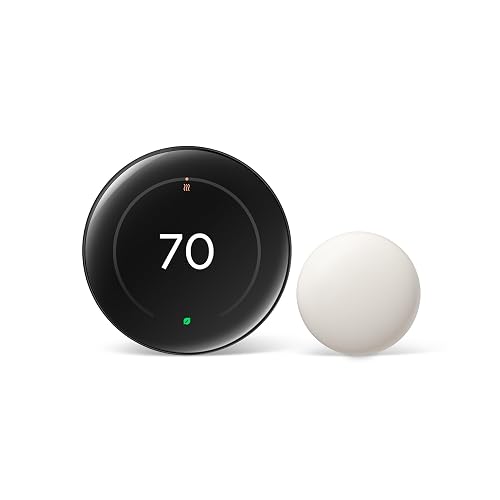
Premium Pick
Google Nest Learning Thermostat (4th gen) Obsidian
Adaptive learning with sensor bundle
Smart-home households
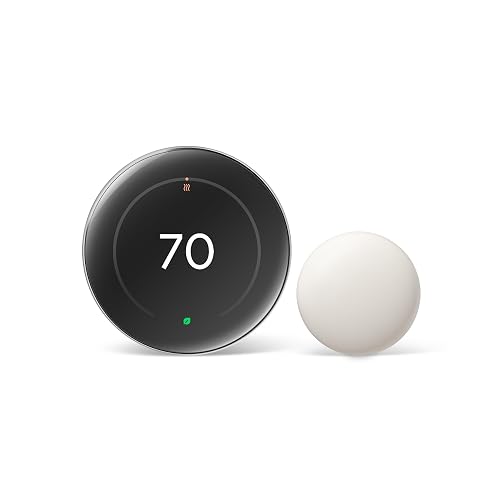
Design Standout
Google Nest Learning Thermostat (4th gen) Silver
Same learning tech, lighter finish
Lighter interior styles
What Each Pick Brings To The Table
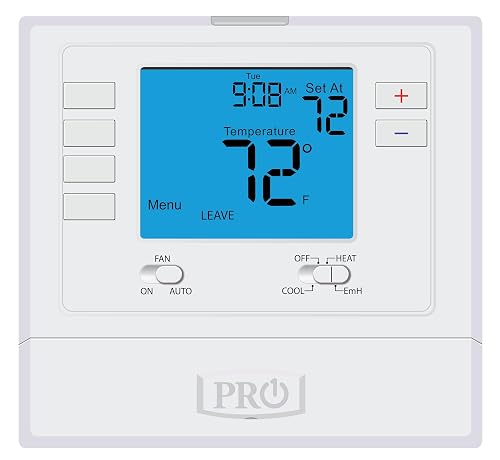
Houses that run both a heat pump and a backup conventional system tend to need a thermostat that can speak both languages, and the PRO1 T725 is built for exactly that dual setup. It handles 2 heat/1 cool heat pump configurations as well as 1 heat/1 cool conventional systems, which makes it a useful single purchase for a home where the upstairs runs on a heat pump and a workshop addition runs on a gas furnace. The 4 sq. in. blue backlit screen reads well from across the room.
For homeowners managing more than one zone or just one tricky system, the 7-day scheduling options (or 5/1/1 split) let you match comfort to a real weekday rhythm rather than guess at fixed times. Compared with the simpler PRO1 T701 below, this one adds scheduling flexibility without adding much complexity.
The Practical Payoff
- ✓Dual system support means one wall unit covers both heat pump and conventional setups.
- ✓Multiple scheduling modes (7-day, 5/1/1, or non-programmable) suit varied routines.
- ✓Blue backlit display keeps readings visible in low light.
- ✓Part of the PRO1 T700 platform, so parts and trim plates stay consistent across rooms.
Things To Consider
- •Scheduling setup takes a few minutes longer than a basic non-programmable unit.
- •Wiring complexity rises if your old thermostat used a different stage configuration.
Feature Snapshot
| | Feature | Specification | Why It Matters |
|---|
| System Support | 2 heat/1 cool heat pump or 1 heat/1 cool conventional | Covers dual-fuel or hybrid homes |
| Display | 4 sq. in. blue backlit screen | Easy reading at a glance |
| Schedule Modes | 7-day, 5/1/1, non-programmable | Matches any household routine |
| Platform | T700 series | Consistent with other PRO1 models |
Made For
Households with a heat pump and a backup conventional system who want one thermostat that can manage both.
Skip It When
You only run a single-stage conventional system, in which case the PRO1 T701 covers the same basics with less setup.
Check on Amazon
The PRO1 T771 stands out for one reason most thermostats ignore: it reaches setpoints down to 25°F, which makes it a sensible pick for garages, sheds, workshops, and other unconditioned spaces where freezing matters. A wide setpoint range up to 90°F means the same unit covers a sun-baked attic office just as easily. Where most living-room thermostats bottom out in the 40s, this one goes further.
For homeowners running a separate wall unit in each zone, the swing adjustment feature lets you tune how often the system cycles, which can be useful in spaces that swing between cold mornings and warm afternoons. It is a non-programmable unit, so the tradeoff is no automatic schedules. Pair it with the smart picks later in this list if you want app control on top of physical control.
Notable Upsides
- ✓Setpoint range from 25°F to 90°F covers specialty low-temperature spaces.
- ✓Swing adjustment helps fine-tune cycling in sheds or workshops.
- ✓4 sq. in. blue backlit display stays readable in dim garages.
- ✓Simple non-programmable interface suits occasional users.
Points To Note
- •No scheduling means manual setpoint changes throughout the day.
- •Calibration controls add a step most living-room thermostats handle automatically.
Best Suited To
Anyone outfitting a garage, shed, or workshop with a single-stage conventional system and needing low-temperature protection.
A Better Fit Elsewhere
Living areas with day-night schedules benefit more from the programmable PRO1 T805 in this lineup.
View Latest Price
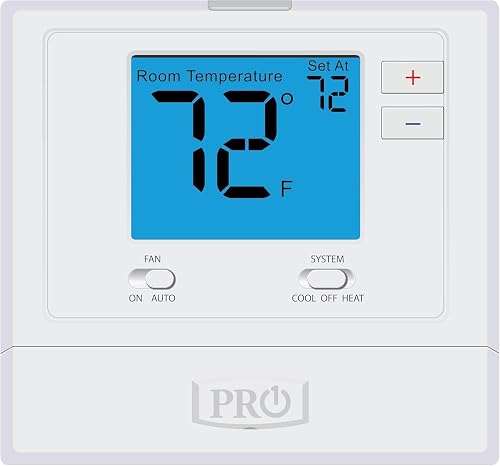
Sometimes a thermostat just needs to set a temperature and stay out of the way, and that is exactly what the PRO1 T701 is for. It is a single-stage non-programmable unit designed for straightforward 1 heat/1 cool conventional systems, which covers the majority of standard forced-air homes. The glow-in-the-dark light button is a small touch that pays off in a dark hallway at 2 a.m.
Renters, in-laws, and guest rooms tend to benefit most from this kind of no-schedule control, since occupants with changing routines do not benefit from locked-in programming. Compared with the programmable PRO1 T805 further down, the T701 trades scheduling flexibility for a shorter learning curve and fewer accidental setting changes.
Where It Helps
- ✓Glow-in-the-dark light button improves nighttime visibility without needing the display on.
- ✓4 sq. in. blue backlit screen is large enough for older eyes.
- ✓Gas or electric configurable setup suits most forced-air configurations.
- ✓Non-programmable design prevents accidental schedule changes by guests.
Worth Noting
- •No automatic scheduling means manual adjustments for day-night transitions.
- •Battery-only operation in some configurations means periodic replacement.
Right Fit For
Rentals, guest rooms, and spaces where simple set-and-forget temperature control matters more than scheduling flexibility.
Look Elsewhere When
A weekday schedule would genuinely trim your energy use, in which case the PRO1 T715 offers scheduling in the same product family.
Check Latest Price
Two-stage gas systems need a thermostat that knows the difference between first-stage and second-stage firing, and the PRO1 T715 handles 2 heat/2 cool configurations cleanly. Multi-stage heating (where the furnace ramps up gradually rather than blasting at full power) tends to deliver more even temperatures, especially in homes with multiple registers spread across distant rooms. The optional hardwire or battery power gives installers flexibility depending on the existing wiring.
For households where comfort variance between upstairs and downstairs is a real complaint, a 2-stage system paired with this thermostat can noticeably smooth things out. Unlike the single-stage T701 and T805, the T715 lets the furnace modulate rather than simply on/off cycle.
What It Does Well
- ✓2 heat/2 cool staging reduces temperature swings in larger homes.
- ✓Compatible with 7-day, 5/1/1, or non-programmable modes for any comfort preference.
- ✓Glow-in-the-dark light button and blue backlit display aid low-light operation.
- ✓Hardwire or AA battery options adapt to varied installation scenarios.
Trade Offs
- •Requires a multi-stage HVAC system to use all features fully.
- •Setup menus run longer than single-stage equivalents.
Quick Facts
| | Feature | Specification | Why It Matters |
|---|
| Stages | 2 heat / 2 cool | Smoother multi-stage gas performance |
| Scheduling | 7-day, 5/1/1, non-programmable | Flexible across routines |
| Display | 4 sq. in. blue backlit screen | Clear room-level readout |
| Power | Battery or hardwire (24V) | Fits most existing wiring |
Whose Shelf It Belongs On
Homeowners with a two-stage gas furnace or AC system who want staged control without stepping up to a smart thermostat.
Not Your Match When
You only have a single-stage conventional system, since the Heagstat non-programmable unit covers that ground for less.
View on Amazon
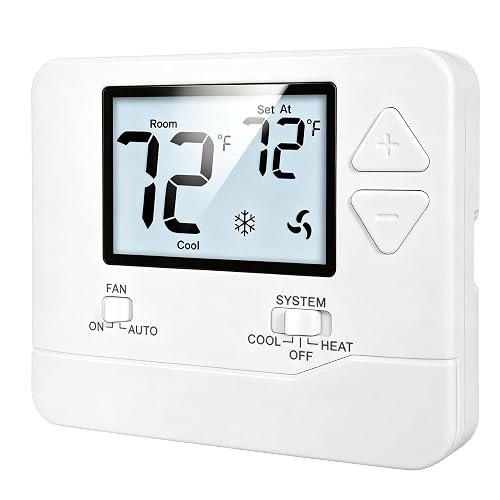
The Heagstat NonProgrammable thermostat slots in for anyone working with a 24VAC conventional single-stage forced-air system, which is the wiring in a lot of older homes. The white backlight is a nice contrast to the blue screens common on other picks in this lineup, and it works with 2 to 5 wire configurations, which matters if you are replacing an older 4-wire install.
You may find this model a sensible choice for secondary zones where you do not want to invest in a feature-rich unit but still want digital accuracy. Compatibility is strictly conventional, so heat pump homes should look at the PRO1 T721 or T725 instead.
Everyday Advantages
- ✓White backlit display offers a different visual style than blue-backlit alternatives.
- ✓Works with 2-5 wire conventional setups common in older homes.
- ✓Simple up/down setpoint control with no schedule menus to navigate.
- ✓Compatible with gas, oil, and electric forced-air furnaces.
Points To Keep In Mind
- •Not compatible with heat pump systems, multi-stage equipment, or 6-8 wire configurations.
- •Lacks any scheduling or remote sensor capability.
Perfect Match For
Older homes with straightforward 1 heat/1 cool forced-air wiring where basic digital control is the goal.
Reach For A Different Pick When
Your home runs a heat pump, in which case the PRO1 T721 handles the heat pump/conventional crossover with similar simplicity.
Check on Amazon
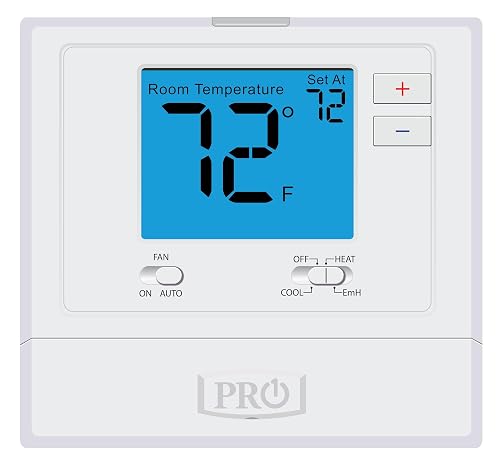
The PRO1 T721 fills a specific gap in the PRO1 lineup: heat pump support without scheduling complexity. It handles 2 heat/1 cool heat pump or 1 heat/1 cool conventional systems, which makes it a clean fit for a heat pump home that wants digital accuracy without investing in programmable menus. The 4 sq. in. blue backlit display matches the rest of the T700 family.
For homeowners standardizing on PRO1 across multiple rooms, the consistent UI between the T701, T715, and T721 means less time learning each thermostat. Compared with the programmable T725, this one drops the scheduling menus entirely in favor of straightforward setpoint operation.
Bright Spots
- ✓Heat pump support (2 heat/1 cool) without scheduling menus.
- ✓Glow-in-the-dark light button aids nighttime adjustments.
- ✓AA battery or hardwire power matches existing wiring.
- ✓UI consistency with other PRO1 T700 series thermostats in the home.
Honest Caveats
- •No scheduling means setpoint changes are manual.
- •Not suitable for multi-stage conventional systems.
Who It Suits Best
Heat pump owners who want heat-pump-aware control without committing to programmable scheduling or smart features.
Where Another Pick Suits Better
If you want scheduling in a heat pump unit, the PRO1 T725 adds 7-day and 5/1/1 programming for the same dual compatibility.
View Latest Price
The Google Nest Temperature Sensor 3-Pack is the easiest way to extend an existing Nest system across rooms that the main thermostat never sees. Each sensor reports the temperature from wherever you place it (a baby’s room, a finished basement, a home office), and the compatible Nest thermostat uses those readings to prioritize the room you care about most. Communication runs up to roughly 50 feet via Bluetooth Low Energy.
For homes with a known hot spot or cold room, this pack is often the simplest answer. It does not replace a thermostat; it works alongside one. Compared with the all-in-one Nest Learning Thermostat later in this list, the 3-pack is purely an add-on for households that already own the main unit.
Positive Points
- ✓Three sensors in one pack cover multiple problem rooms.
- ✓Compatible with Nest Learning Thermostat and Nest Thermostat E.
- ✓Bluetooth Low Energy keeps battery life reasonable on each sensor.
- ✓Helps prioritize heating or cooling toward the room you actually use.
Where It May Fall Short
- •Requires a compatible Nest thermostat already installed to function.
- •Does not independently control HVAC equipment.
Who Should Grab It
Existing Nest households wanting finer room-by-room temperature prioritization without buying a second full thermostat.
Swap It Out When
You do not yet own a Nest thermostat, in which case the Nest Learning Thermostat 4th gen bundles in a sensor as part of the full kit.
Check Latest Price
The PRO1 T805 sits on the larger T800 platform, which mainly shows up in the roomier 7 sq. in. blue backlit display. That extra screen real estate is genuinely useful if you read the thermostat from across a living room or have older eyes that appreciate bigger numbers. It runs in 7-day, 5/1/1, or fully non-programmable modes, so the unit can be set up to suit any household rhythm.
For homes with a single-stage conventional system and a desire for schedules without stepping up to a smart thermostat, the T805 lands in a useful middle ground. Compared with the smaller T701, you give up the compact display but gain scheduling flexibility.
Everyday Wins
- ✓Extra-large 7 sq. in. display reads clearly from across the room.
- ✓Triple-mode flexibility (7-day, 5/1/1, non-programmable) adapts to any routine.
- ✓Glow-in-the-dark light button helps in dark hallways.
- ✓T800 platform consistency for households standardizing on PRO1.
A Few Limitations
- •Larger footprint may not match older compact wall plates.
- •Single-stage only, so multi-stage homes need the PRO1 T715.
Built With In Mind
Single-stage conventional homeowners who want a bigger, easier-to-read display and the option to schedule but do not need a smart thermostat.
Consider Something Else When
You need multi-stage HVAC support, in which case the PRO1 T715 handles 2 heat/2 cool systems on the same brand.
View on Amazon
The Google Nest Learning Thermostat (4th gen) Obsidian is the bundle that pairs the adaptive learning thermostat with one 2nd-gen Nest Temperature Sensor in a dark finish. The thermostat itself learns your preferred temperatures over time and adjusts on the fly as your routine shifts, which is genuinely useful in homes with changing weekday/weekend patterns. The included sensor extends that learning into a priority room.
For households committing to a smart-home ecosystem, the Obsidian finish pairs well with darker interiors and modern hardware. Compared with the silver version further down, the only difference is the finish, so the choice is purely aesthetic.
The Helpful Details
- ✓Adaptive learning removes the need to manually program seasonal schedules.
- ✓Bundled 2nd-gen sensor extends priority-room control out of the box.
- ✓Obsidian finish suits dark or modern interior palettes.
- ✓Compatibility with Nest Temperature Sensors allows multi-room expansion.
Possible Compromises
- •Higher cost than a non-programmable wall unit.
- •Requires Wi-Fi setup and an account for full feature access.
Spec Overview
| | Feature | Specification | Why It Matters |
|---|
| Generation | 4th gen Nest Learning Thermostat | Latest adaptive logic |
| Finish | Obsidian | Dark, modern wall presence |
| Included Sensor | Nest Temperature Sensor (2nd gen) | Priority-room control out of box |
| Compatibility | Nest Temperature Sensor ecosystem | Expandable with additional sensors |
The Right Fit
Smart-home households in dark or modern interiors who want adaptive temperature control plus a bundled sensor.
Another Choice May Suit
You prefer a lighter finish on the wall, in which case the Nest Learning Thermostat 4th gen Silver bundle delivers the same learning tech.
Check on Amazon
The Silver edition of the Nest Learning Thermostat (4th gen) bundle delivers the same learning engine and the same included 2nd-gen Nest Temperature Sensor as the Obsidian version above, with a lighter metallic finish on the dial and body. For homes with brushed-nickel hardware, white walls, or Scandinavian interiors, the silver finish blends in where dark hardware would feel heavy.
Functionally identical to the Obsidian bundle, this one is a finish-driven choice for shoppers who want the smart features but care about the visual weight on the wall. It also expands via additional Nest Temperature Sensors, much like the rest of the Nest ecosystem.
Where It Excels
- ✓Same adaptive learning engine as the Obsidian bundle.
- ✓Silver finish suits lighter, neutral, or minimalist interiors.
- ✓Included 2nd-gen sensor adds priority-room control from day one.
- ✓Expandable with extra Nest Temperature Sensors for whole-home coverage.
Soft Spots
- •Finish preference is the only differentiator from the Obsidian bundle.
- •Higher learning curve for households new to smart thermostats.
Who Will Love This
Smart-home adopters with lighter interior palettes who want adaptive scheduling and bundled room sensing.
Where A Sibling Pick Shines
Darker interior spaces benefit more from the Obsidian finish of the matching Nest Learning Thermostat bundle.
View Latest Price
What Matters Most Before Choosing multiple thermostats
Compatibility leads every other consideration, since a thermostat that does not match your HVAC stages simply will not work. Match the stage count first: 1 heat/1 cool conventional, 2 heat/1 cool heat pump, 2 heat/2 cool gas, and so on. Wire count matters just as much, especially in older homes where a 4-wire setup rules out thermostats expecting common (C-wire) power.
Programming needs vary widely across a household. Living rooms with predictable weekday routines benefit from 7-day scheduling. Guest rooms and rentals often run better on simple non-programmable units. Rooms with shifting comfort priorities (nurseries, finished basements) pair well with remote sensors that read temperature in a specific zone.
Power source is the third filter. Some thermostats run on AA batteries only, while others support hardwired 24V common. C-wire setups tend to support brighter displays and Wi-Fi without battery swaps, but battery-only installs avoid the need to pull a common wire from the furnace.
Key Considerations Across These Picks
Pitfalls Shoppers Hit
The most common mistake is buying a thermostat based on the room aesthetic rather than the system behind the wall. A multi-stage furnace paired with a single-stage thermostat wastes the equipment’s potential, while a smart thermostat installed on a heat-only system loses half its features. Always confirm stages and wire count before chasing features.
Second on the list is underestimating how often schedules change. A rigidly programmed thermostat in a room with rotating occupants can create more friction than it solves. Match the programming depth to the stability of the routine in that space.
Where The Extra Money Goes
Premium picks like the Nest Learning Thermostat bundle pay for adaptive learning, app control, and bundled sensors that read multiple rooms. The cost step from a $20 non-programmable to a learning thermostat covers software, connectivity, and ecosystem expansion. That upgrade pays off most in homes with shifting routines and Wi-Fi already in place.
Mid-tier programmable thermostats like the PRO1 T715 and T805 cover most of the comfort improvement at a fraction of the smart-thermostat cost. The honest read is that the upgrade is worth it when schedules genuinely change day to day, and less worth it for a steady weekday routine.
Frequently Asked Questions
QCan I use multiple thermostats from different brands in the same home?
Yes, as long as each thermostat is matched to its own HVAC system or zone. Different brands generally coexist on independent systems without interference.
QDo I need a C-wire for every thermostat I install?
Not always. Many wall units in this list run on AA batteries, though Wi-Fi models and brighter displays often perform better with a common wire for continuous power.
QHow do remote sensors differ from buying a second thermostat?
Remote sensors report temperature only, while a second thermostat independently controls its own HVAC system. Sensors extend a single thermostat’s awareness; a second thermostat adds a new control point.
QWhat does “multi-stage” actually mean for comfort?
Multi-stage HVAC runs at a lower setting most of the time and ramps up only on extreme days, which tends to reduce temperature swings and noise compared with single-stage on/off cycling.
QWill a smart thermostat work without Wi-Fi?
Yes for basic setpoint changes on the wall, though remote app control and learning features require a connection. Schedules set up in advance keep running during Wi-Fi outages.
Closing Thoughts
Picking the right thermostat for each space comes down to matching the system behind the wall and the routine of the people in the room. Programmable wall units cover most homes well, specialty picks handle garages and workshops, and learning thermostats earn their place in households where schedules shift often. Take a few minutes to confirm your stages and wires, and the rest of the choice tends to fall into place.