
A stubborn thermostat in a small office feels like a tiny rebellion against your entire day. The air sits too warm at 9 a.m., too cold by 3 p.m., and the hardware never quite matches the way your team actually works. The right wall thermostat fixes that quietly, by giving you a temperature curve that follows your schedule instead of fighting it.
This roundup covers ten office thermostats across a wide range of system types, from basic single-stage dials to learning smart thermostats that adjust themselves. Each pick is matched to a specific kind of workspace, whether that’s a single-room professional office, a garage shop with a forced-air heater, or a busy open-plan area where comfort complaints never seem to end. You’ll find plain-language breakdowns of what each one does well, where it falls short, and which reader profile gets the most from it.
The Choices Worth Comparing
PRO1 T725 Heat Pump/Conventional Programmable Wall Thermostat

PRO1 T771 Single Stage Non-Programmable Wall Thermostat
Honeywell TH1100DH1004 Horizontal PRO 1000 Thermostat
PRO1 T701 Single Stage Non-Programmable Wall Thermostat

PRO1 T715 Multi-Stage Programmable Gas Thermostat
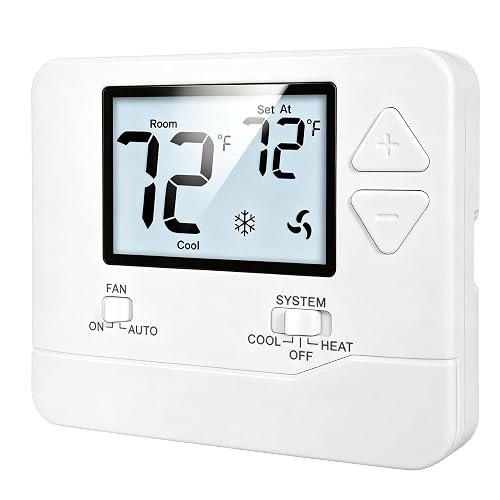
Heagstat NonProgrammable Thermostat 1 Heat/1 Cool
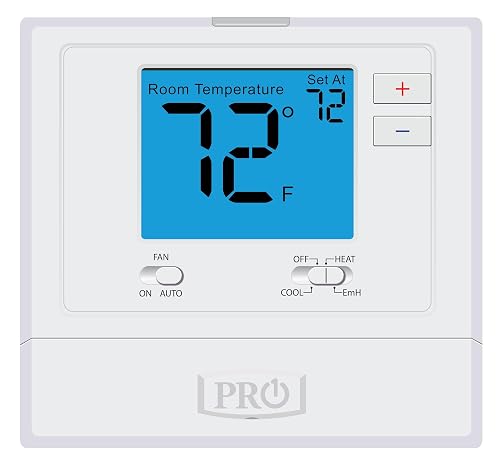
PRO1 T721 Non-Programmable Wall Thermostat

PRO1 T805 Single Stage Programmable Wall Thermostat
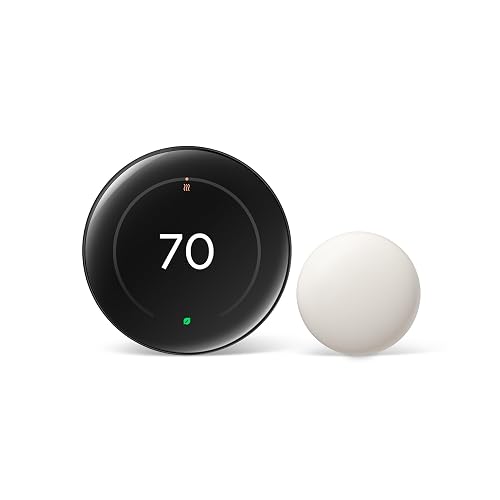
Google Nest Learning Thermostat (4th gen) Obsidian + Sensor
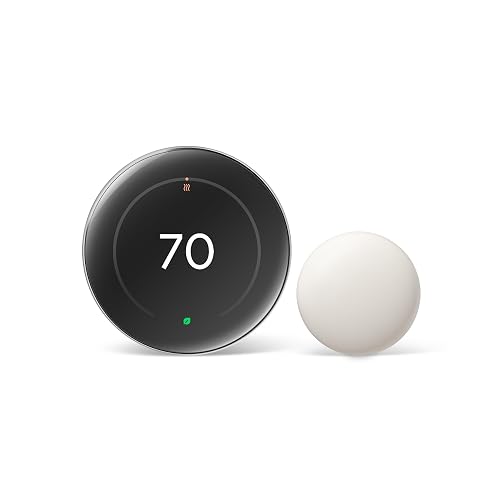
Google Nest Learning Thermostat (4th gen) Silver + Sensor
The Picks, Examined More Closely
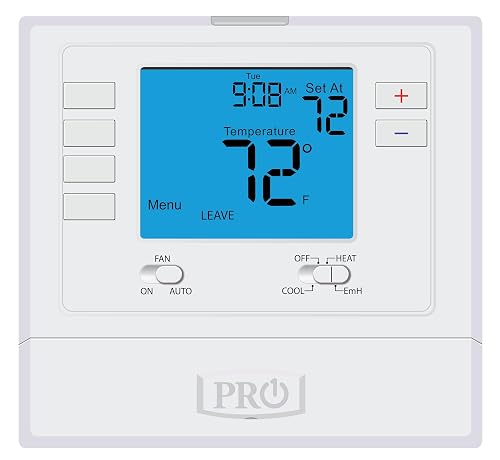
The PRO1 T725 is the kind of office thermostat that quietly takes over scheduling so nobody on your team has to think about it. It works with 2 heat / 1 cool heat pump systems and 1 heat / 1 cool conventional systems, which covers the common rooftop heat pump setups you’ll find in light commercial spaces. Seven-day or 5/1/1 programming lets you shape wake, leave, return, and sleep blocks around real work hours, rather than locking into a single weekday template.
Compared with the simpler PRO1 T701 covered later, this model adds programmability and broader heat pump compatibility on the T700 platform. The 4-square-inch blue backlit screen reads cleanly across a meeting room, and the system supports common-wire installations in most offices.
Practical Advantages
- Heat pump and conventional support on one unit, useful for offices that may switch equipment later
- 7-day or 5/1/1 programming fits a real Mon-through-Fri work schedule
- Blue backlit display stays readable in low-lit meeting rooms
- Sits on the established T700 platform with predictable button layout
Points To Keep In Mind
- Programming setup takes a few minutes the first time, more than a plain dial-style unit
- May require a common wire or backup power depending on your existing wiring, worth checking before mounting
Quick Facts
Who It Suits Best
Offices with heat pump systems that want weekday-and-weekend scheduling without paying for a full smart thermostat.
Consider Something Else When
Spaces with only heat-only single-stage equipment will find the Honeywell TH1100DH1004 a simpler, lower-spec match.
The PRO1 T771 is built for the spaces most office thermostats overlook: a garage workshop attached to a small business, a detached storage building, or a back room that only needs heating. The wide setpoint range from 25°F up to 90°F makes it useful where ordinary home thermostats simply won’t go cold enough. A 4-square-inch blue backlit display keeps the readout visible in low-light corners.
Where the T701 sticks to a standard living-area setpoint, the T771 steps outside that range, which is the real reason to pick it. Swing adjustment and calibration controls help fine-tune performance in spaces that drift between heated and unheated hours.
Useful Touches
- Setpoint range from 25°F to 90°F, rare in this category
- Backlit display stays readable in low-light areas like garages
- Swing adjustment and calibration help match uneven heating zones
Trade Offs
- Non-programmable, so any schedule changes happen manually
- Better suited to utility spaces than customer-facing offices
Made For
Workshops, garages, and back-of-house rooms that need lower temperature targets than a standard office.
Skip It When
A customer-facing office with normal heating needs will get more from the PRO1 T701’s cleaner presentation.
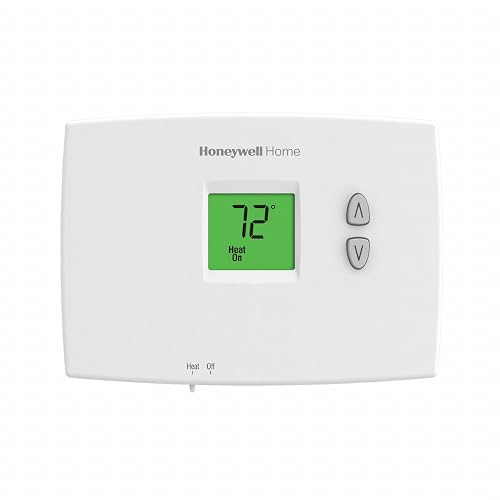
The Honeywell TH1100DH1004 is the office thermostat that does one thing very well: it runs a heat-only system without fuss. The horizontal layout suits older mechanical boxes where the wiring drop sits at a particular height, and dual power support means it can run on either batteries or a hard-wire common. The backlit screen reads cleanly in hallways and front-desk areas where lighting varies through the day.
Unlike the PRO1 T701 or T805 covered elsewhere, this Honeywell strips the experience down to setpoint and a switch. Adjustable temperature scales, from a standard 40 to 90°F range down to a 35 to 90°F garage range, make it a quiet workhorse for small offices with simple heating hardware.
Useful Highlights
- Heat-only focus keeps the install path short and predictable
- Dual power: batteries or hard-wire common, depending on what the wall allows
- Backlit display handles a range of office lighting conditions
Where It Is Less Suited
- No cooling control, so it can’t run a heat-pump summer mode
- Horizontal-only form factor may not match every existing wall plate
Best Suited To
Small offices and satellite rooms with dedicated heat-only furnaces that want a proven, no-learning-curve control.
Look Elsewhere When
Offices that need both heating and cooling should move up to the PRO1 T701 or PRO1 T805 instead.
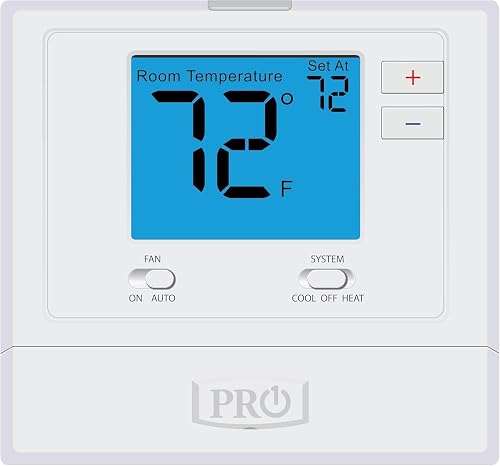
The PRO1 T701 is the sensible middle of the line for small offices that just want a clean thermostat that works. It targets 1 heat / 1 cool conventional systems, which covers a huge share of single-zone offices with a furnace and a separate air conditioner. The 4-square-inch blue backlit display and the glow-in-the-dark light button help you find the controls in a dark hallway after hours.
Where the T721 covered later adds heat pump compatibility, the T701 stays conventional-only, which keeps the wiring simple. Gas, oil, and electric furnace support makes it flexible across different utility setups, and the T700 platform design keeps the button layout familiar if you upgrade later.
Strong Points
- Spacious 4-square-inch blue backlit display, easy to read across a small office
- Glow-in-the-dark light button for after-hours adjustments
- Conventional-only focus keeps installation straightforward for most offices
Worth Noting
- No scheduling or programmability, so changes happen by hand
- Not a match for heat pump systems, the PRO1 T721 or T725 handle those
Feature Snapshot
Whose Shelf It Belongs On
Single-zone offices that prefer dial-style simplicity over weekly scheduling and smart features.
Swap It Out When
An office that wants preset schedules should reach for the PRO1 T805, which pairs a bigger screen with programming.
The PRO1 T715 is built for offices that have outgrown a single-stage system. It supports 2 heat / 2 cool gas setups, which is exactly what larger two-stage furnaces and matching air conditioners use to keep wide floor plans comfortable. The thermostat can run 7-day, 5/1/1, or non-programmable depending on the schedule your team actually keeps.
Compared with the PRO1 T701 covered earlier, this model is a step up in capability without jumping to a smart thermostat. Battery or hard-wire power flexibility helps during retrofits, and the T700 platform button layout keeps the day-to-day experience familiar.
Useful Strengths
- Two-stage heating and cooling support for larger two-stage HVAC systems
- Three programming modes, including full non-programmable for set-and-forget use
- T700 platform consistency if your office already runs other PRO1 hardware
Worth Bearing In Mind
- Overkill for a single-zone office with basic equipment
- More setup time than a non-programmable dial, so plan a quiet afternoon for install
Who Should Grab It
Larger offices and open-plan floors with two-stage gas furnaces that want scheduled heating and cooling.
Where A Sibling Pick Shines
Single-stage conventional systems get a more natural fit from the PRO1 T701, which keeps the install simpler.
The Heagstat NonProgrammable Thermostat fits a specific office situation: 24VAC conventional single-stage systems with 2 to 5 wires already in the wall. That covers a lot of older light-commercial buildings where a wider wire count would mean opening up drywall. The white backlight stays easy on the eyes in front-of-house settings compared with sharper blue screens.
Versus the PRO1 T701, this model leans even more stripped-down, which is the whole point. There’s no weekly programming to configure, and the install path is short when the wire count already matches the spec sheet.
Why It Works Well
- Designed for 2-5 wire installs common in older light-commercial walls
- White backlight reads cleanly in customer-facing offices
- Non-programmable design means no staff training required
Honest Caveats
- Limited to single-stage conventional systems, no heat pump support
- Will not work with 6-8 wire configurations found in some newer offices
At A Glance
The Right Fit
Older light-commercial offices with limited thermostat wiring that want a no-training, dial-style wall control.
A Better Fit Elsewhere
Offices with more wires in the wall or heat pump equipment should look at the PRO1 T701 or PRO1 T725 instead.
The PRO1 T721 is a useful bridge pick for offices that aren’t sure which HVAC system they’ll end up with. It works in either 2 heat / 1 cool heat pump mode or 1 heat / 1 cool conventional mode, which gives a property manager room to switch equipment later without swapping thermostats. The 4-square-inch blue backlit display and glow-in-the-dark light button are shared with the rest of the T700 line, so the feel is familiar.
Where the T701 stays conventional-only, the T721 adds heat pump support. Compared with the programmable T725 covered earlier, this model trims scheduling out entirely, which some offices actually prefer.
The Value In It
- Switchable heat pump or conventional mode, useful for mixed equipment inventories
- Blue backlit display with glow-in-the-dark light button for after-hours use
- T700 platform consistency across the PRO1 line
Things To Consider
- No weekly scheduling, unlike the T725
- Configuration step for heat pump vs conventional adds a small install wrinkle
Perfect Match For
Offices that may switch between a heat pump and a conventional system down the line and want one thermostat to cover both.
Another Choice May Suit
Offices that already run 2 heat / 2 cool gas equipment get more headroom from the PRO1 T715.
The PRO1 T805 is the office thermostat you reach for when the screen size actually matters. The 7-square-inch blue backlit display is roughly 75% larger than the 4-square-inch screens on the T701 and T721, which makes a real difference across a conference room or open workspace. It runs 1 heat / 1 cool conventional systems with 7-day, 5/1/1, or non-programmable modes, so you can build a real schedule without giving up the option to run it set-and-forget.
Compared with the T725 covered earlier, the T805 is conventional-only, but it sits on the newer T800 platform with a cleaner, more readable interface. For most conventional-system offices that want a programmable unit, this is the more practical choice.
A Strong Showing
- Extra-large 7 sq. in. blue backlit display, readable from across a room
- Three operating modes: 7-day, 5/1/1, or non-programmable
- T800 platform with glow-in-the-dark light button for after-hours use
Minor Gripes
- Conventional-only, no heat pump support, unlike the T721
- Larger footprint may cover old paint or wall marks left by smaller units
Feature Card
Built With In Mind
Conventional-system offices that want weekly scheduling plus a screen large enough to read across the room.
Not Your Match When
Offices running heat pump equipment will get a more natural fit from the PRO1 T725.
The Google Nest Learning Thermostat in Obsidian is for offices that want the hardware to do the thinking. The 4th generation model learns the temperatures you set, the times you set them, and adjusts the schedule as your routine changes. The included 2nd-generation Nest Temperature Sensor adds remote-sensing capability, which matters in larger offices where one wall reading doesn’t represent the whole floor.
Compared with the PRO1 T805 covered earlier, the Nest trades manual programming for a learning algorithm and adds app-based control. The obsidian finish suits darker reception areas and modern office design palettes.
Positive Takeaways
- Learning algorithm builds a schedule from your adjustments over time
- Included remote sensor helps balance temperatures across larger floor plans
- Obsidian finish fits modern, darker office design palettes
Things To Weigh Up
- App and account setup adds a layer most basic wall thermostats skip
- Learning period can feel imprecise during the first couple of weeks
Best Suited To
Tech-forward offices that want remote sensing and are comfortable setting up an app-based control system.
Reach For A Different Pick When
Offices that want a simple wall control without app setup should stay with the PRO1 T805.
The silver version of the Google Nest Learning Thermostat (4th gen) offers the same learning engine and remote sensor as the Obsidian model, just in a lighter finish. That subtle change makes a real difference in offices with white walls, light wood trim, or Scandinavian-style furniture palettes where a darker thermostat would feel out of place.
Functionally, the silver unit behaves identically to the Obsidian covered above. The choice between the two comes down to office design, not capability, and both share the same 2nd-generation temperature sensor for multi-room readings.
Everyday Perks
- Silver finish fits lighter, modern office design palettes
- Same learning engine and 2nd-gen temperature sensor as the Obsidian model
- App-based control allows remote adjustments for off-site managers
Potential Compromises
- Same setup complexity as the Obsidian version, with app and account required
- Learning curve during the first few weeks of use
Who Will Love This
Offices with lighter interior design that want learning thermostat features and a wall finish that blends in.
Where Another Pick Suits Better
Offices without a strong design preference, or with darker interiors, may prefer the Obsidian version of the same Nest unit.
What To Match Against Your Office Before You Choose
Start With Your HVAC System, Not the Brand
Every office thermostat in this roundup is built for a specific kind of HVAC equipment, and picking the wrong match is the most common reason for a swap-out a month later. A conventional furnace with central air pairs with a 1 heat / 1 cool thermostat such as the PRO1 T701 or T805, while a heat pump setup needs 2 heat / 1 cool hardware like the PRO1 T725. Two-stage gas systems with matched two-stage cooling are a step beyond that, where the PRO1 T715 becomes the natural fit. Before any other feature matters, identify what your equipment actually is, including how many wires run to the wall. Most of the units here use AA batteries or a hard-wire common, and the Heagstat’s 2 to 5 wire limit catches a lot of older light-commercial buildings that would otherwise need rewiring.
Match the Schedule to the Way You Actually Work
Programmable units earn their keep when your office has predictable blocks: open by 8, quiet by 6, closed on weekends. For those spaces, the PRO1 T725 and PRO1 T805 let you set weekly schedules that follow real rhythms. Non-programmable units like the PRO1 T701 or Honeywell TH1100DH1004 make more sense in offices where temperature is set once and rarely touched, or in utility rooms where nobody is watching the clock. The Nest Learning Thermostat sits in a third category, where the hardware builds a schedule from your adjustments, which suits offices whose hours change week to week. The honest read is that the most feature-rich option is only the best one if your team will use the features, and a simpler dial-style unit often wins for back rooms.
Read the Display Before You Mount the Box
A thermostat’s display is the part you’ll look at dozens of times a day, and the difference between a 4-square-inch screen and a 7-square-inch one becomes obvious fast. The PRO1 T805’s extra-large display reads cleanly from across a conference room, while the 4-square-inch screens on the T701 and T721 work fine for a private office. Backlight color matters too: blue backlights are common and easy to read, while the Heagstat’s white backlight can feel calmer in customer-facing spaces. Glow-in-the-dark light buttons, present across the T700 and T800 platforms, help when you walk into a dark office at 6:30 a.m. and want to find the controls without turning on the lights.
Weigh Smart Features Against Daily Reality
The Google Nest Learning Thermostat adds remote sensing, app control, and a learning algorithm that no other pick in this roundup matches. That capability is genuinely useful in offices with uneven temperatures or off-site managers, but it comes with an app-based setup and a learning period during the first couple of weeks. For many small offices, a programmable wall thermostat like the PRO1 T805 delivers most of the comfort gains without the added setup layer. The decision comes down to whether your team will actually engage with the app, or whether a wall-mounted weekly schedule is enough.
Key Considerations Across These Picks
Mistakes Worth Dodging
The most common buying slip in this category is matching a thermostat to the wrong system type, so a heat pump gets a conventional-only unit, or a two-stage system gets a single-stage one. Before anything else, count your wires at the wall and confirm your equipment’s stage count. The second trap is overlooking the wire count limit on simpler units like the Heagstat, which only accepts 2 to 5 wires. Older light-commercial buildings with 6 to 8 wires need a different match, even if the price looks attractive.
When Paying More Pays Off
The jump from a non-programmable dial to a programmable or learning thermostat earns its keep when your office has predictable schedule swings, such as a closed weekend block or a Friday early close. The PRO1 T805’s oversized display and the Nest’s remote sensor are the kinds of upgrades that change day-to-day comfort rather than just spec sheet numbers. The case for spending up is strongest when your office’s hours actually vary, and weakest in utility spaces where the temperature is set once and forgotten.