
Swapping out a wall thermostat that has run its course is one of those small home upgrades that quietly changes how comfortable a space feels. You twist the old dial one last time, pull the faceplate off, and suddenly every room with a Trane system connected to it becomes a fresh project.
The challenge is matching the new thermostat to whatever your older Trane system actually expects to see on the wall. Compatibility, the number of heating and cooling stages, and whether you want a simple set-and-forget unit or a programmable schedule all matter before you commit.
This roundup walks through seven thermostats that cover the common replacement scenarios, from single-stage conventional systems to multi-stage heat pumps. The goal is to help you land on a unit that talks to your existing wiring without forcing a larger rewiring project than you planned for.
A Closer Look At The Lineup
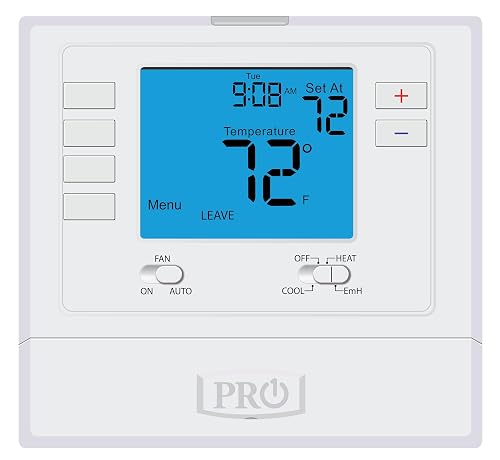
PRO1 T725 Heat Pump/Conventional Programmable Thermostat

PRO1 T771 Single Stage Non-Programmable Thermostat
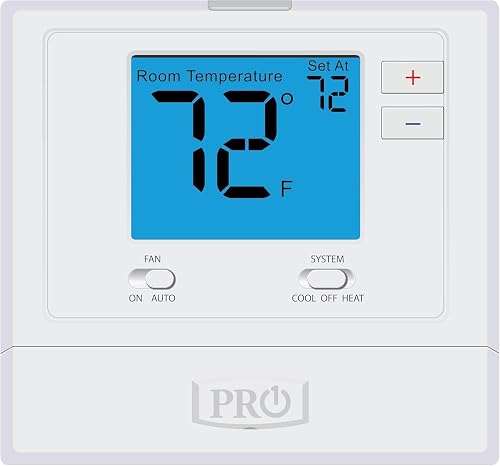
PRO1 T701 Single Stage Non-Programmable Thermostat

PRO1 T715 Multi-Stage Programmable Gas Thermostat
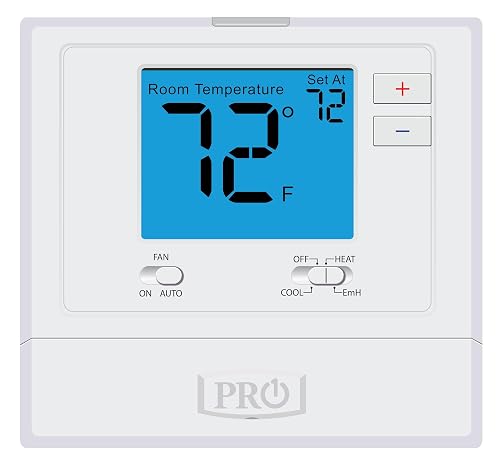
PRO1 T721 Non-Programmable Thermostat (2H/1C)
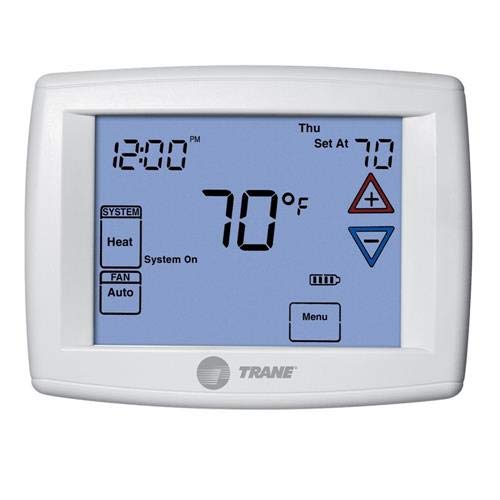
Trane TCONT302AS42DA Multi-Stage Touchscreen Thermostat

PRO1 T805 Single Stage Programmable Thermostat
Homes that have shifted between fuel types or run a heat pump alongside a conventional backup tend to collect wall thermostats that no longer match what’s behind them. The PRO1 T725 solves that by accepting either configuration from the same unit, reading 2 heat/1 cool heat pump setups or 1 heat/1 cool conventional systems on the fly.
Built on the T700 platform, it offers 7-day or 5/1/1 scheduling, which gives you a different program for weekdays and weekends without locking you into one rigid routine. The 4 sq. in. blue backlit display stays readable from across the room, and the glow-in-the-dark light button helps on those late-night adjustments.
Noteworthy Benefits
- Dual system support means one replacement covers either a heat pump or a conventional system, useful when household equipment changes over the years
- 7-day and 5/1/1 programming options let weekdays, Saturday, and Sunday each run on their own schedule
- 4 sq. in. blue backlit display keeps the current temperature and mode legible from a distance
- Shared T700 platform design helps if you ever swap thermostats between rooms
Things To Consider
- Wiring must match a 2 heat/1 cool heat pump or a 1 heat/1 cool conventional setup, so checking the existing terminal labels before ordering matters
- Programming takes a few minutes the first time you set it up, and you may want the manual nearby for the more advanced schedule blocks
Key Specs
Who It Suits Best
Households running a heat pump with a conventional backup, or anyone unsure which system category their wiring actually supports, will find the T725 forgiving on install day.
Where Another Pick Suits Better
For a pure single-stage conventional system with no scheduling needs, the PRO1 T701 keeps things even simpler at a lower tier.
Detached garages, workshops, and storage sheds often need heating or cooling at temperatures most living-room thermostats refuse to hold. The PRO1 T771 stretches its setpoint range down to 25°F and up to 90°F, which makes it useful in spaces that aren’t climate-controlled year-round but still need a hard floor on the thermometer.
It’s a non-programmable unit, so there are no schedules to enter and no app to pair with. Set the temperature once and the wall takes over, with a 4 sq. in. blue backlit display that shows the current reading and the swing adjustments behind the panel. For most utility spaces, that directness is the whole point.
Strong Points
- Setpoint range of 25°F to 90°F covers unusually cold or warm spaces that residential thermostats often ignore
- Non-programmable design means no menu diving after the first setup
- 4 sq. in. blue backlit display offers a clean, no-nonsense readout
- Swing adjustment and calibration controls sit behind the cover, out of accidental reach
Worth Noting
- Limited to single-stage 1 heat/1 cool conventional systems, so it won’t fit homes with multi-stage equipment
- No scheduling means you’ll adjust the temperature manually when seasons change
At A Glance
Made For
Owners of detached garages, workshops, sheds, or any single-stage conventional space that needs a wide temperature range without scheduling.
Look Elsewhere When
Households that need full 7-day programming should reach for the PRO1 T805, which offers scheduling on a similar single-stage platform.
Most homes with older Trane systems are running a straightforward 1 heat/1 cool conventional setup, and the wall thermostat doesn’t need to do much more than call for heat or cool on demand. The PRO1 T701 fits that role without piling on features that go unused.
It shares the larger T700 platform footprint with the T725 reviewed above, which means a familiar physical feel if you handle multiple units in the same project. The 4 sq. in. blue backlit display, glow-in-the-dark light button, and gas or electric compatibility give it just enough range to cover a typical residential replacement.
Key Advantages
- Non-programmable operation removes the menu learning curve for first-time users
- Gas or electric compatibility widens the equipment types it can control
- Glow-in-the-dark light button makes the controls findable in a dark hallway
- Shared T700 platform sizing helps with consistent wall cutouts across rooms
Trade Offs
- Lacks any scheduling, so manual setpoint changes are part of the routine
- Limited to single-stage 1 heat/1 cool conventional systems only
Right Fit For
Older homes running a single-stage gas or electric conventional system where the priority is simple, predictable wall control.
Swap It Out When
Anyone wanting a programmable schedule on the same single-stage footprint should look at the PRO1 T805 instead.
Two-stage gas systems are common in homes that have been upgraded over the years, and a single-stage thermostat leaves performance on the table by only ever calling for first-stage heat or cool. The PRO1 T715 reaches into 2 heat/2 cool gas systems, letting the equipment modulate properly when the weather asks for it.
You can run it as 7-day, 5/1/1, or non-programmable depending on how much scheduling you want. Compared to the T701 above, it adds a programming menu and multi-stage support, while the T700 platform keeps the wall footprint the same. Battery or hardwire power offers some flexibility on how you supply it.
A Few Highlights
- 2 heat/2 cool support lets a two-stage furnace and AC work at partial capacity when full blast isn’t needed
- Three operating modes (7-day, 5/1/1, non-programmable) let you start simple and grow into scheduling later
- 4 sq. in. blue backlit display and glow-in-the-dark light button carry over from other T700 models
Honest Caveats
- Wiring for two-stage systems involves more terminal connections, so a careful look at the existing bundle is wise before buying
- Programming depth is greater than the single-stage PRO1 units, which can feel like extra setup for a small household
Feature Snapshot
Best Suited To
Homeowners with a two-stage gas furnace and central AC who want the system to modulate rather than run flat-out.
Consider Something Else When
Single-stage systems get by comfortably with the simpler PRO1 T701, and there’s no real reason to pay for stages you can’t use.
Heat pumps usually call for a thermostat that understands reversing valve logic, and not every non-programmable wall unit does. The PRO1 T721 supports 2 heat/1 cool heat pump systems or 1 heat/1 cool conventional systems, which makes it a flexible replacement when you’re not sure what the next house’s wiring will look like.
Like the other T700 models, it runs on the same 4 sq. in. blue backlit display with a glow-in-the-dark light button. Power comes from AA batteries or a hardwire option, and the non-programmable layout keeps the front of the unit simple. For most daily use, the controls stay out of the way.
Why It Works Well
- Heat pump and conventional compatibility in one non-programmable package
- Glow-in-the-dark light button for quick nighttime adjustments
- Battery or hardwire power options offer installation flexibility
- Shared T700 footprint keeps wall openings consistent across the house
Points To Keep In Mind
- No scheduling means setpoint changes are manual when the season shifts
- Heat pump systems require proper terminal labeling at the subbase before installation
Who Will Love This
Heat pump owners who want a simple wall thermostat without committing to weekly programming blocks.
Another Choice May Suit
The PRO1 T725 covers similar heat pump wiring with the added benefit of 7-day programming for hands-off scheduling.
Whole-home Trane systems with multiple heating and cooling stages need a wall unit that can keep up, and the TCONT302AS42DA handles up to 4 heat stages and 2 cool stages. That headroom matters for households with heat pumps paired to dual fuel or larger gas setups, where the thermostat has to coordinate more than one call for heat.
The 7-day programmable touchscreen sets it apart from the button-driven PRO1 models in this list, and it supports gas, oil, electric, heat pump, and dual fuel configurations. A new subbase is required when replacing TCONT800 series units, so this isn’t a swap-in-and-go job. For most homes already running Trane equipment throughout, the rewiring effort is part of the package.
Notable Upsides
- Supports up to 4 heat/2 cool stages for multi-stage Trane systems
- 7-day, 5/1/1, or non-programmable scheduling on a touchscreen interface
- Gas, oil, electric, heat pump, and dual fuel compatibility in one unit
Potential Drawbacks
- Rewiring or reconfiguration is required, and a new subbase must be installed when replacing TCONT800 series thermostats
- Heavier install commitment than the PRO1 wall units above, which are closer to direct swaps
Quick Facts
Perfect Match For
Homes fully committed to Trane equipment across heating and cooling, where the wall thermostat has to coordinate multiple stages of equipment.
Skip It When
Single-stage and two-stage homes will be just as well served by the PRO1 T701 or PRO1 T715 at a lower tier of complexity.
Schedulers and large-print readers both benefit from a wall unit that doesn’t make you lean in to check the temperature. The PRO1 T805 jumps to a 7 sq. in. blue backlit display, noticeably larger than the 4 sq. in. screens on the T700-platform units earlier in the list.
It covers 1 heat/1 cool conventional systems and offers 7-day, 5/1/1, or non-programmable modes, so the weekly schedule is fully customizable. The T800 platform footprint is slightly bigger than the T700, so any older wall opening may need a trim plate or minor patching.
Advantages To Know
- 7 sq. in. display is the largest in this roundup, helpful for readability
- 7-day, 5/1/1, or non-programmable modes match a variety of household routines
- Glow-in-the-dark light button aids nighttime adjustments
- T800 platform design supports a clean wall profile on the larger cutout
Small Caveats
- Larger footprint than the T700-platform PRO1 models, which can leave a visible outline on existing wall openings
- Limited to single-stage 1 heat/1 cool conventional systems
Who Should Grab It
Schedulers who want each day of the week on its own program, plus anyone who values a larger wall display for at-a-glance reading.
Reach For A Different Pick When
Multi-stage gas homes will be better matched by the PRO1 T715, which can drive two-stage equipment.
What To Check Before Swapping Your Wall Thermostat
Compatibility sits at the top of the list, and it starts with the wiring already in the wall. Pull the old faceplate off and read the terminal labels on the subbase. The letters tell you which systems the bundle can support, and matching those letters to a replacement’s spec sheet is faster than guessing.
Stages come next, and they’re easy to overlook. A single-stage furnace only needs one call for heat, while a two-stage system can run at partial capacity during milder weather. Putting a single-stage thermostat on two-stage equipment forces the system to run flat-out, costing efficiency. Count how many heat and cool stages your indoor and outdoor units advertise before you settle on a pick.
Power supply matters more than people expect. Some thermostats run on AA batteries, while others need a common wire pulled from the HVAC system. The PRO1 T721, for instance, accepts either approach, which is helpful in older homes where the wiring bundle is short on conductors.
If you want scheduling, 7-day programming lets every weekday run on its own plan, while 5/1/1 groups Monday through Friday and treats Saturday and Sunday separately. Non-programmable units stay simpler but require manual setpoint changes when the season shifts.
Common Slip Ups And Where The Extra Money Goes
Where Shoppers Go Wrong
A frequent mistake is treating any wall thermostat as a universal replacement. The terminal bundle behind the old unit is the source of truth, and ignoring it tends to end with a returns trip. Another common slip is buying a multi-stage thermostat for a single-stage system, paying for capability the equipment will never call on.
When Paying More Pays Off
The premium tier in this category tends to buy wider stage support, larger displays, and touchscreen controls. The Trane TCONT302AS42DA, for example, supports up to 4 heat/2 cool stages and handles dual fuel, which is more capability than most single-stage or two-stage homes will ever use. The extra cost also covers more flexible scheduling on a larger screen, which becomes meaningful in homes where multiple people adjust the temperature throughout the day.
Frequently Asked Questions
How do I know if a new thermostat will work with my older Trane system?
The terminals on your existing subbase are the best starting point. Match those letters to the new unit’s wiring diagram, and check that the stage count on the new thermostat is equal to or greater than what your indoor and outdoor equipment supports.
Do I need a common wire for these thermostats?
The PRO1 T721 and several other units in this list can run on AA batteries, which is helpful if the existing wiring bundle doesn’t include a common conductor. The Trane TCONT302AS42DA typically expects a hardwired connection with a new subbase, so plan rewiring before installation.
What’s the difference between programmable and non-programmable models?
Programmable thermostats store a schedule for each day or block of days, automatically shifting setpoints at the times you choose. Non-programmable models hold a single setpoint until you change it manually, which is fine for utility spaces or anyone who likes a fixed temperature.
Can I install one of these thermostats myself?
Most homeowners comfortable with a screwdriver and a voltage tester can handle a like-for-like swap. New subbases, multi-stage wiring, and any change to the conductor bundle are situations where a professional installer reduces the risk of miswiring.
Will a new thermostat make my heating and cooling system run more efficiently?
The thermostat itself doesn’t change how the equipment runs, but a programmable schedule can trim runtime during hours when nobody is home. Multi-stage thermostats also let two-stage systems modulate, which often runs the equipment at lower capacity during milder weather.
Wrap Up
The right replacement comes down to matching the wiring that’s already in the wall, the number of stages your equipment supports, and how much scheduling you actually want. A simple single-stage home doesn’t need a touchscreen, and a multi-stage Trane system doesn’t get the most out of a non-programmable wall unit.
Start by reading the terminals on the old subbase, then narrow the list to thermostats that match both the stage count and the power source. From there, scheduling, display size, and fuel type are the details that pick the winner for your wall.