
A wall thermostat feels invisible until it quits on you. One minute you’re adjusting the setpoint before bed, the next the screen is blank and the furnace ignores you. For households weighing a simple swap against a smarter upgrade, the wall-mounted category covers a surprising range, from bare-bones single-stage dials to learning thermostats that pick up your routine.
This roundup focuses on pepi thermostats in the practical sense: wall-mounted, programmable or non-programmable units that pair with conventional and heat pump systems. The list spans budget single-stage models, multi-stage programmable boards, and one premium learning option. If you’re a homeowner matching a thermostat to a system, a renter who just needs the temperature right, or a property manager replacing several units at once, the picks below cover those scenarios.
A Fast Comparison Of The Options

PRO1 T725 Heat Pump/Conventional Programmable Thermostat
PRO1 T771 Single Stage Non-Programmable Thermostat
PRO1 T701 Single Stage Non-Programmable Thermostat
PRO1 T715 Multi-Stage Programmable Gas Thermostat

Heagstat NonProgrammable Thermostat 1 Heat/1 Cool

ELECTECK 5 Pack Non-Programmable Digital Thermostat

Garystat Digital Non-Programmable Thermostat with Humidity

PRO1 T721 Heat Pump/Conventional Non-Programmable Thermostat
PRO1 T805 Single Stage Programmable Thermostat

Google Nest Learning Thermostat (4th Gen) Obsidian
Meet The Standout Selections
The PRO1 T725 sits in an unusual spot: a programmable board that talks to either a 2 heat/1 cool heat pump or a 1 heat/1 cool conventional system. For households with a heat pump who want scheduled comfort without paying smart-thermostat prices, this PRO1 unit fills that gap. Compared with the simpler PRO1 T771 coming up, the T725 trades the wide temperature range for a programmable schedule and a heat pump wiring map.
The 4 sq. in. blue backlit display handles the four daily schedule blocks (wake, leave, return, sleep) that most families actually use. Owners running 7-day or 5/1/1 programs can swap modes without re-wiring, depending on which routine fits their week.
Where It Delivers
- Handles 2H/1C heat pump wiring, which many budget boards don’t support.
- 7-day or 5/1/1 programming covers the two scheduling styles most people actually set.
- Blue backlit display stays readable in a darkened hallway or basement stairwell.
- Schedule blocks (wake, leave, return, sleep) map directly to common work-from-home routines.
Things To Consider
- Only one cool stage on the heat pump side, so two-stage cooling compressors won’t get full use.
- Battery or hardwire power options mean you’ll want to confirm common wire availability during install.
Feature Snapshot
Who It Suits Best
Homeowners with a heat pump who want scheduled comfort without moving to a learning thermostat.
Consider Something Else When
The PRO1 T771 makes more sense if your space is a garage or shed with a wide setpoint range and no schedule needs.
The PRO1 T771 doesn’t try to be clever. It’s a single-stage, non-programmable wall thermostat aimed at spots where the temperature range matters more than a schedule, such as garages, workshops, and sheds. Unlike the heat pump-friendly PRO1 T725 above, this unit stays on the simple side of the PRO1 lineup.
Setpoint range of 25°F to 90°F covers spaces that need to stay just above freezing or those that run warmer in summer. The 4 sq. in. blue backlit display gives the same readability you’d expect in a living room, and swing adjustment lets owners tune how often the system cycles.
What Works In Its Favor
- 25°F to 90°F setpoint range handles both cold storage and warm workshop climates.
- Single-stage 1H/1C operation keeps wiring simple for older conventional furnaces.
- Swing adjustment fine-tunes short-cycling behavior without software menus.
- Backlit display is easy to read in low-light garage conditions.
Trade Offs
- No programmability, so daily adjustments have to be made by hand.
- Only fits single-stage conventional systems, not heat pump configurations.
Made For
Workshops, garages, sheds, and outbuildings where setpoint range beats scheduling.
Skip It When
The PRO1 T721 is a better match for households running a heat pump without programming needs.
First-time thermostat installers often want fewer menus, not more. The PRO1 T701 delivers exactly that: a single-stage non-programmable board built on the larger T700 platform with a glow-in-the-dark light button for late-night adjustments. It sits in the same family as the PRO1 T771 above, trading that model’s wide range for a more conventional home setpoint spread.
The 4 sq. in. blue backlit display handles 1 heat/1 cool conventional wiring, which covers most gas or electric furnace setups without an extra transformer. For a basic replacement where the old thermostat has died, this PRO1 unit is one of the easier swaps on the list.
What Earns Its Place
- Glow-in-the-dark light button helps locate the controls in a dark hallway.
- Single-stage 1H/1C compatibility covers most standard residential furnace wiring.
- Gas or electric configurable matches common utility setups.
- Simple non-programmable interface reduces setup mistakes.
Worth Noting
- No scheduling means weekend overrides have to be done manually.
- Battery-powered operation may need periodic swaps if the c-wire is absent.
Quick Facts
Right Fit For
First-time installers replacing a basic wall thermostat on a 1H/1C conventional system.
Reach For A Different Pick When
The Garystat Digital Thermostat offers humidity readouts for those tracking indoor moisture levels.
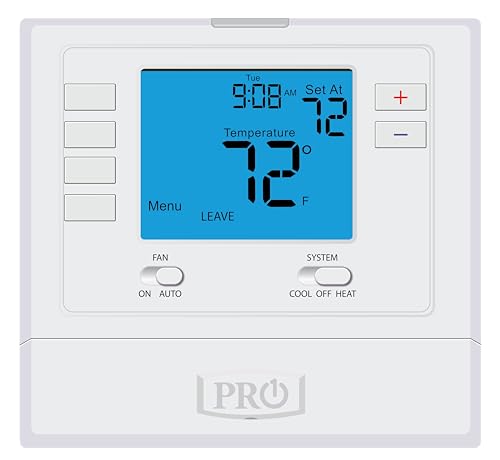
Two-stage gas furnaces and matching two-stage cooling deserve a thermostat that knows it. The PRO1 T715 covers 2 heat/2 cool conventional systems with 7-day, 5/1/1, or non-programmable modes, depending on how the owner wants to use it. Unlike the single-stage PRO1 T701 earlier, the T715 adds the second stage on both heating and cooling sides.
Built on the T700 platform, this PRO1 unit pairs a 4 sq. in. blue backlit display with a glow-in-the-dark light button for low-light visibility. Battery or hardwire power gives the installer flexibility on the wiring side, and the wide setpoint compatibility makes it a comfortable fit for multi-stage HVAC setups.
Points In Its Favor
- 2H/2C capacity uses both stages of a two-stage furnace and AC system.
- Three mode options (7-day, 5/1/1, non-programmable) cover different comfort preferences.
- Glow-in-the-dark button helps find the controls during overnight wake-ups.
- Multi-stage scheduling can reduce temperature swings between cycles.
Honest Caveats
- Not a heat pump board, so heat pump households should look elsewhere.
- Multi-stage wiring adds complexity during install compared to single-stage swaps.
Who Should Grab It
Households with 2H/2C conventional gas systems looking for flexible scheduling options.
Another Choice May Suit
The PRO1 T725 is the better call for heat pump systems that need scheduling.
Budget wall thermostats tend to cut corners in places you can’t see. The Heagstat 1H/1C board is a 24VAC conventional single-stage unit that handles gas, oil, and electric furnace setups matched with an independent outdoor AC condenser and full indoor ductwork. Compared with the PRO1 T701 above, this Heagstat sits firmly on the value side of the category.
The 2 to 5 wire base matches most older thermostat backplates where owners don’t want to run a new cable. White backlighting keeps the screen readable in dim hallways, and the non-programmable layout cuts setup steps for anyone who doesn’t need a schedule.
What Helps Most
- 24VAC single-stage compatibility covers most legacy conventional systems.
- 2 to 5 wire base adapts to older wiring without pulling a new cable.
- Gas, oil, or electric furnace configuration adds installation flexibility.
- White backlight keeps the display readable in low-light hallways.
Points To Keep In Mind
- 6 to 8 wire systems won’t fit this base, so newer multi-stage homes are out.
- Not compatible with heat pump systems, which rules out some replacements.
- Common battery maintenance tends to come up in owner reports for non-hardwired installs.
Best Suited To
Budget-focused households with a 1H/1C conventional system and older wiring.
Where Another Pick Suits Better
The ELECTECK 5 Pack is the smarter move for property managers needing several units at once.
Property managers, landlords, and small landlords often replace thermostats in clusters. The ELECTECK 5 Pack bundles five single-stage 1H/1C boards into one listing, electric or gas/oil configurable. Where the single-unit Heagstat above handles one room at a time, this ELECTECK pack spreads the same wiring across a small portfolio.
Each board in the 5-pack covers single-stage heating, cooling, and heat pump without aux systems. The trade-off shows up in the spec sheet: this is a non-programmable unit, so daily adjustments happen by hand, which is usually fine for rental properties where tenants set their own comfort levels.
Strong Points
- Five thermostats per pack lowers the per-unit cost across a small property portfolio.
- Single-stage 1H/1C and heat pump without aux coverage handles most rental HVAC.
- Electric or gas/oil configuration matches common utility configurations.
- Non-programmable interface reduces tenant tampering with schedules.
Small Caveats
- Does not work with multi-stage systems, so it’s limited to simpler HVAC layouts.
- 120/240V electric baseboard heaters are out of scope for this board.
- Five units in one order may be more than a single-home owner actually needs.
Whose Shelf It Belongs On
Property managers and small landlords replacing thermostats across multiple units.
Not Your Match When
The Heagstat single-unit board makes more sense for a single-home replacement.
Indoor humidity shapes how a room feels as much as temperature does. The Garystat Digital Thermostat pairs a 1H/1C single-stage conventional setup with a built-in temperature and humidity readout on its large blue LCD display. For households in muggy climates, that humidity number matters more than you’d think.
Unlike the simpler PRO1 T701 reviewed earlier, this Garystat adds the humidity monitor on top of the standard single-stage control. The large blue LCD display sits at a glance-friendly size, and the electric/gas/oil configurable setup covers common residential systems without extra wiring steps.
The Practical Payoff
- Built-in humidity monitor reads indoor moisture alongside temperature.
- Large blue LCD display improves readability from across a room.
- Gas, oil, or electric furnace configuration matches common HVAC setups.
- Single-stage wiring keeps installation similar to a basic swap.
A Few Limitations
- Not compatible with multistage heating and cooling systems.
- HVAC central air conditioning with inverter compressors falls outside the supported list.
- Compatibility check is recommended before purchase, which adds a prep step.
Perfect Match For
Households in humid climates who want a quick indoor humidity glance alongside temperature.
Swap It Out When
The PRO1 T805 fits better when a large programmable display is the priority over humidity data.
Some homes use a heat pump; others run a conventional furnace. The PRO1 T721 covers both, supporting 2H/1C heat pump or 1H/1C conventional systems on a single non-programmable board. Where the PRO1 T725 above adds programmability, this T721 stays simple, which fits owners who don’t want to learn a schedule menu.
Built on the same T700 platform as the rest of the PRO1 lineup, this unit ships with a 4 sq. in. blue backlit display and the glow-in-the-dark light button for low-light adjustments. AA battery or hardwire power keeps the install flexible across older wiring.
The Helpful Details
- Dual support for 2H/1C heat pump and 1H/1C conventional systems.
- Glow-in-the-dark light button makes the controls easy to find at night.
- AA battery or hardwire power adds wiring flexibility.
- Non-programmable layout avoids schedule setup steps.
Things To Weigh
- No scheduling means daily setpoint changes happen by hand.
- Only one cool stage on the heat pump side, similar to the T725.
Feature Card
Built With In Mind
Owners with a heat pump or conventional system who prefer a non-programmable wall control.
Look Elsewhere When
The PRO1 T725 is the upgrade path for those who later want programmable scheduling.
Reading a thermostat from across the room shouldn’t require squinting. The PRO1 T805 ships with an extra-large 7 sq. in. blue backlit display on the T800 platform, paired with a glow-in-the-dark light button for nighttime control. For vision-impaired users, that screen size is the actual selling point, not a spec sheet brag.
Designed for 1H/1C conventional HVAC, this PRO1 unit supports 7-day, 5/1/1, or non-programmable modes. The trade-off shows up in system scope: single-stage only, no heat pump wiring. Compared with the smaller PRO1 T701 earlier, this T805 trades the compact base for a more readable face.
Reasons It Performs
- 7 sq. in. extra-large display reads from across a medium-sized room.
- Three operating modes (7-day, 5/1/1, non-programmable) adapt to owner preference.
- Glow-in-the-dark light button helps locate controls in dark hallways.
- T800 platform offers updated features over the older T700 line.
Where It May Fall Short
- Only fits single-stage conventional systems, not heat pump setups.
- Larger display footprint may not align with older compact backplates.
The Right Fit
Owners who prioritize a large, readable display and run a single-stage conventional system.
Another Choice May Suit
The PRO1 T715 is the right call when a 2H/2C conventional setup is the home configuration.
Learning thermostats earn their keep by adapting to a household over weeks, not hours. The Google Nest Learning Thermostat (4th gen) Obsidian reads your routine and adjusts the schedule without manual programming, paired with a Nest Temperature Sensor (2nd gen) for room-specific readings. Compared with the simple PRO1 T701 earlier, this is a different category entirely: a connected device, not a wall dial.
The 4th gen platform is Google’s most advanced thermostat release to date, with a brighter display and tighter integration with smart home platforms. Where the PRO1 T725 above uses a fixed schedule, this Nest picks up the setpoints you set by hand and starts building a routine automatically.
A Favorable Mix
- Learning routine adapts the schedule based on real setpoint adjustments.
- Included Nest Temperature Sensor (2nd gen) reads specific rooms.
- Smart home integration connects with broader connected-home setups.
- Brighter Obsidian display improves visibility from a distance.
Practical Considerations
- Requires a c-wire or power accessory in many older wiring configurations.
- Learning period takes a few weeks to settle into a reliable routine.
- Wi-Fi dependency means a network outage limits remote adjustments.
Technical Highlights
Who Will Love This
Smart home enthusiasts who want a thermostat that learns their routine and integrates with connected platforms.
Where A Sibling Pick Shines
The PRO1 T805 covers the household that prefers a large, programmable wall display without the smart-home layer.
What To Weigh Before Choosing pepi thermostats
System compatibility drives everything else. A 1H/1C conventional furnace won’t accept a 2H/2C thermostat without leaving wires disconnected, while a heat pump system needs a board that understands the reversing valve. Match the system’s stage count first, then narrow down by features.
Programmability is the next fork. Households with predictable schedules benefit from 7-day or 5/1/1 options, which can shave setpoints during work hours without thinking about it. Vacation properties and garages often do fine with a non-programmable board, since the temperature stays put most of the time.
Power and wiring matter more than spec sheets suggest. Many older homes lack a c-wire, which some smart thermostats require. Battery-only boards like the PRO1 T771 install without rewiring, but battery swaps become a recurring chore. Hardwire units need either an existing common wire or a power accessory kit.
Display and readability come down to the room. Larger screens help in wide living rooms and in homes where someone reads the temperature from a distance. Blue backlit displays hold up in dim basements and hallways, and glow-in-the-dark light buttons help during overnight wake-ups.
Smart Habits For pepi thermostats Shoppers
Common Shopping Slip Ups
The biggest pitfall is matching by stage count alone. Two-stage furnaces paired with single-stage boards lose efficiency, while single-stage homes overpaying for 2H/2C thermostats add complexity without benefit. Heat pump households face the same trap, since heat pump wiring differs from conventional wiring, and not every board supports both.
Another common mistake is assuming a smart thermostat will install in any home. Many older systems lack a c-wire, and learning thermostats like the Nest often need a power accessory or professional install. Confirming the existing wire count before ordering saves a return trip.
Where The Extra Money Goes
Premium thermostats earn their price through learning routines, room sensors, and smart home integration. Lower-tier boards focus on accurate temperature control without the connected features. The upgrade makes sense for households with shifting schedules, multiple smart home devices, and room-specific comfort needs.
For households with a predictable routine and a single-stage conventional system, a programmable board often delivers most of the comfort benefit at a lower entry point. The premium tier pays off when the household’s schedule changes often enough that a fixed program becomes a hassle to update.
Frequently Asked Questions
What does 1H/1C mean on a thermostat?
It refers to one stage of heating and one stage of cooling. Single-stage systems run at full output or off, while multi-stage systems can throttle for finer comfort control.
Do I need a c-wire for a wall thermostat?
Some thermostats need a common wire for continuous power, especially smart and learning models. Battery-only boards like several in this roundup install without one, but may need periodic battery changes.
Can I install a thermostat myself?
Most wall thermostats in this roundup install with basic tools and a clear understanding of the existing wire labels. Turn off power at the breaker, photograph the old wiring, and label each wire before swapping.
What’s the difference between programmable and non-programmable?
Programmable thermostats follow a set schedule across the week. Non-programmable boards keep the temperature where you set it until you adjust it manually.
Are learning thermostats worth it?
Learning thermostats adapt to a household’s routine over time, which suits unpredictable schedules. Households with predictable weekly patterns may find a fixed programmable schedule just as effective.
Wrap Up
A wall thermostat is one of the cheaper parts of an HVAC system, yet it shapes daily comfort more than most components. The right pick depends on your system’s stage count, your schedule, and how much smart-home integration fits your home. Match those three before ordering, and the choice gets much simpler.