
Upgrading the wall thermostat is one of the few comfort changes that touches your home every single day, yet the category is oddly full of jargon. Terms like “heat pump compatible”, “single-stage”, “C-wire”, and “swing adjustment” sound technical, but each one changes how a system actually runs. The right pick can smooth out temperature swings, lower noise from short-cycling equipment, and finally give you dependable control over a garage or bonus room that never quite felt right.
This list covers eight wall-mounted thermostats suited to a range of central heating setups, from simple single-stage furnaces to multi-stage gas systems and radiant floors. A few lean fully programmable for set-and-forget scheduling, while others stay non-programmable on purpose for people who want one dial, one number, and zero fuss. There’s also a radiant floor option for anyone running low-voltage mat heating under tile or laminate.
Use the table below to scan the lineup, then jump to the individual reviews for the detail that actually matters for your system, your wiring, and your daily routine.
How The Shortlist Stacks Up
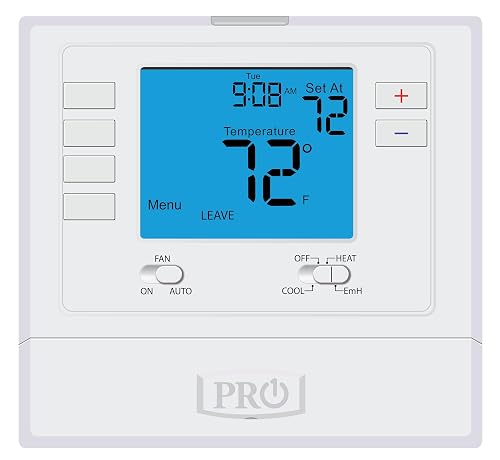
PRO1 T725 Heat Pump/Conventional Programmable Wall Thermostat

PRO1 T771 Single Stage Non-Programmable Wall Thermostat
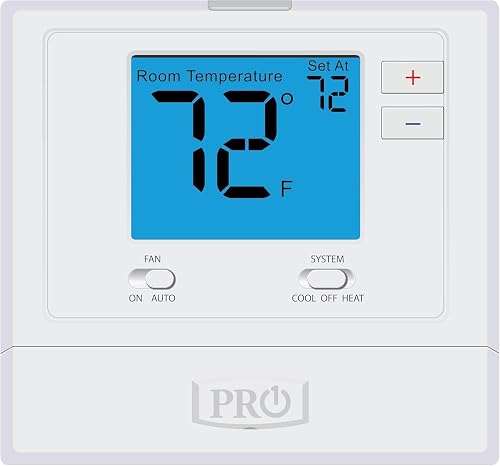
PRO1 T701 Single Stage Non-Programmable Wall Thermostat

PRO1 T715 Multi-Stage Programmable Gas Thermostat
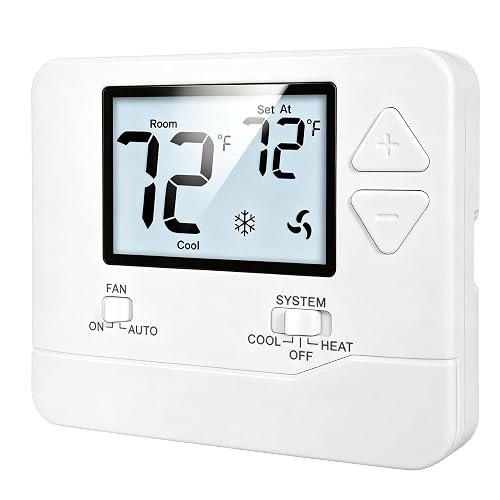
Heagstat NonProgrammable Thermostat 1 Heat/1 Cool
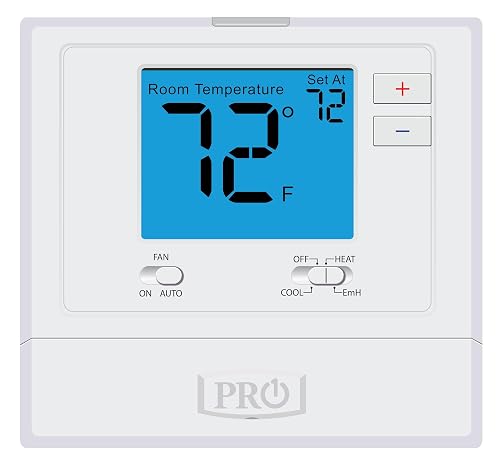
PRO1 T721 Non-Programmable Wall Thermostat (2H/1C)

OJ Microline UTN4 Radiant Floor Heat Thermostat

PRO1 T805 Single Stage Programmable Wall Thermostat
More Details On Our Top Picks
The PRO1 T725 sits on the T700 platform and handles both 2 heat/1 cool heat pump systems and 1 heat/1 cool conventional systems, so households with dual-fuel setups only need one wall unit. A 4 square-inch blue backlit screen shows the active schedule mode at a glance, which makes mid-cycle adjustments easier in a dim hallway.
Programmable scheduling covers 7-day or 5/1/1 patterns, meaning weekdays and weekends can share a routine while individual days still flex. Compared to the simpler T701, this model adds programming depth without the larger footprint of the T805.
Why It Works Well
- Dual compatibility covers heat pump and conventional wiring on one unit
- 7-day and 5/1/1 scheduling adapt to shift workers and hybrid schedules
- Glow-in-the-dark light button helps in power-outage and night-time moments
- Mid-size display balances readability and wall footprint
Points To Keep In Mind
- Programming setup takes longer on first install than a non-programmable alternative
- Smaller screen than the T805, which matters for low-vision users
Key Specs
Who It Suits Best
Homeowners with a heat pump who want weekday and weekend scheduling without moving up to a touch-screen flagship.
Where Another Pick Suits Better
Run a two-stage gas furnace and prefer maximum staging headroom, and the PRO1 T715 Multi-Stage Programmable Gas Thermostat fits more naturally.
The T771 leans into the niche that the rest of the lineup ignores: a wide setpoint range from 25°F to 90°F. That low end is what makes it genuinely useful in unheated garages, sheds, and workshops where you need freeze protection without overworking a small space heater.
Swing adjustment and calibration settings let the thermostat match a remote temperature probe to a wall reading, which matters when the unit sits next to a drafty door. Against the T701, this model trades programmability for a wider operational window.
Points In Its Favor
- 25°F minimum setpoint protects plumbing in unconditioned spaces
- Calibration control helps align the reading with a separate thermometer
- Non-programmable layout is friendly for seasonal or secondary spaces
Honest Caveats
- Single-stage only, so multi-speed equipment is out of reach
- No scheduling, which feels limiting in a main living area
Right Fit For
Anyone heating a detached garage, workshop, or storage building where a wide setpoint range matters more than scheduling features.
Consider Something Else When
You need scheduling in a primary living area, and the PRO1 T805 Single Stage Programmable Wall Thermostat is the better match.
The T701 keeps the focus tight: one target temperature, one actual reading, and a clearly backlit display. For households that never wanted scheduling in the first place, the simplicity is the entire point. You mount it, set it, and largely stop thinking about it.
It supports 1 heat/1 cool conventional systems with gas or electric configurations, which covers a huge share of older U.S. homes. The glow-in-the-dark light button is a small but real benefit in homes where the thermostat sits in a hallway light switch zone.
Noteworthy Benefits
- Straightforward controls cut down on programming confusion
- Glow-in-the-dark button improves night-time visibility
- Works with both gas and electric conventional equipment
Practical Considerations
- No scheduling, so energy-saving set-backs require manual changes
- Limited to single-stage systems, not multi-stage furnaces
Best Suited To
Owners of older single-stage systems who want a clear display and zero learning curve.
Look Elsewhere When
You want a large easy-to-read screen, and the PRO1 T805 Single Stage Programmable Wall Thermostat offers a noticeably bigger display.
The T715 targets 2 heat/2 cool gas systems, which makes it the natural fit for households running a two-stage furnace and central air. A two-stage system uses a low fire for most of the day and a high fire for cold snaps, and staging needs a thermostat that knows the difference.
Programming supports 7-day, 5/1/1, and non-programmable modes, so you can grow into scheduling instead of committing on day one. Compared to the single-stage T701, this is a meaningful step up for anyone whose furnace is already multi-stage.
Everyday Advantages
- 2 heat/2 cool staging supports high-efficiency gas equipment
- Three programming modes give flexibility during the learning period
- Blue backlit display keeps the room reading clear at night
Things To Weigh
- Overkill for a single-stage furnace that lacks second-stage wiring
- Commonly reported setup menus take patience to learn on first install
Who Should Grab It
Owners of two-stage gas furnaces who want scheduling flexibility without a smart platform.
Skip It When
Your system is a simple 1 heat/1 cool conventional setup, and the PRO1 T701 handles the job with less menu navigation.
Heagstat’s non-programmable thermostat targets 24VAC conventional single-stage 1 heat/1 cool systems, including gas, oil, and electric furnaces paired with an outdoor air-conditioning condenser. The 2 to 5 wire base makes it a direct match for older homes where a neutral wire or C-wire is not present.
Without a C-wire, smart thermostats often fail to power up, so a non-programmable wall unit that runs on the existing wiring avoids that headache. The white backlight helps in low-light hallways and nighttime checks.
The Good Stuff
- 2 to 5 wire install fits older homes without a C-wire
- Compatible with gas, oil, and electric conventional systems
- White backlight keeps the display visible in dim rooms
Some Limits To Know
- Not designed for heat pump or multi-stage wiring
- No scheduling, so savings depend on manual changes
Made For
Owners of older conventional systems with limited wiring who want a straightforward replacement.
Another Choice May Suit
You have a heat pump and want scheduling, and the PRO1 T725 covers that ground with programming support.
The T721 covers 2 heat/1 cool heat pump and 1 heat/1 cool conventional systems without the programming depth of the T725. That makes it a reasonable bridge for households that have a heat pump today but may switch to a conventional gas furnace in the future.
You get the same T700 platform display and glow-in-the-dark light button found across the family. Power comes from AA batteries or a hardwire option, which is helpful during a swap when the old thermostat’s common wire is missing.
Benefits That Matter
- Works across heat pump and conventional wiring in one unit
- Battery or hardwire power gives flexibility during swaps
- Glow-in-the-dark button supports low-light operation
Trade-Offs To Consider
- No scheduling, which limits set-back savings
- Smaller display than the T805 flagship
Whose Shelf It Belongs On
Homeowners between equipment types who want one non-programmable unit that handles either configuration.
Reach For A Different Pick When
You want 7-day programming today, and the PRO1 T805 Single Stage Programmable Wall Thermostat is the closer match.
The UTN4 steps outside the central air-handler world and into radiant floor heating. It runs on 120/240v circuits and includes a built-in Class A GFCI, which is the safety device required for underfloor electric systems in most U.S. and Canadian installations.
Dual sensing uses both an internal air sensor and the included floor sensor, so the system can protect flooring from overheating while keeping the room comfortable. Compared to the rest of the roundup, this is the only model purpose-built for mat heating under tile, stone, laminate, or engineered wood.
Reasons It Performs
- Class A GFCI is integrated, simplifying code-compliant installs
- Dual sensing balances room comfort with floor temperature limits
- 120/240v compatibility covers the two most common radiant voltages
Potential Drawbacks
- Non-programmable, so multi-zone scheduling needs extra hardware
- Not interchangeable with a central air thermostat
Perfect Match For
Anyone with electric radiant floor heating in a bathroom, kitchen, or basement who wants one wall control with built-in ground fault protection.
Swap It Out When
You need a thermostat for a forced-air gas furnace, and the PRO1 T701 Single Stage Non-Programmable Wall Thermostat is the closer match.
The T805 closes the lineup on the T800 platform, which trades the 4 square-inch display of earlier models for an extra-large 7 square-inch blue backlit screen. For anyone reading a thermostat from across the room, that screen size change is the entire reason to upgrade.
Programming covers 7-day, 5/1/1, and non-programmable modes, so the unit can grow or shrink with your routine. Glow-in-the-dark light button support keeps nighttime operation familiar for users of earlier PRO1 models.
The Value In It
- 7 sq. in. display is genuinely easier to read from a distance
- Three programming modes offer room to experiment with schedules
- Conventional 1 heat/1 cool fit covers the most common home setup
Where It Is Less Suited
- Larger wall footprint than the T701 or T721, which may not match shallow junction boxes
- Single-stage only, so two-stage owners miss out
Who Will Love This
Households that prioritize a large, readable display and want optional scheduling without moving into a smart platform.
A Better Fit Elsewhere
You run a multi-stage gas furnace, and the PRO1 T715 Multi-Stage Programmable Gas Thermostat lines up with that equipment.
Picking The Right Wall Thermostat For Your System
Start With The Equipment, Not The Brand
The most important spec on any wall thermostat is system compatibility, because the wrong match simply will not work. A single-stage unit cannot control a two-stage furnace, and a heat pump thermostat uses different terminals than a conventional gas system. Look at the wiring at your current thermostat: count the wires, note which terminals are populated, and match that pattern to the replacement.
For households running a heat pump, the model needs to recognize the reversing valve and auxiliary heat signals. A conventional gas furnace is a simpler setup that only needs R, W, Y, and G in most cases. The right match saves you from jumper wires, adapter kits, or a return trip to the retailer.
Programming Versus Set-And-Forget
Programmable thermostats make sense when your schedule is consistent, like weekdays at the office and weekends at home. The 7-day option offers maximum flexibility for shift workers, while 5/1/1 covers the more common weekday and weekend split. Non-programmable units trade those features for fewer buttons, fewer menus, and a faster install, which is genuinely all some households need.
For a garage, shed, or seasonal space, the non-programmable route usually wins. You walk in, set the temperature once, and forget it. In a primary living area, scheduling tends to pay back the small learning curve in comfort and energy use.
Display, Wiring, And Practical Touches
Display size matters more than people expect. A 4 square-inch screen is fine for a hallway thermostat viewed from two feet away, while a 7 square-inch screen is easier to read from across a large living room. Glow-in-the-dark light buttons help in homes where the thermostat sits next to a light switch and gets bumped in the dark.
Wiring depth matters too. A C-wire, short for common wire, delivers continuous 24-volt power to the thermostat, and smart units often demand one. The Heagstat model is designed for older homes with two to five wires, while many programmable units assume a more complete harness is already in the wall.
Key Considerations Across These Picks
Common Shopping Slip Ups
Counting wires on the existing thermostat before browsing is the single most skipped step. Shoppers regularly pick a programmable multi-stage unit only to find their furnace is single-stage, or grab a heat pump model for a system that has no outdoor unit. The fix is straightforward: take the cover off the old thermostat, photograph the terminal block, and match that picture to the new model’s wiring diagram.
Another common miss is assuming every “programmable” thermostat has the same scheduling depth. A 7-day model lets you set every day independently, while 5/1/1 forces weekdays to share a routine. Pick the one that mirrors how your household actually lives, not the one with the longest feature list.
What The Higher Tier Buys
Spending up within this category usually buys larger displays, dual-fuel staging support, and longer programming windows. The PRO1 T805 is essentially the T701 with a bigger screen and added scheduling depth, which is a meaningful upgrade for eyes-on-wall readability rather than core heating performance.
The bigger leap is moving from single-stage to multi-stage staging, which lets a two-stage furnace run a low fire most of the day. That change is felt in noise, draft, and temperature stability. If your furnace already supports staging, choosing a thermostat that can speak to it is the upgrade that pays off most clearly.
Frequently Asked Questions
What is a C-wire and why does it matter?
A C-wire is a common wire that delivers continuous 24-volt power from the furnace to the thermostat. Older homes with only two to five conductors may not have one, and some thermostats are designed to operate without it.
Can a non-programmable thermostat work with a heat pump?
Yes, as long as the model lists heat pump compatibility, like the PRO1 T721. The thermostat just controls the system manually without stored schedules, which can be a feature rather than a limitation for some users.
How does a multi-stage thermostat differ from a single-stage model?
A multi-stage thermostat can call for low and high heating output, while a single-stage unit only signals on or off. Two-stage furnaces paired with a multi-stage thermostat tend to run quieter and hold a steadier temperature.
Do I need a special thermostat for radiant floor heating?
Yes, electric radiant floor systems need a thermostat rated for line voltage, often 120 or 240 volts, with a built-in GFCI for ground fault protection. A standard 24-volt central heating thermostat is not interchangeable with radiant floor equipment.
Is a programmable thermostat worth the extra setup time?
For households with a predictable weekday and weekend schedule, programming usually pays back the setup time in comfort and savings. Households that wander the thermostat manually may prefer the simplicity of a non-programmable unit.
Closing Remarks
The right wall thermostat is the one that matches your equipment, your wiring, and how you actually live with the system. Match the terminals first, choose programming only if you’ll use it, and pick a display you can read from where you stand. Once those three boxes line up, the rest of the upgrade tends to take care of itself.