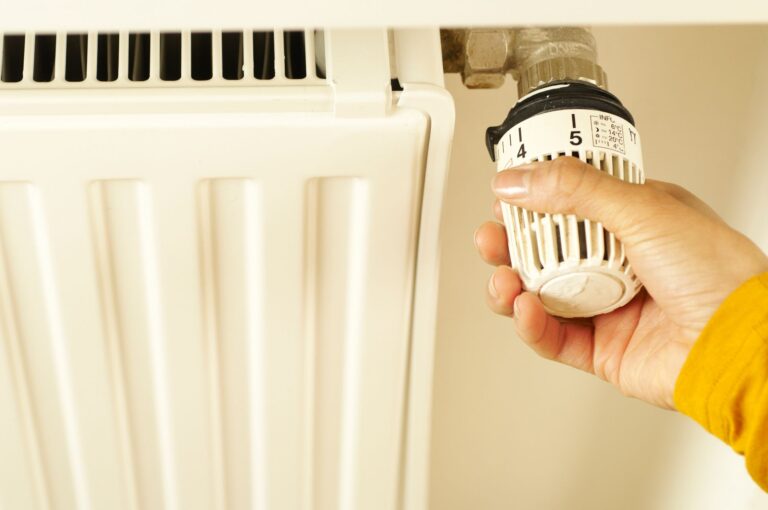

Picking a thermostat for a heat pump setup is a slightly different puzzle than a standard furnace. Heat pumps run heating and cooling on the same equipment, and many of them need a thermostat that knows how to talk back to the compressor, the reversing valve, and (on colder days) the auxiliary heat strips. A regular furnace thermostat will short-cycle the compressor, skip defrost cycles, or just leave you chilly in January.
This list gathers ten wall-mounted options built for the job, from simple non-programmable units for a garage or guest room to commercial-grade panels with multi-stage staging. The goal is to help you match a thermostat’s capabilities to the system hanging in your basement or attic, so the gear you already own can finally run the way it was designed to.
A Snapshot Of The Selections
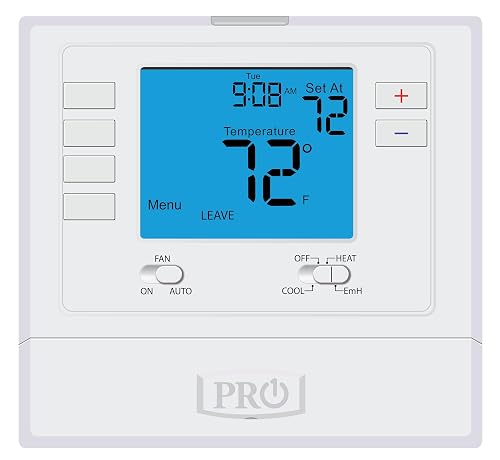
PRO1 T725 Heat Pump/Conventional Programmable Thermostat

PRO1 T771 Single Stage Non-Programmable Thermostat
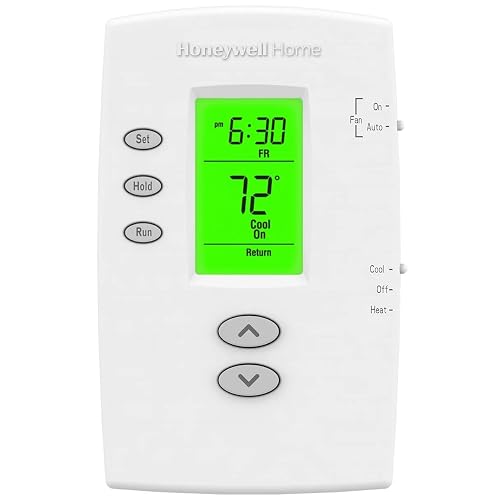
Honeywell TH2110DV1008 PRO 2000 Vertical Thermostat
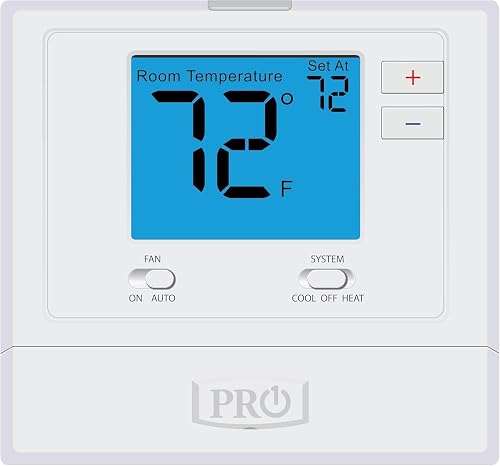
PRO1 T701 Single Stage Non-Programmable Thermostat

PRO1 T715 Multi-Stage Programmable Gas Thermostat
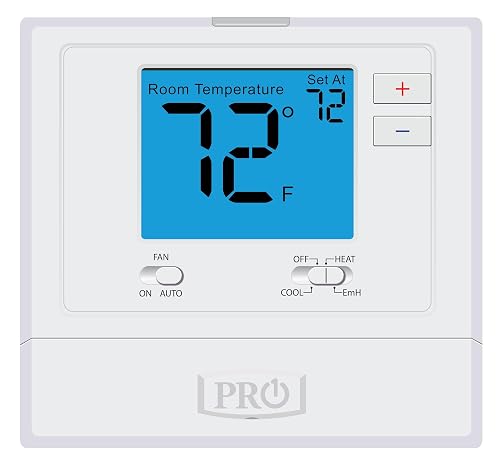
PRO1 T721 Non-Programmable Heat Pump Thermostat
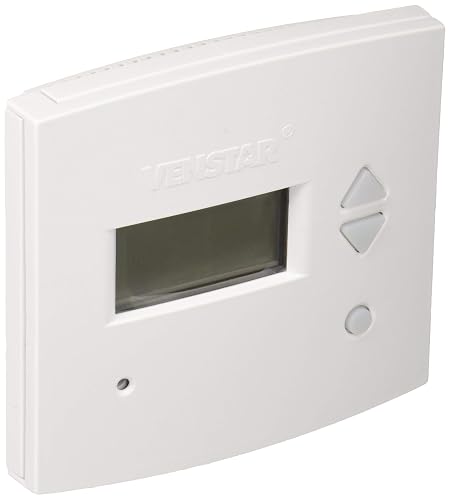
Venstar T2800 Commercial Platinum Thermostat
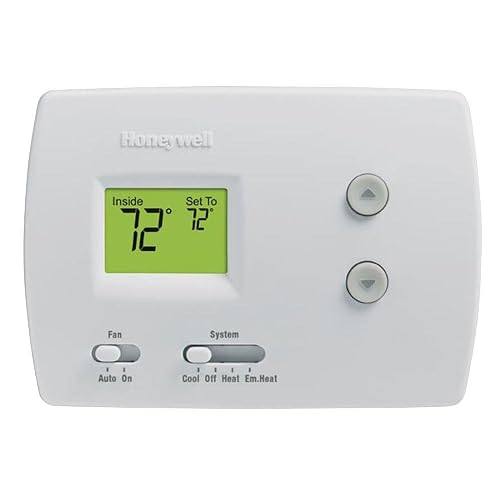
Honeywell RTH3100C1002/E1 Digital Heat Pump Thermostat

Honeywell TH3210D1004 Pro 3000 Thermostat

PRO1 T805 Single Stage Programmable Thermostat
What Each Pick Brings To The Table
The PRO1 T725 is a programmable wall unit designed to handle two-stage heat pump systems on one side and a standard one-heat, one-cool conventional setup on the other, which means it covers a wider range of equipment than most thermostats in this price tier. It belongs to the T700 platform, so the on-screen layout and menu structure will feel familiar to anyone who has installed a PRO1 unit before. A four-square-inch blue backlit display reads clearly across the living room, and the schedule mode shows the four daily periods (wake, leave, return, sleep) most homeowners actually use.
For a household running a heat pump without auxiliary heat strips, the staging logic keeps the compressor from short-cycling, which extends equipment life. Compared with the non-programmable PRO1 T771, this unit gives you weekday and weekend schedules without forcing you to learn a smartphone app.
Where It Excels
- Two-stage heat pump and single-stage conventional support in one unit
- 7-day and 5/1/1 scheduling covers most household routines
- Blue backlit four-square-inch display is easy to read from across a room
- Menu structure on the T700 platform is straightforward for first-time installers
Things To Consider
- Does not work with multi-stage conventional furnaces, so it cannot replace a 2H/2C gas setup
- Requires either a common wire (C-wire) or fresh batteries for consistent power
Who It Suits Best
Homeowners with a 2H/1C heat pump and a guest-room or addition wired to a separate conventional system, who want one wall unit that can manage both.
Consider Something Else When
Your home runs a 2H/2C gas furnace, in which case the PRO1 T715 multi-stage unit fits more naturally.
The PRO1 T771 leans into a specific niche: rooms and outbuildings that need a wider temperature setpoint range than a normal living space. Its setpoint scale runs from 25°F to 90°F, which means a workshop or detached garage can be kept barely above freezing in winter without the thermostat balking at a low reading. The four-square-inch blue backlit display keeps current and target temperatures visible, and swing adjustment helps dial in how far the room has to drift before the system kicks on.
This is a non-programmable model, so the appeal is in its simplicity and its calibration features, not in a smart app or weekly schedule. Where the PRO1 T701 focuses on everyday household comfort, the T771 is built for spaces where you need low-temperature protection without the complexity.
Points In Its Favor
- Setpoint range down to 25°F suits garages, sheds, and unconditioned spaces
- Swing adjustment and calibration controls let you fine-tune the on-off cycle
- Single-stage design keeps wiring simple for DIY installs
- Compact wall footprint, easy to mount in tight spots
Trade Offs
- Non-programmable, so no automatic setback for unoccupied hours
- Limited to single-stage conventional systems, so not a fit for heat pump staging
Built With In Mind
Owners of detached workshops, hobby greenhouses, or converted sheds who want a thermostat that handles sub-freezing setpoints without skipping the call for heat.
Look Elsewhere When
You need a programmable schedule for daily comfort, in which case the PRO1 T725 brings that functionality along with broader system support.
The Honeywell TH2110DV1008 is the Pro 2000 vertical, a Honeywell Home model built for heat-only, cool-only, or heat pump systems that do not use auxiliary heat. Its tall vertical shape is unusual in a category full of squarish wall plates, and that orientation makes the backlit display easy to scan at a glance. You get weekday and weekend programming (5-2 scheduling), plus one-touch access to the setpoint and built-in compressor protection that prevents short-cycling.
Homeowners who want a no-frills Honeywell unit with a clean schedule will find this one refreshingly direct. Unlike the programmable PRO1 T725, it skips 7-day flexibility, but it covers the most common use case for a single homeowner or small household without burying the controls under layers of menus.
What Pays Off
- Vertical layout reads cleanly, even mounted in narrow wall space
- 5-2 programming covers the most common weekday and weekend routines
- Built-in compressor short-cycle protection for heat pump installs
- Backlit display shows both ambient and setpoint temperatures
Honest Caveats
- Not designed for heat pump systems that use auxiliary heat strips, which limits cold-climate use
- No 7-day scheduling, so rotating work shifts may need manual overrides
Right Fit For
Households with a heat pump in a milder climate and no auxiliary strip heat, who want a straightforward Honeywell with weekday and weekend scheduling.
A Better Fit Elsewhere
Anyone in a colder region with backup heat strips should consider the PRO1 T725, which is designed to coordinate both stages.
The PRO1 T701 is a back-to-basics single-stage thermostat built for conventional heating and cooling. The four-square-inch blue backlit display is large enough to read from a couch, and the glow-in-the-dark light button solves the “where is the on switch” problem in a hallway at 2 a.m. It supports gas or electric systems, runs on either batteries or a hardwire common feed, and stays out of the way of everyone who does not want to learn a thermostat.
For a small home or a rental unit where the goal is “set it and forget it,” this is the kind of unit that handles the job without any screen swiping. Compared with the programmable T725, you give up the schedule, but you get a simpler interface that a tenant or a guest can operate without instruction.
Practical Pluses
- Glow-in-the-dark light button makes adjustments easy in dark hallways
- Works with gas, electric, or conventional HVAC systems
- Runs on AA batteries or hardwire, depending on what the wall offers
- Spacious four-square-inch display is easy on aging eyes
Small Caveats
- Non-programmable, so energy-saving setbacks require manual changes
- Limited to single-stage conventional systems, so no heat pump staging
Who Will Love This
Landlords and homeowners outfitting a rental, guest room, or workshop who want a no-learning-curve wall thermostat for a 1H/1C conventional system.
Skip It When
You run a heat pump and want a thermostat that knows how to stage the compressor, in which case the PRO1 T721 is a more direct match.
The PRO1 T715 steps the platform up to 2H/2C multi-stage gas systems, with a thermostat that can be set to 7-day, 5/1/1, or non-programmable mode depending on your preference. The four-square-inch blue backlit display and glow-in-the-dark light button are familiar from the T700 family, and the deeper staging capability means the furnace can run on low fire most of the time and only ramp to high fire on the coldest mornings. That usually translates to quieter operation and more even temperatures across the house.
Compared with the single-stage T701, the T715 coordinates two heating stages and two cooling stages, which is what most two-stage furnaces and AC condensers actually need. For multi-stage installs, using a single-stage stat means losing the efficiency benefits of the second stage.
The Good Stuff
- 2H/2C staging gets the most out of a two-stage gas furnace and AC
- Three programming modes (7-day, 5/1/1, non-programmable) cover any routine
- Glow-in-the-dark light button is useful in low-light hallways
- Blue backlit display is the same room-readable size as the T701
Points To Note
- Programming depth is overkill for a small home with a single-stage system
- Some installers report the menu structure takes a session to learn, so first-timers should set aside time
Made For
Homeowners with a two-stage gas furnace and central AC who want scheduling flexibility and the efficiency gains of low-fire operation.
Another Choice May Suit
You have a simpler single-stage system, in which case the PRO1 T701 keeps the cost down and the learning curve short.
The PRO1 T721 is a non-programmable unit that flips between two-heat, one-cool heat pump mode and one-heat, one-cool conventional mode, which is genuinely useful for households with mixed equipment. The four-square-inch blue backlit screen and the glow-in-the-dark light button are carried over from the broader T700 line, so the experience matches other PRO1 models you might already have elsewhere in the house. It runs on AA batteries or a hardwire feed, and the menu system is shallow enough to navigate without reading the manual cover to cover.
Where the T725 is the programmable version of this concept, the T721 is the simpler cousin that costs less and asks fewer questions. For a vacation home or a first-time thermostat swap, that trade-off is often the right one.
The Upside
- Switches between heat pump and conventional mode without re-wiring
- Glow-in-the-dark light button helps in dark hallways or bedrooms
- Runs on AA batteries or common-wire power, depending on the install
- Shallow menu structure is approachable for first-time installers
Some Limits To Know
- Non-programmable, so no automatic setback for sleep or away hours
- Limited to 2H/1C heat pump staging, so not a fit for multi-stage equipment
Best Suited To
First-time installers and vacation-home owners who want a thermostat that handles either a heat pump or a conventional system without complicated setup.
Reach For A Different Pick When
You need a weekly schedule, in which case the PRO1 T725 adds 7-day and 5/1/1 programming to the same heat pump support.
The Venstar T2800 is a commercial-grade wall thermostat with a feature set aimed at light commercial spaces: offices, storefronts, server rooms, or workshop buildings. It supports three heat stages and two cool stages, plus three configurable outputs, which gives an installer room to wire economizers, ventilation, or auxiliary equipment around the unit. The backlit display, color-coded keys, and green or red LED indicator make the operating state obvious from across a room.
Service indicators on the display remind staff when to change the filter or service a UV light, which is a quiet but valuable feature for buildings that do not have a dedicated maintenance crew. Compared with the residential PRO1 T715, the T2800 brings more stages and more configurability, with the trade-off being a menu structure that takes longer to master.
The Helpful Details
- 3H/2C staging handles light commercial HVAC with room to spare
- Color-coded backlit keys and a red or green status LED read clearly at a distance
- Filter and UV service reminders on the display help maintenance scheduling
- Three configurable outputs let an installer tailor wiring to specific equipment
What To Weigh
- Feature depth is more than a typical homeowner needs for a single-family house
- Initial setup usually takes a session with the installer manual nearby
The Right Fit
Facility managers and small-business owners running a light commercial building with multi-stage equipment who want service reminders and configurable outputs.
Swap It Out When
You are outfitting a single-family home, in which case the PRO1 T715 covers two-stage residential use without the commercial menu.
The Honeywell RTH3100C1002/E1 is dedicated to heat pump operation, which means the wiring and menu are built specifically for a compressor and auxiliary heat strip. It is non-programmable, but it does the heat pump basics well, including backlit display visibility, soft-touch buttons, and mercury-free construction. The compatibility scope is narrow on purpose: heat pumps only, with the assumption that the home’s wiring already supports the auxiliary heat relay.
For a single-stage heat pump in a mild climate, this is a clean, durable choice that avoids the overhead of a multi-stage stat. It does not work with electric baseboard heat, gas backup heat pumps, or multi-stage systems, so the install list is short. If your system is on that list, the simplicity pays off in long-term reliability.
Notable Gains
- Purpose-built for heat pumps, including auxiliary heat coordination
- Backlit display with soft-touch buttons is easy to operate in low light
- Mercury-free construction avoids older thermostat hazards
- Honeywell Home build tends to hold up well in high-traffic hallways
Details To Watch
- Will not work with heat pumps that use a gas backup, electric baseboard, or multi-stage equipment
- Non-programmable, so any setback has to be done by hand
Whose Shelf It Belongs On
Homeowners with a single-stage heat pump in a mild climate, who want a thermostat that stays out of the way and keeps the compressor protected.
Not Your Match When
You need to control a heat pump plus a gas furnace backup, in which case a multi-stage unit like the PRO1 T715 fits more cleanly.
The Honeywell TH3210D1004 is the Pro 3000 line, configured for 2H/1C systems and built for precise temperature management. It maintains comfort within plus or minus one degree Fahrenheit (about half a degree Celsius), which is tighter than most wall stats in this category, and shows both the current room temperature and the setpoint at the same time on its backlit display. The non-programmable design keeps the controls focused on the basics, with a backlit screen that reads in low light.
For households that care more about steady temperature than scheduling, this is a comfortable middle ground. The 2H/1C support covers a two-stage heat pump or a heat pump plus auxiliary heat scenario, depending on the wiring. Compared with the Honeywell RTH3100C, the TH3210D adds the second heat stage for slightly more complex equipment.
What It Does Well
- Half-degree precision keeps room temperature steady in shoulder seasons
- Backlit display shows both current and setpoint temperatures at a glance
- 2H/1C support handles two-stage heat pump or heat pump plus auxiliary
- Honeywell build is widely supported by HVAC service technicians
Where It May Fall Short
- Non-programmable, so no automatic setback for sleeping hours
- No 7-day or 5/1/1 schedule, so daily routines need manual adjustment
Who Should Grab It
Households running a 2H/1C heat pump who value tight temperature control more than a built-in weekly schedule.
Where A Sibling Pick Shines
You want a weekly schedule, in which case the PRO1 T725 covers the same 2H/1C heat pump scope with 7-day and 5/1/1 programmability.
The PRO1 T805 sits on the newer T800 platform, and the headline difference is the seven-square-inch blue backlit display, which is significantly larger than the four-square-inch screens on the T700 series. For anyone who has ever squinted at a wall thermostat from across a room, that extra screen real estate is the whole pitch. It supports 1H/1C conventional systems with 7-day, 5/1/1, or non-programmable modes, so you can pick the level of scheduling that fits your routine.
Conventional only here, so heat pump owners will want to look elsewhere. For a single-stage furnace and AC setup, the T805 brings a bigger display and a more flexible schedule than the PRO1 T701, which keeps things simple but skips the programming.
Well-Handled Touches
- Extra-large seven-square-inch display reads from across a room
- Three programming modes (7-day, 5/1/1, non-programmable) fit any routine
- Glow-in-the-dark light button helps in dark hallways
- T800 platform refresh improves on the older T700 menu structure
What To Weigh
- Limited to single-stage conventional systems, so heat pump installs need a different unit
- Larger display means a larger wall footprint than the T701
Perfect Match For
Households with a single-stage conventional furnace and AC who want a bigger, easier-to-read screen and a flexible weekly schedule.
Where Another Pick Suits Better
You run a heat pump, in which case the PRO1 T721 or T725 brings the staging logic that a heat pump actually needs.
What To Match Up Before You Buy
Picking a thermostat for a heat pump is mostly about matching the stat to the equipment it is controlling. The first question is the number of heating and cooling stages: a single-stage system (1H/1C) needs only one call for heat or cool, while a two-stage system (2H/1C or 2H/2C) can run on low fire most of the time, which is more efficient and usually quieter. Mismatched staging is the single most common reason a heat pump ends up short-cycling or running rough.
The second question is auxiliary heat. Many heat pumps in colder climates include electric strip heat that kicks in when the outdoor temperature drops too low for the compressor alone. A thermostat has to know how to coordinate that auxiliary stage, and not every wall stat on the market is wired for it. If the system has backup heat strips, a heat-pump-rated thermostat with an AUX terminal is the safer pick.
The third question is scheduling. Programmable models (like the PRO1 T725 or T805) offer 7-day or 5/1/1 schedules for households with predictable routines. Non-programmable models (like the PRO1 T701 or T721) keep the controls simple and often cost less, which suits rentals, guest rooms, or homes where the temperature is set once and rarely touched.
Finally, take a look at the C-wire, which is the common wire that delivers continuous 24-volt power to the thermostat. Some heat pump stats need it to run reliably, while others fall back on AA batteries. Pulling the wall plate and counting wires before you buy saves a return trip later.
Picking Through The Details That Matter
The display is the part of a thermostat you interact with every day, so size and backlighting are worth weighing. The PRO1 T805’s seven-square-inch screen is meaningfully larger than the four-square-inch screens common on the T700 family, which matters in a long hallway or a living room with high ceilings. Backlighting helps at night, and a glow-in-the-dark light button (offered on several PRO1 models) means you are not hunting for the on switch with your phone flashlight.
Power source is the other practical detail. Units that run on AA batteries are easier to install in older homes without a common wire, while hardwired thermostats tend to hold time and settings through brief power losses. Either approach works, but the existing wall wiring usually decides the choice for you.
Pitfalls Shoppers Hit
A common mistake is buying a conventional-only thermostat for a heat pump system, which leaves the compressor unprotected and the auxiliary heat unmanaged. The fix is to read the product’s compatibility list before purchase and confirm it covers “2H/1C heat pump” or similar wording if the home runs a heat pump.
Another slip is overspending on a multi-stage thermostat for a single-stage system, which adds menu complexity without any real benefit. A $30 single-stage stat will run a single-stage heat pump just as well as a $90 multi-stage unit, and the simpler interface is easier for guests, tenants, or family members to operate. Match the stat to the system, not the other way around.
Where The Extra Money Goes
Higher-tier thermostats in this category earn their price with broader staging support, more scheduling flexibility, and larger displays. A 2H/2C commercial unit like the Venstar T2800 brings configurable outputs and service reminders that are overkill for a small home but invaluable in a light commercial space. A 7-day programmable with a seven-square-inch display like the PRO1 T805 is worth the upgrade for anyone who reads the thermostat from across the room and wants different temperatures for weekdays and weekends.
The upgrade pays off when the system actually uses the extra capability. For a two-stage gas furnace, a multi-stage stat delivers quieter low-fire operation. For a household with rotating schedules, a 7-day programmable saves the manual override dance. Where the system is single-stage and the routine never changes, the simpler stat is the better deal.
Frequently Asked Questions
Can any programmable thermostat work with a heat pump? No, only thermostats that specifically list heat pump compatibility will manage the compressor, reversing valve, and auxiliary heat stages correctly. Conventional-only stats can short-cycle a compressor, which shortens equipment life.
What is auxiliary heat, and why does the thermostat need to know? Auxiliary heat is the electric strip or backup furnace that kicks in when the heat pump alone cannot keep up in very cold weather. A thermostat with an AUX terminal coordinates when the backup runs, so the home stays warm without running up the energy bill unnecessarily.
Do heat pump thermostats need a C-wire? Many do, but not all. Some models run on AA batteries, which makes them easier to retrofit in older homes without a common wire. Check the product description for power requirements before buying.
Is a non-programmable thermostat a bad choice for a heat pump? Not necessarily. A non-programmable stat can run a heat pump just fine, as long as it is heat-pump compatible. The trade-off is that any setback for sleep or travel has to be done by hand.
How do I know if my heat pump is single-stage or two-stage? Check the indoor air handler label or the outdoor unit model number, which usually lists the stage count in the spec sheet. Your HVAC installer can confirm in a few minutes, and knowing this up front is the key to matching the right thermostat.
Wrap Up
The right thermostat is the one that matches the system already hanging in your mechanical room, the schedule you actually keep, and the wiring in the wall. For a 2H/1C heat pump with backup heat strips, a heat-pump-rated programmable stat like the PRO1 T725 or T721 keeps the staging and the auxiliary heat coordinated. For a single-stage conventional system with a simple routine, the PRO1 T701 or T805 gets the job done without the learning curve. Take a few minutes to confirm the stage count and the C-wire, and any of these ten picks will run the equipment the way it was designed to run.