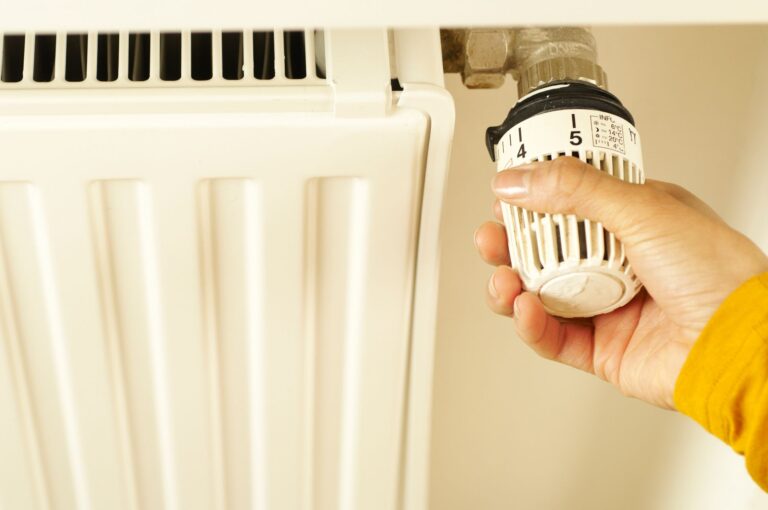

Hunting for a new wall thermostat feels easier than it actually is. Heating systems vary widely, and the wrong match means cycling issues, dead batteries mid-winter, or a screen you can’t read at 6 a.m. This roundup covers ten specific wall thermostats suited to common heating setups, from basic garage units to multi-stage programmable systems. The goal is simple: match your existing equipment to a control that fits the way you actually live, whether that’s a workshop that only sees you on weekends or a family home with a strict weekday routine.
A Fast Comparison Of The Options
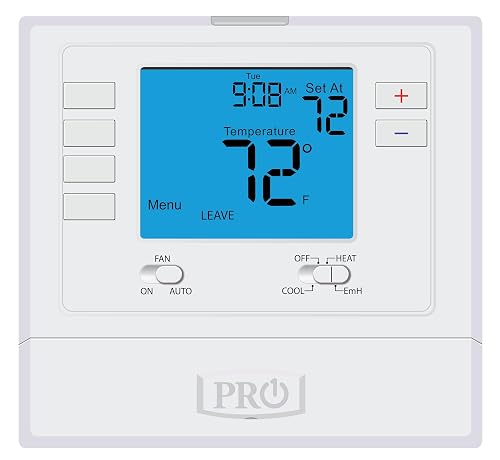
PRO1 T725 Programmable Heat Pump Thermostat (2H/1C)

PRO1 T771 Single Stage Non-Programmable Thermostat
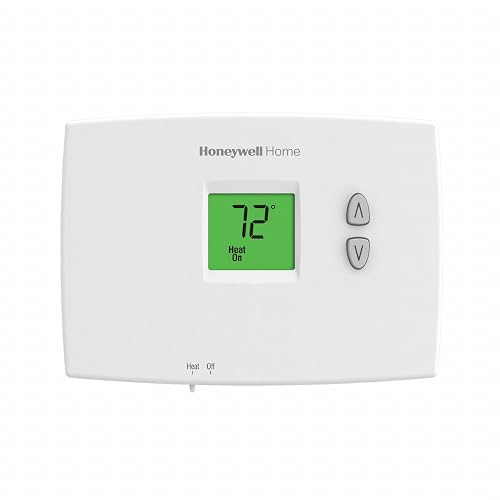
Honeywell TH1100DH1004 PRO 1000 Horizontal Thermostat
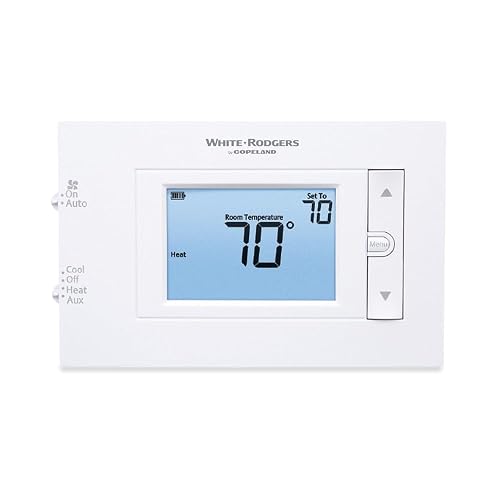
White-Rodgers 1F83H-21NP Heat Pump Thermostat
PRO1 T701 Single Stage Non-Programmable Thermostat

PRO1 T715 Multi-Stage Programmable Gas Thermostat (2H/2C)
PRO1 T721 Non-Programmable Heat Pump Thermostat (2H/1C)
Reliance 9000507-045 Lower Electric Thermostat

White-Rodgers 1E78-144 Single Stage Thermostat

PRO1 T805 Single Stage Programmable Thermostat
The Strengths Of Each Pick
Homeowners with a heat pump system and a backup furnace often struggle to find a single wall control that handles both. The PRO1 T725 addresses that directly, covering 2 heat/1 cool heat pump setups and 1 heat/1 cool conventional setups from one unit. Programming follows a familiar 7-day or 5/1/1 schedule, so weekday mornings can run warmer than weekend afternoons without manual intervention.
The display is a 4 sq. in. blue backlit screen, which is large enough to read across a living room. For anyone replacing an aging builder-grade thermostat, the upgrade here is functional rather than flashy: more accurate setpoint control and clearer schedule labels. It sits comfortably at the top of the list because it handles the most common residential configurations without forcing you into extra staging equipment.
A Few Highlights
- Supports both heat pump and conventional systems from a single wall unit
- 7-day or 5/1/1 programming fits predictable family schedules
- Backlit 4 sq. in. display remains readable in dim hallways
- Common four-stage configuration covers most U.S. residential HVAC setups
- Schedule labels like wake, leave, return, and sleep reduce guesswork
Points To Keep In Mind
- Not designed for multi-stage gas furnace homes, which limits some upgrades
- Programming setup can take an hour for first-time users building a weekly schedule
Quick Facts
Whose Home It Belongs In
Households running a heat pump with conventional backup who want one thermostat instead of two separate controls.
Look Elsewhere When
You have a two-stage gas furnace, in which case the PRO1 T715 Multi-Stage Programmable Gas Thermostat (2H/2C) is the closer match.
Detached garages, sheds, and workshops often need a thermostat that reaches lower temperatures than a typical living room model. The PRO1 T771 covers a setpoint range from 25°F to 90°F, which is unusually wide for a residential unit. That lower limit matters for spaces where pipes or stored materials benefit from staying just above freezing without cycling on and off constantly.
The non-programmable design is a deliberate choice here. Most workshop owners don’t need a weekly schedule; they want a knob-style simplicity that turns the heater on and holds the temperature. A 4 sq. in. blue backlit display handles the reading, and swing adjustment plus calibration controls let you fine-tune cycling behavior to match a garage heater’s response.
Bright Spots
- Setpoint range down to 25°F suits unconditioned spaces
- Non-programmable interface keeps operation to the basics
- Backlit display readable in low-light workshops
Things To Consider
- Limited to single-stage conventional systems, so heat pump homes should look elsewhere
- No scheduling means less overnight setback potential for primary living spaces
Made For
Garage, shed, and workshop owners who need cold-tolerant setpoint control without a learning curve.
Skip It When
You want a 7-day programmable schedule in a primary living area, where the Honeywell TH1100DH1004 PRO 1000 Horizontal Thermostat handles basic heat-only setups more typically.
Heat-only homes get a quieter thermostat market than full HVAC systems, and the Honeywell TH1100DH1004 PRO 1000 lands squarely in that lane. The horizontal layout, dual-power design, and backlit display make it feel like a purpose-built control for baseboard or single-stage furnace applications. For a small home or a single-zone setup, the straightforward digital readout removes the guesswork of an old mercury dial.
You give up programmability, which for many heat-only owners is fine. The temperature scale is adjustable, so a garage version can read 35 to 90°F while a living room version can stay at 40 to 90°F. That adjustability is one of the more useful features for anyone retrofitting the unit into a new space. Compared to the PRO1 T771 above, this one is more of a residential living-area pick than a workshop option.
Practical Pluses
- Dual-power design supports both battery and hardwire configurations
- Adjustable temperature scale adapts to garage or living-area use
- Backlit display stays readable in varied lighting
Honest Caveats
- No scheduling features, so you adjust manually rather than letting the unit run a weekly plan
- Limited to heat-only systems, so cooling homes need a different model
Right Fit For
Single-stage heat-only households and baseboard electric homeowners who want simple backlit control.
Reach For A Different Pick When
You need cold-climate setpoint control in a detached space, where the PRO1 T771 Single Stage Non-Programmable Thermostat’s lower range is more useful.
Replacing a heat pump thermostat often means working around a wall box that isn’t quite square, and the White-Rodgers 1F83H-21NP comes with a built-in level to address that exact frustration. The 80 Series has been around long enough that installers tend to trust it, and the backlit display reads clearly whether the unit is in a hallway or a basement mechanical room.
Like the PRO1 T725 covered earlier, this is a heat pump-compatible model, but the feature set is simpler. There’s no weekly programming, which keeps the menu shallow. For a heat pump home that wants a reliable, non-programmable control, the 1F83H-21NP is a focused tool. The trade-off shows up the moment you want a setback schedule, in which case the PRO1 T725 is the more capable pick.
Where It Helps
- Built-in level supports clean, square wall mounting
- Backlit display handles low-light basements and utility rooms
- Heat pump compatibility covers most ducted heat pump installations
Worth Bearing In Mind
- No programming means manual setpoint changes for sleep and away periods
- Installation still requires basic wiring familiarity; you may want an electrician for unfamiliar thermostats
Key Specs
Best Suited To
DIY-friendly homeowners replacing an aging heat pump thermostat who want a leveled, no-schedule wall unit.
Swap It Out When
You want weekly programming, in which case the PRO1 T725 Programmable Heat Pump Thermostat (2H/1C) brings 7-day scheduling to the same system type.
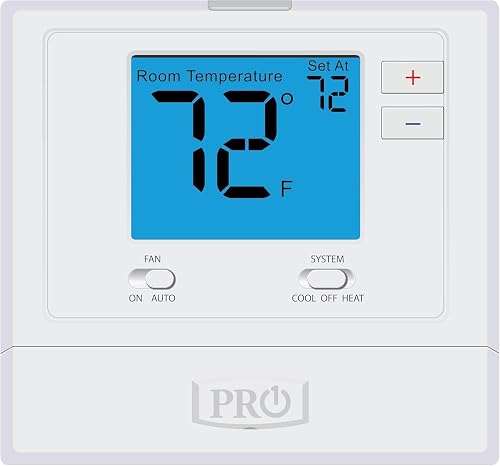
The PRO1 T701 sits on the larger T700 platform, which means the screen is more generous than the average non-programmable wall thermostat. A glow-in-the-dark light button helps when you’re fumbling for the controls in a dark hallway at 5 a.m., and the backlit display stays readable across the room. For a conventional 1H/1C system, this covers the common residential baseline without adding scheduling complexity.
It’s worth comparing this to the Honeywell TH1100DH1004 PRO 1000 covered earlier. The Honeywell is heat-only and horizontal; the T701 is a vertical 1H/1C unit with both heating and cooling support. For homeowners with a furnace and central air who don’t want to program a weekly schedule, the T701 handles both from a familiar wall-mount form factor.
Strong Points
- Glow-in-the-dark light button for nighttime visibility
- 4 sq. in. blue backlit display is generous for a non-programmable unit
- Supports both gas and electric conventional systems
Small Caveats
- No 7-day scheduling, so overnight setbacks require manual changes
- Limited to single-stage systems, so multi-stage homes need a different model
Who It Suits Best
Conventional gas or electric homeowners who want a larger, easier-to-read wall thermostat without programming menus.
Consider Something Else When
You have a two-stage gas furnace, where the PRO1 T715 Multi-Stage Programmable Gas Thermostat (2H/2C) handles the extra stages properly.
Two-stage gas furnaces need a thermostat that talks back at the same level, and the PRO1 T715 is built for that role. The 2H/2C staging capability allows the furnace to run at a lower output on milder days, which often means quieter operation and more even temperatures. Programming options include 7-day, 5/1/1, or non-programmable, so the unit can grow with your routine.
The T700 platform here carries a 4 sq. in. blue backlit display and the same glow-in-the-dark light button as the T701 above. Power can come from AA batteries or a hardwire connection, which gives you flexibility if the existing wall only carries two wires. For households stepping up from a single-stage control, this is the natural upgrade path.
What Makes Sense
- 2H/2C staging supports two-stage gas furnace systems
- Flexible programming modes (7-day, 5/1/1, or non-programmable)
- AA battery or hardwire power options simplify retrofits
Trade-Offs To Consider
- Staging benefits only show up on systems that actually have multiple stages
- Programming setup takes longer for households building a weekly plan from scratch
Feature Snapshot
Perfect Match For
Homeowners with a two-stage gas furnace who want a programmable wall control that takes advantage of the staging.
Not Your Match When
You run a single-stage system, in which case the PRO1 T701 Single Stage Non-Programmable Thermostat is a simpler, less expensive fit.
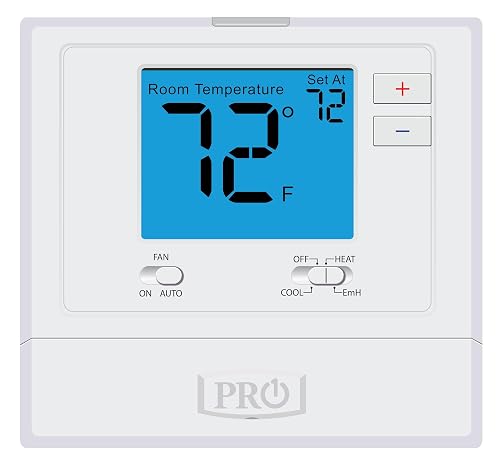
Some households have a mix of heating equipment depending on the addition or zone, and the PRO1 T721 handles both 2H/1C heat pump and 1H/1C conventional systems from one wall unit. Like the other T700-series models, the display is a 4 sq. in. blue backlit panel paired with a glow-in-the-dark light button, which is genuinely useful in a hallway at night.
It is the non-programmable sibling to the T725 reviewed earlier. The trade-off is intentional: less menu diving in exchange for fewer scheduling options. For a guest room, a finished basement, or a second home that doesn’t need weekly programming, the T721 covers the same equipment family without the learning curve.
Positive Takeaways
- Supports both heat pump and conventional system wiring
- Glow-in-the-dark light button improves nighttime usability
- T700 platform display is larger than most non-programmable alternatives
Less Ideal Details
- No 7-day scheduling, so primary living areas may want a programmable model
- Common 2H/1C configuration is more limited than the T725’s options
Who Will Love This
Homeowners with mixed heating equipment in secondary spaces who want one non-programmable control that fits either system.
A Better Fit Elsewhere
Your main living area needs weekly programming, where the PRO1 T725 Programmable Heat Pump Thermostat (2H/1C) brings 7-day scheduling to the same system family.
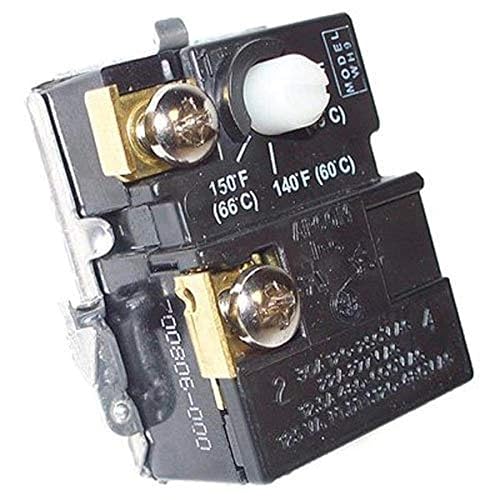
The Reliance 9000507-045 sits in a different category than the wall thermostats above. It is a direct-fit replacement thermostat for electric water heaters, designed to mount to the lower element of a dual-element tank. When a water heater thermostat fails, the symptom is usually lukewarm or scalding water, and this part restores normal cycling without replacing the entire tank.
Installation is mechanical: power off, access the lower panel, swap the unit, and reset. For homeowners comfortable with basic electrical work, this is a focused replacement part rather than a lifestyle upgrade. Compared to the wall thermostats in this roundup, it serves a completely different function, so it lands here as a specialty utility pick.
Advantages To Know
- Direct-fit for electric water heater lower element positions
- Restores normal water temperature without full tank replacement
- Mechanical design suited to long service in utility spaces
Factors To Consider
- Requires working inside a live appliance, so non-DIYers should call a plumber or electrician
- Not interchangeable with the wall thermostats elsewhere in this roundup
Built With In Mind
Homeowners diagnosing lukewarm water in an electric water heater who need a direct replacement thermostat for the lower element.
Where Another Pick Suits Better
You need wall temperature control, in which case any of the wall thermostats above fits that brief more directly.
Older homes sometimes run on millivolt heating systems, and not every modern thermostat is rated for that low-voltage setup. The White-Rodgers 1E78-144 covers both 24-volt and millivolt systems, which is a meaningful compatibility point. For a wall furnace or a floor furnace in a vintage home, that dual rating removes the guesswork at install time.
The non-programmable design and backlit display keep the interface shallow. It is compatible with single-stage heating, cooling, and heat pump systems (without auxiliary heat), which gives it some flexibility across different households. Compared to the Honeywell TH1100DH1004 covered earlier, this one trades heat-only simplicity for cooling support and millivolt compatibility.
Positive Points
- Works with both 24V and millivolt heating systems
- Backlit display handles low-light hallways
- Supports single-stage heating, cooling, and heat pump (without aux) systems
Some Limits To Know
- Not compatible with electric baseboard heat, which limits some retrofit situations
- No programming means manual setpoint changes for sleeping and away hours
Feature Card
The Right Fit
Owners of older homes with millivolt or 24V single-stage systems who need a backlit, no-schedule control.
Not Your Match When
You have electric baseboard heat, in which case a model specifically rated for line-voltage baseboard control is required.
The PRO1 T805 lands at the end of this roundup with the largest display in the lineup, a 7 sq. in. blue backlit screen on the T800 platform. For households that read the thermostat from across a large room or struggle with smaller digits, that extra screen real estate makes a noticeable difference. Programming options include 7-day, 5/1/1, or non-programmable, so the unit adapts to a flexible routine.
Compatibility covers conventional 1H/1C systems. The glow-in-the-dark light button is a useful touch for late-night adjustments, similar to the smaller T700-series models. Compared to the T725 reviewed earlier, this is a conventional-only unit with a larger display, which makes it the better pick for living areas where the screen is the priority.
Useful Strengths
- 7 sq. in. display is the largest in this roundup
- Flexible programming (7-day, 5/1/1, or non-programmable)
- Glow-in-the-dark light button supports late-night visibility
Where It Is Less Suited
- Larger footprint may not match shallow retrofit wall boxes
- Conventional-only, so heat pump homes need a different model
Spec Overview
Who Should Grab It
Conventional-system homeowners who want a generous display and full programming flexibility in a single wall control.
Look Elsewhere When
You run a heat pump, in which case the PRO1 T725 Programmable Heat Pump Thermostat (2H/1C) is the better match for the equipment.
What Matters Most Before Choosing Thermostats For Heaters
A thermostat is only as good as the system it talks to, and matching the equipment comes first. Look at the wiring label inside the HVAC panel or the manual for your furnace, heat pump, or boiler. The number of heating and cooling stages dictates whether a single-stage, multi-stage, or heat-pump-rated model is the right fit. Picking a thermostat with too few stages for the equipment means the control never gets to use the full range the system was designed to deliver.
Power source is the second practical filter. Many modern thermostats run on AA batteries or 24-volt hardwire. Battery-only models are easier to install in retrofits where the existing wiring only carries two conductors. Hardwire models, on the other hand, often provide steadier power and can support additional features without worrying about a dead battery in midwinter.
Programmability shapes the daily experience. A 7-day schedule lets you set a different routine for weekdays and weekends, which is useful in a family home. Non-programmable models keep the menu shallow and the price lower, which is often the better fit for a workshop, guest room, or second home. The right answer depends on how predictable your routine is and whether you’d actually program the schedule after install.
The user interface matters more than people expect. A backlit display, a glow-in-the-dark light button, and readable digits make late-night adjustments less frustrating. If you read the thermostat from across a large living room, a 7 sq. in. display may be worth prioritizing. If you read it from inches away in a dim hallway, a glow-in-the-dark button saves fumbling in the dark.
Key Considerations Across These Picks
Common Buying Mistakes
A frequent slip is choosing by feature count instead of system compatibility. A 7-day programmable model does nothing for a single-stage furnace that already cycles correctly, and a multi-stage thermostat underperforms on a single-stage system. Read the equipment label first, then narrow the field.
Another common miss is ignoring voltage. Millivolt floor furnaces, 24V systems, and line-voltage electric baseboards each require different thermostat classes. The wrong match at install time can mean the system never powers on, or worse, an electrical issue. Confirming the voltage before ordering saves a return trip.
Where The Extra Money Goes
A higher-tier model usually buys two things: more accurate temperature control and more flexible scheduling. Multi-stage thermostats modulate furnace output for quieter operation and more even temperatures, which is genuinely noticeable in colder climates.
Larger displays, glow-in-the-dark buttons, and dual-power options are the smaller upgrades that show up in daily use. They don’t change how the system runs, but they make the control easier to live with, especially in homes where the thermostat is read often and from a distance.
Frequently Asked Questions
What is a heat pump thermostat, and how is it different from a standard thermostat?
A heat pump thermostat is designed to control systems that move heat rather than generate it, including backup heat strips for cold weather. Standard thermostats may lack the staging logic a heat pump needs to switch between compressor and auxiliary heat efficiently.
Can a programmable thermostat save money on heating?
Programmable thermostats support setbacks that lower the setpoint when you’re asleep or away, which can reduce run time. The actual savings depend on your climate, schedule, and how consistently you use the schedule.
Do I need a C-wire for a digital wall thermostat?
Many digital wall thermostats require a common wire (C-wire) to provide continuous power from the HVAC system. Some models use AA batteries or power-stealing adapters as alternatives, which is useful in older homes with limited wiring.
What does non-programmable mean for a thermostat?
A non-programmable thermostat holds the setpoint you set until you change it manually. It does not run a weekly schedule, so any overnight or away setback has to be adjusted by hand.
Is a heat-only thermostat different from a heat/cool thermostat?
Heat-only thermostats control heating equipment without cooling, which suits baseboard electric, boilers, and some furnaces. Heat/cool models add cooling staging, which is necessary for central air, heat pumps, and dual-fuel systems.
Closing Remarks
The right thermostat comes down to your existing equipment, your routine, and the size of the display you actually want to read. Match the system first, decide on programmability second, and pick a screen you’ll be comfortable checking at 6 a.m. Once those three boxes are checked, the choice between the models above usually makes itself.