

A non-programmable thermostat strips temperature control down to one job: hold the room where you set it. No scheduling menus, no app logins, no learning curve. For a guesthouse, garage workshop, rental unit, or a household that simply prefers a wall dial over a phone screen, that simplicity is the whole point. The picks below cover single-stage conventional systems, heat pump setups, and a dedicated floor-heating control, so you can match the thermostat to the equipment already on the wall.
An Overview Of The Picks
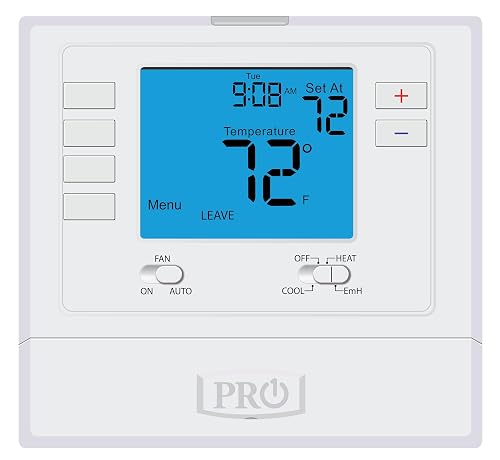
PRO1 T725 Heat Pump/Conventional Programmable Wall Thermostat

PRO1 T771 Single Stage Non-Programmable Wall Thermostat
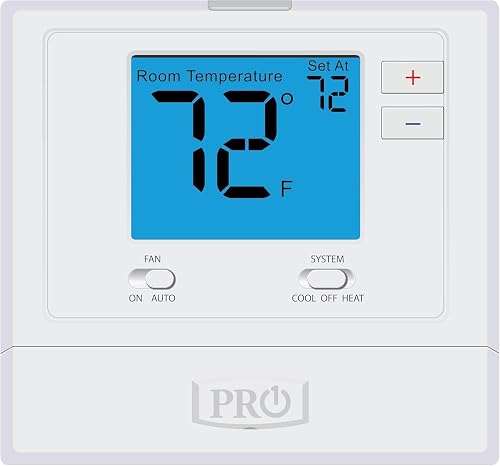
PRO1 T701 Single Stage Non-Programmable Wall Thermostat

PRO1 T715 Multi-Stage Programmable Gas Wall Thermostat
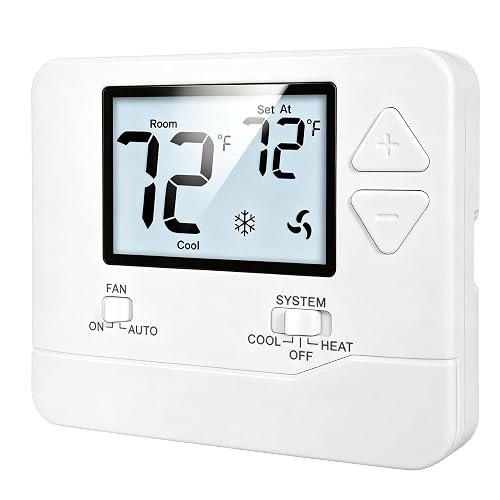
Heagstat Non-Programmable Thermostat 1 Heat/1 Cool
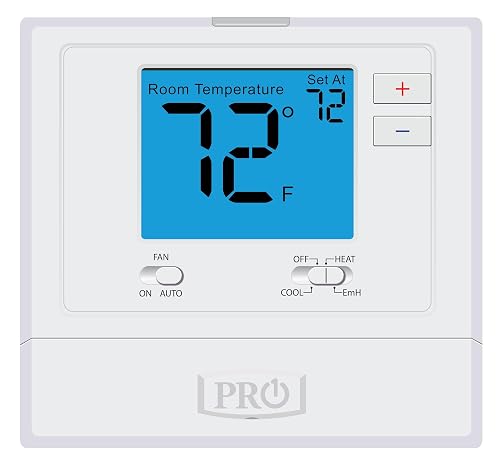
PRO1 T721 Non-Programmable Wall Thermostat

OJ Microline UTN4 Radiant Floor Heat Thermostat with GFCI

PRO1 T805 Single Stage Programmable Wall Thermostat
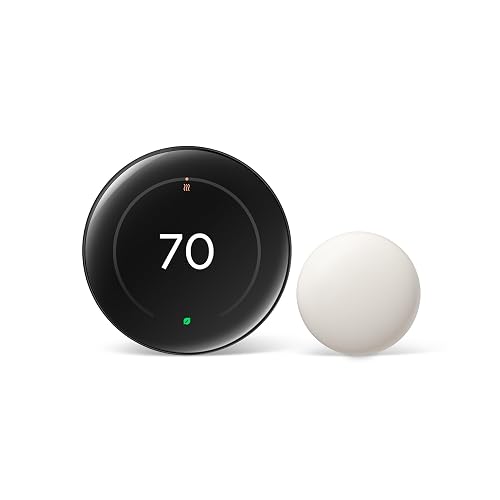
Google Nest Learning Thermostat 4th Gen with Temperature Sensor, Obsidian
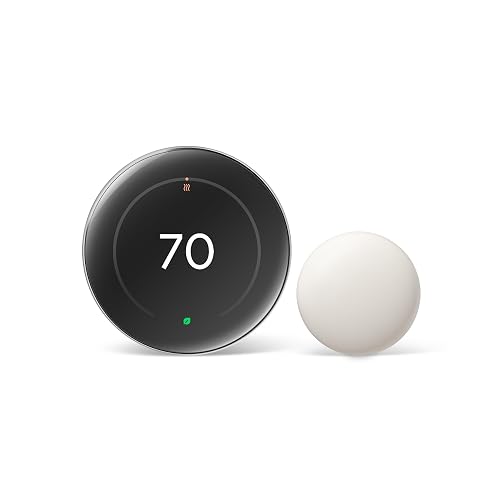
Google Nest Learning Thermostat 4th Gen with Temperature Sensor, Silver
Heat pump homes tend to live in a different wiring world than a basic furnace-and-air setup, and the PRO1 T725 sits comfortably across both. A 4-square-inch blue backlit screen gives you the room temperature, setpoint, and current system mode at a glance, while the schedule engine accepts 7-day or 5/1/1 programs (a five-day weekday block plus Saturday and Sunday). For most households, the screen is large enough to read across a room without squinting, which matters more than spec sheets suggest.
It covers 2 heat/1 cool heat pump configurations and 1 heat/1 cool conventional systems, so the same wall box can stay put through an equipment swap. The T700 platform underneath keeps the menu logic familiar if you’ve owned a PRO1 unit before. Compared with the simpler PRO1 T701 covered later, this model is the upgrade path when your home runs a heat pump rather than a standalone furnace.
What Makes Sense
- Works with both 2H/1C heat pump and 1H/1C conventional wiring, which protects you from buying the wrong model during a system change.
- 7-day and 5/1/1 scheduling options cover most weekly routines without forcing a strict template.
- The 4-square-inch backlit display is readable from across a living room in low light.
- Sits on the T700 platform, a known, broadly documented hardware family.
Things To Consider
- Heat pump compatibility is only 2H/1C, so three-stage heat pump homes will need a different model.
- It is programmable, not strictly non-programmable, so you may find more menu depth than you want for a guesthouse or workshop.
- Installation typically benefits from a C-wire (common wire) for steady power, which older homes sometimes lack.
Who Will Love This
Homeowners with a 2H/1C heat pump or a standard conventional system who want scheduling flexibility and a wall-mounted, app-free experience.
Look Elsewhere When
You run a strictly single-stage conventional furnace and want a simpler, non-programmable wall unit, in which case the PRO1 T701 is a closer match.
Most wall thermostats assume a comfortable indoor range, but the PRO1 T771 stretches the setpoint scale from 25°F up to 90°F. That wider window makes it a natural fit for spaces that run colder or warmer than a living room, such as detached garages, storage sheds, workshops, and unconditioned basements. In our view, that flexibility is the real reason to pick this model over a tighter-range competitor.
It is a non-programmable single-stage unit built for 1 heat/1 cool conventional systems, with swing adjustment and calibration controls hidden behind the front panel. The 4-square-inch blue backlit display is shared with the T701 and T721, so the on-wall look stays consistent across the family. Owners commonly appreciate the simple up-and-down temperature keys, which keep operation honest and unconfusing for visiting relatives or tenants.
Practical Advantages
- Setpoint range covers 25°F to 90°F, which suits low-temperature spaces where a standard thermostat would bottom out.
- Single-stage design keeps wiring straightforward for 1H/1C conventional systems.
- Swing adjustment and calibration controls allow fine-tuning without calling a technician.
- Shared T700 platform layout with the T701 and T721 means a familiar feel if you already own a PRO1 unit.
Worth Noting
- The wider setpoint range is specialized; for a typical conditioned home, the lower end of the scale is irrelevant.
- It is non-programmable, so there is no automatic setback (a feature that lowers temperature automatically when you’re away or asleep) for energy savings overnight.
Feature Snapshot
Made For
Garage, shed, and workshop owners who need a wall thermostat that can hold unusually low temperatures without complaint.
Where Another Pick Suits Better
Main living spaces with a normal comfort range are better served by the PRO1 T701, which has a more typical setpoint scale.
The PRO1 T701 is the kind of thermostat you mount once and stop thinking about. Designed for 1 heat/1 cool conventional systems, it strips the wall experience down to a clear temperature readout and an up/down setpoint, with no scheduling layers between you and the room. For most households, that is exactly the point.
A 4-square-inch blue backlit display shows the relevant numbers from across a room, and a glow-in-the-dark light button makes the controls easy to find on a midnight hallway pass. The T700 platform under the hood supports either battery or hard-wired power, which gives you a fallback when a C-wire is missing. Against the T721 reviewed below, the T701 is the simpler sibling with a more limited system target.
The Practical Payoff
- Non-programmable operation means no menu navigation for guests, kids, or tenants.
- Glow-in-the-dark light button helps you locate the controls in a dark hallway.
- 4-square-inch backlit display is generous for a non-programmable unit.
- Battery or hard-wired power support simplifies older homes without a C-wire.
Trade Offs
- Limited to 1H/1C conventional systems, so heat pump homes need the T721 or T725 instead.
- No scheduling means no automatic setback, so you must adjust the setpoint manually when leaving.
Right Fit For
Renters, second homes, and anyone who wants a wall dial that does one job without menu layers.
Skip It When
Your home runs a heat pump, in which case the PRO1 T721 brings the same simple wall interface to 2H/1C heat pump wiring.
Two-stage gas systems benefit from a thermostat that knows the difference between a gentle ramp-up and a full-burner call for heat. The PRO1 T715 targets exactly that hardware, supporting 2 heat/2 cool gas systems with 7-day, 5/1/1, or non-programmable modes depending on how much scheduling you want. For larger homes with multi-stage equipment, this unit keeps the wall experience straightforward.
The 4-square-inch blue backlit display and glow-in-the-dark light button match the rest of the T700 family, so it feels familiar if you’ve handled the T701 or T721. Battery or hard-wired power options make the install more forgiving in older homes. Compared with the single-stage T701, the T715 is the right step up only when your furnace actually has two heat stages.
Benefits That Matter
- Supports 2 heat/2 cool systems, which is the standard for multi-stage gas furnaces and matched AC condensers.
- Three operating modes (7-day, 5/1/1, or non-programmable) let you disable scheduling entirely if you prefer.
- Shared T700 platform with the T701 and T721 keeps the menu layout familiar.
- Backlit display and glow-in-the-dark button help in dark hallways.
Points To Note
- It is programmable, not strictly non-programmable, so non-programmable shoppers may find the menu depth more than they need.
- Multi-stage compatibility is wasted on single-stage furnaces; the T701 is a more honest match there.
Technical Highlights
Best Suited To
Homeowners with a 2H/2C gas furnace and air conditioning setup who want the option to schedule without being forced into it.
Another Choice May Suit
Single-stage homes will get more honest value from the PRO1 T701, since the T715’s multi-stage support goes unused.
The Heagstat lands in that “replace the old one and move on” category. Built for 24VAC conventional single-stage 1H/1C forced-air systems, it works with gas, oil, and electric furnaces paired with an independent outdoor AC condenser and complete indoor ductwork. You may find it a relief if you simply need the room temperature back under your control without touching a phone.
A white backlight illuminates the display when you press the light button, which is a small but welcome touch during a midnight furnace cycle. The mounting base accepts 2 to 5 wires, and 6 to 8 wire systems are not a fit, so the install is best suited to simpler legacy setups. Compared with the PRO1 T701, this unit is the lower-cost option aimed at replacement jobs rather than whole-home upgrades.
Strengths Worth Knowing
- Compatible with gas, oil, and electric furnaces for broad single-stage coverage.
- White backlight keeps the display readable in low light.
- 2 to 5 wire base simplifies replacement in older homes.
- Non-programmable interface keeps the wall experience direct.
Honest Caveats
- It is not compatible with heat pump systems, so heat pump homes need a different model such as the PRO1 T721.
- Wiring setups with 6 to 8 conductors do not match the base, which can rule out some newer installations.
- Lower-cost construction may show wear sooner in high-traffic hallways, depending on use.
Perfect Match For
Homeowners replacing a worn-out single-stage thermostat in a 2 to 5 wire setup who want a simple, no-frills wall unit.
A Better Fit Elsewhere
Heat pump households should look at the PRO1 T721, which is built for 2H/1C heat pump wiring.
Some homes straddle the line between heat pump and conventional wiring, especially after a partial equipment upgrade. The PRO1 T721 covers both 2H/1C heat pump and 1H/1C conventional configurations on the same wall plate, which is a quiet form of insurance if you aren’t sure which system is on the other side of the drywall. For most owners, that flexibility is the headline feature.
You get the same 4-square-inch blue backlit display and glow-in-the-dark light button found on the T701 and T771, keeping the look consistent across rooms. Power options include AA batteries or a hard-wired connection, which helps in older homes without a dedicated C-wire. Against the T725 covered earlier, the T721 is the non-programmable version of the same dual-system family.
Advantages To Know
- Works with both 2H/1C heat pump and 1H/1C conventional systems on a single wall unit.
- Non-programmable operation keeps the menu shallow and direct.
- Shared T700 display and glow-in-the-dark button for low-light readability.
- Battery or hard-wired power support broadens installation options.
Small Caveats
- It is non-programmable, so any setback must be done manually.
- Dual-system compatibility can be overkill for a home that only runs one equipment type, in which case the T701 or T771 is more focused.
Who Should Grab It
Homeowners with mixed or uncertain equipment history who want one wall thermostat that can handle either wiring layout.
Swap It Out When
You know your system is single-stage conventional, in which case the PRO1 T701 is a simpler, more direct match.
Radiant floor heating lives in its own category, and a standard wall thermostat will not talk to it properly. The OJ Microline UTN4 is built specifically for electric radiant systems under tile, carpet, stone, laminate, and engineered wood, with a built-in Class A GFCI (Ground Fault Circuit Interrupter, a safety device that cuts power if it detects current leaking through water or a person) that is required for underfloor heating. You may find that the included floor sensor and dual-sensing design make this unit a fit for bathrooms and basements where the floor is the room’s primary heat source.
It accepts 120/240V input, which covers the most common North American radiant mat voltages, and the non-programmable interface keeps the wall control to setpoint and sensor mode. A 3-year warranty and USA product support back the install. Compared with the other entries here, this one is the only pick that targets radiant floor heating rather than forced-air HVAC.
Points In Its Favor
- Built-in Class A GFCI is a code requirement for underfloor heating, removing a separate breaker step.
- Dual sensing reads both ambient air and floor temperature, which helps protect wood and laminate surfaces.
- 120/240V compatibility covers most residential radiant mat installations.
- Includes a floor sensor in the box, so you do not need to source a separate probe.
Less Ideal Details
- It is purpose-built for electric radiant floors and will not operate a standard forced-air furnace or heat pump.
- Non-programmable operation means no automatic floor setback, which some homeowners prefer for energy savings.
- Sensor replacement and GFCI testing are part of long-term ownership on any floor-heat thermostat.
Built With In Mind
Homeowners with electric radiant floor heating in a bathroom, kitchen, or basement who want a wall thermostat with a GFCI built in.
Reach For A Different Pick When
Your home uses forced-air heating and cooling, in which case the PRO1 T701 or T721 is the right tool for the job.
Some wall thermostats ask you to lean in to read the temperature. The PRO1 T805 takes the opposite approach with a 7-square-inch blue backlit display, which is generous even by smart-thermostat standards. For aging-in-place households or anyone reading from across a larger room, that screen real estate is the whole story.
It runs on the T800 platform and supports 1H/1C conventional systems with 7-day, 5/1/1, or non-programmable operating modes. The glow-in-the-dark light button matches the rest of the PRO1 lineup, keeping the visual language consistent. Against the T701, the T805 is the larger, more readable sibling when screen size matters more than system complexity.
Bright Spots
- 7-square-inch display is the largest in the lineup, making it easy to read from a distance.
- Three operating modes (7-day, 5/1/1, non-programmable) let you match the thermostat to your routine.
- Glow-in-the-dark light button helps in a dark hallway.
- T800 platform provides a modern interface layer over conventional wiring.
Where It May Fall Short
- Limited to 1H/1C conventional systems, so multi-stage or heat pump homes need a different model.
- The larger display takes more wall space than the T701’s 4-square-inch screen.
Product Snapshot
Whose Shelf It Belongs On
Households where a large, readable wall display matters more than menu depth, especially in living areas used by older adults.
Consider Something Else When
You prefer a more compact wall footprint, in which case the PRO1 T701 keeps the same 1H/1C compatibility in a smaller box.
The Nest Learning Thermostat (4th gen) sits at the opposite end of the spectrum from the simple wall dials above, and that is by design. Instead of asking you to set a schedule, it observes your manual adjustments over the first week or two and builds a temperature routine around them. For most tech-comfortable households, that learning behavior is the headline feature.
The package includes a 2nd-generation Nest Temperature Sensor, which lets the system read temperatures in another room and balance the system around where you actually spend time. The Obsidian finish gives the wall plate a darker, more dramatic look than the silver variant covered next. Compared with the PRO1 T725, the Nest is a leap into app-based control and energy reporting rather than a strictly wall-mounted experience.
The Upside
- Learning engine builds a schedule from your manual adjustments, so you avoid programming menus.
- Included 2nd-generation Temperature Sensor helps manage hot and cold spots in larger homes.
- Obsidian finish gives a distinctive, modern look on the wall.
- Connects to a broader smart home ecosystem for remote control and energy history.
Worth Bearing In Mind
- It is the most expensive pick on the list by a wide margin, so the value case is weaker for simple replacement jobs.
- App-dependent features mean a less direct experience for households that want a wall-only thermostat.
- It is not strictly non-programmable, since the schedule is algorithm-driven rather than user-set.
Perfect Match For
Smart-home households that want the thermostat to handle scheduling automatically and value remote app control.
Look Elsewhere When
You specifically want a no-menu, app-free wall experience, in which case the PRO1 T701 or T771 is a closer fit.
The Silver variant of the Nest Learning Thermostat (4th gen) carries the same internals as the Obsidian version above, with a lighter metallic finish that blends into more traditional interiors. The package still includes a 2nd-generation Nest Temperature Sensor, so the multi-room balancing benefit carries over unchanged. You may find this finish easier to coordinate with white trim or stainless hardware.
The learning behavior, app control, and energy reporting are identical to the Obsidian model, so the choice is purely cosmetic. For most owners, the silver plate reads as a quieter wall presence. Against the rest of the list, this pick still sits in the premium, app-driven camp rather than the simple non-programmable wall dial category.
A Few Strong Suits
- Same learning engine and app ecosystem as the Obsidian variant, with no functional compromise.
- Silver finish integrates with a wider range of interior palettes.
- Included 2nd-generation Temperature Sensor helps manage temperature swings across rooms.
Small Limitations
- Premium pricing applies here just as it does to the Obsidian variant.
- App-driven features and a learning algorithm make it a poor match for households that want a strictly wall-only interface.
Who Will Love This
Homeowners who want the Nest learning experience with a lighter wall finish that suits traditional or transitional interiors.
Not Your Match When
You prefer a no-app, no-menu wall thermostat, in which case the PRO1 T701 or T771 is the right tool.
## What Matters Most Before Choosing Thermostats Non ProgrammablesMatch The System, Not The Brochure
The single most important step is matching the thermostat to the equipment on the wall. Conventional furnaces and air conditioners run on a 1H/1C or 2H/2C layout, while heat pumps add a reversing valve to the wiring. A 1H/1C conventional thermostat on a 2H/1C heat pump will not behave correctly, and the inverse wastes a feature. The PRO1 T701, T771, and Heagstat cover 1H/1C conventional setups, the T721 and T725 add heat pump support, and the T715 stretches into 2H/2C gas systems.
For specialty systems, the choice narrows quickly. Electric radiant floor heating needs a thermostat with a floor sensor and built-in GFCI protection, which is why the OJ Microline UTN4 stands alone in that niche. Confirming the wire count on the existing base before buying can save a return trip, since 2 to 5 wire systems are a different install from 6 to 8 wire layouts.
Consider Who Will Use It
Households with kids, frequent guests, or short-term tenants often benefit from a strictly non-programmable wall interface, since fewer controls means fewer misadjustments. Rentals lean the same way, since a non-programmable unit is harder to leave in an odd state. The T701 and T771 are strong fits here, with the T771’s wider setpoint range making it more flexible for unusual spaces.
For households that want some scheduling without diving into menus, the T715 and T805 add 7-day or 5/1/1 modes that you can simply leave disabled. Aging-in-place households benefit from larger displays, where the T805’s 7-square-inch screen is the easiest read in the lineup.
Look At Display And Light Details
A thermostat you cannot read at a glance will frustrate you, so the screen size and backlight matter more than spec sheets imply. The PRO1 T701, T715, T721, and T771 share a 4-square-inch blue backlit display with a glow-in-the-dark light button, which is plenty for most living areas. The T805’s 7-square-inch screen is the upgrade when reading distance is a concern.
Power source is the other quiet detail. Battery-powered installs are easier in older homes without a C-wire, while hard-wired connections provide steadier power. Several PRO1 units accept either, which gives you a fallback when wiring is uncertain.
## Key Considerations Across These PicksMistakes Worth Dodging
The most common slip is buying a thermostat that does not match the system type on the other side of the wall. A heat pump home paired with a 1H/1C conventional thermostat will short-cycle or ignore the reversing valve, and a conventional home paired with a heat pump unit will have unused wiring slots. Always confirm the equipment label or the installer documentation before settling on a model.
The other frequent miss is ignoring the wire count. Bases designed for 2 to 5 wires will not seat properly on 6 to 8 wire systems, and forcing the install can damage the connectors. A quick look at the existing wall plate before checkout avoids a return.
Why Top Tier Costs More
Higher-tier thermostats in this category typically add system compatibility, scheduling flexibility, or larger displays, rather than app features. The T715’s 2H/2C support and 7-day scheduling are why it sits above the T701, and the T805’s 7-square-inch screen and T800 platform are the premium over the 4-square-inch T700 family. The Nest entries sit at the top because they shift into learning algorithms, app integration, and a temperature sensor in the box.
For most households, the upgrade is worth paying for when the equipment actually needs the extra stages or the screen size genuinely helps. It is harder to justify when the home runs a single-stage conventional system and the wall is a few feet from the thermostat.
## Frequently Asked QuestionsWhat Does Non-Programmable Mean On A Thermostat?
A non-programmable thermostat does not store a weekly schedule and instead holds one setpoint until you change it. You adjust the temperature by hand whenever you want a different room condition.
This keeps the controls shallow and direct, which is why non-programmable units are common in rentals, guest spaces, and homes where the schedule changes daily.
Can A Non-Programmable Thermostat Save Energy?
Without automatic setbacks (automatic temperature reductions during away or sleep hours), energy savings depend on you adjusting the setpoint manually when you leave or sleep. Compared with a programmable model that runs setbacks on its own, a non-programmable unit will not trim runtime automatically.
Setting a lower winter setpoint and a higher summer setpoint before bed or before leaving home is the manual equivalent and can still cut energy use over a season.
Do I Need A C-Wire For These Thermostats?
Several PRO1 units accept either battery power or a hard-wired connection, which sidesteps the C-wire (common wire, a dedicated power wire that many modern thermostats require) requirement for older homes. If your existing base lacks a C-wire, look for a model that supports battery power.
For homes that do have a C-wire, hard-wired installation is generally steadier over the long term and avoids periodic battery swaps.
Will A Heat Pump Thermostat Work On A Conventional System?
Some heat pump thermostats include a conventional mode that lets them handle 1H/1C standard wiring, but the reverse is not always true. Confirming the equipment label before buying keeps you from under- or over-buying.
The PRO1 T721 and T725 are examples of dual-system units that cover both wiring layouts on the same wall plate.
Is The Learning Behavior Of A Nest Thermostat The Same As Programming?
It serves a similar purpose, since the thermostat ends up running a temperature schedule, but the schedule is built from your manual adjustments rather than typed-in blocks. You can still override the learned schedule at any time.
For households that dislike menu-based programming, the learning approach is a more hands-off way to reach a comparable end result.
## Closing Remarks The right thermostat is the one that matches your equipment, fits the room, and stays out of your way. For most homes, a PRO1 T700-series unit covers the basics with a familiar wall interface, while a T721 or T725 adds heat pump support when needed. The Nest entries belong to a different category altogether, where app control and learning behavior replace the simple wall dial. Pick the unit that matches your wiring, and the rest of the decision usually takes care of itself.