
Finding the right wall thermostat used to mean staring at a wiring diagram and hoping for the best. The current generation of programmable and non-programmable controls has made life easier, but picking one that talks to your specific HVAC system still takes a little homework. This list focuses on the practical details: which models handle a 2 heat/1 cool heat pump, which ones keep things simple for a garage or shed, and which screens actually stay readable in low light.
Every pick below was chosen for compatibility, day-to-day usability, and clear installation expectations. The T700 and T800 platforms from PRO1 dominate the list because they cover most residential setups. Braeburn and Honeywell round things out for specialty applications and minimalist households.
A Quick View Of The Lineup
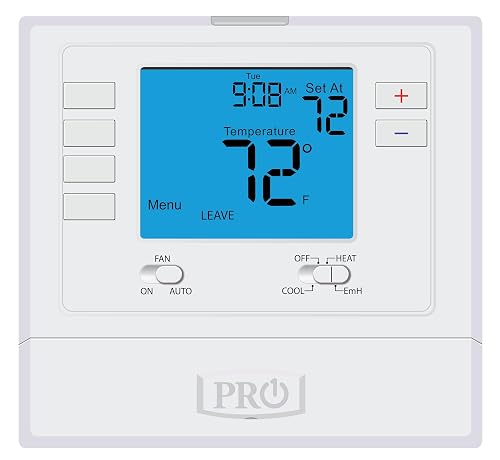
PRO1 T725 Programmable Wall Thermostat (2H/1C Heat Pump)

PRO1 T771 Non-Programmable Wall Thermostat (Single Stage)
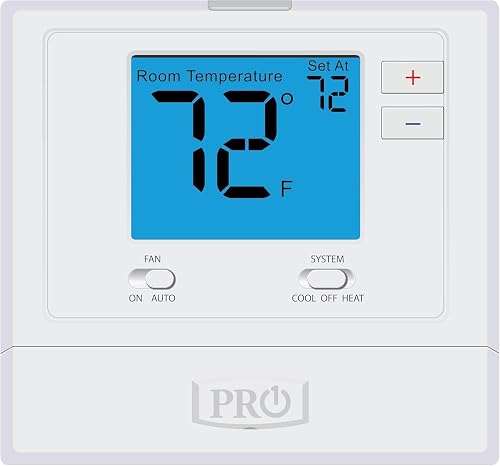
PRO1 T701 Non-Programmable Wall Thermostat (1H/1C)

PRO1 T715 Multi-Stage Programmable Gas Thermostat (2H/2C)
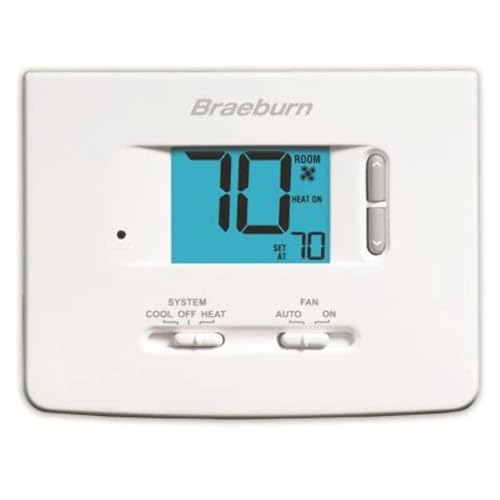
Braeburn 1020NC Non-Programmable Thermostat (1H/1C)
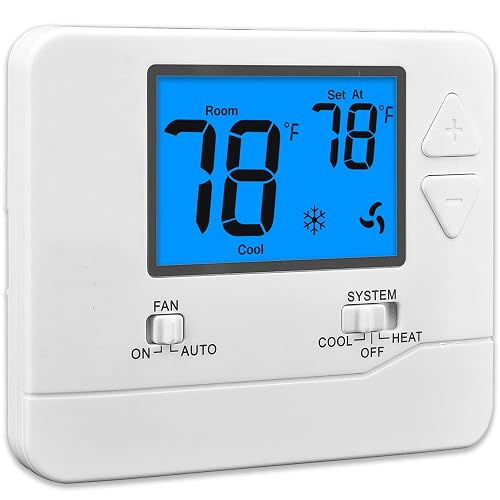
Suuwer Non-Programmable Thermostat (1H/1C, Blue Backlight)

Honeywell Home RTH5160 Non-Programmable Thermostat
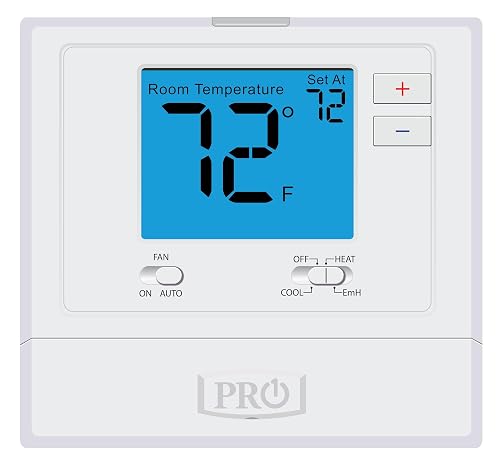
PRO1 T721 Non-Programmable Wall Thermostat (2H/1C)
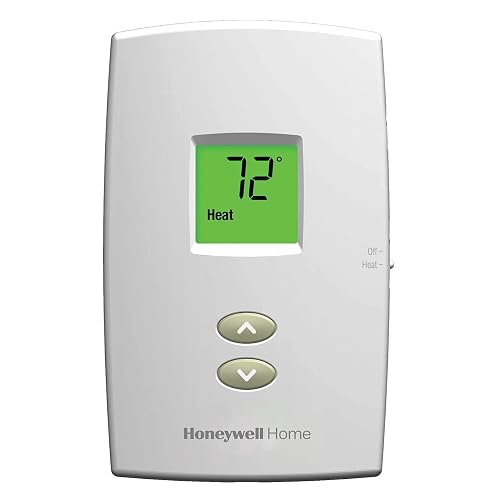
Honeywell TH1100DV1000 Pro-Digital 2-Wire Heat Only

PRO1 T805 Programmable Wall Thermostat (1H/1C, 7-Day)
Meet The Standout Selections
The PRO1 T725 sits at the top of this list because it handles two configurations most homes actually run: a 2 heat/1 cool heat pump or a 1 heat/1 cool conventional system. A “heat pump” is an HVAC unit that moves heat rather than generating it, so it needs a control that knows the difference between strip heating and compressor stages. You can pick 7-day or 5/1/1 scheduling (where 5/1/1 means weekdays plus Saturday and Sunday set independently), which is genuinely useful for anyone whose routine shifts during the week.
The 4 sq. in. blue backlit display is the same family you’ll see across the T700 platform, including the T701 covered later. Owners commonly find the readout easy on aging eyes, and the schedule labels (wake, leave, return, sleep) keep programming language simple. For mixed households, this T725 feels like a steady upgrade over a basic dial thermostat.
Advantages To Know
- Switches between 2H/1C heat pump and 1H/1C conventional without a separate model.
- 7-day and 5/1/1 programming adapt to rotating work schedules.
- Backlit 4 sq. in. screen readable in dim hallways and bedrooms.
- T700 platform commonality makes replacement and accessories familiar territory.
- Schedule labels (wake, leave, return, sleep) reduce the learning curve for first-time programmers.
Things To Consider
- Wiring on heat pump systems can confuse first-time installers, so a photo of the existing terminal block is worth taking before you buy.
- Battery and hardwire options exist, but jumper settings on the back plate require a careful read of the manual.
Who It Suits Best
Homeowners with a heat pump who want one thermostat that handles real programming without paying for smart-home extras.
Where Another Pick Suits Better
Heating-only homes with just two wires at the wall will get simpler setup from the Honeywell TH1100DV1000 Pro-Digital 2-Wire Heat Only.
The T771 is the odd one out in the PRO1 lineup, and that’s a compliment. Its setpoint range stretches down to 25°F, which matters in detached garages, workshops, and sheds where you want freeze protection without running the heat constantly. It’s a single-stage, non-programmable unit, so there’s nothing to schedule and nothing to misconfigure in a space that only needs basic temperature control.
Like the T701 below, it shares the T700 platform’s 4 sq. in. blue backlit display. The “single stage” label means it controls one heating and one cooling stage, so it’s not the right match for multi-stage furnaces. In a workshop, though, the wide range and simple interface do exactly what they need to.
Useful Touches
- Setpoint range down to 25°F covers cold garages and unconditioned spaces.
- Non-programmable design removes any temptation to fiddle in a utility space.
- Swing adjustment and calibration let you fine-tune how often the system kicks on.
Trade Offs
- No scheduling means a separate unit for any space that benefits from setback temperatures.
- Limited to single-stage conventional systems, so it won’t talk to multi-stage furnaces.
Made For
Garages, sheds, and workshops that need freeze protection and basic on/off control.
Consider Something Else When
You need scheduled setbacks in a primary living space, where the PRO1 T725 Programmable Wall Thermostat (2H/1C Heat Pump) is a better fit.
The T701 is the kind of thermostat that disappears into a hallway and just does its job. It runs on the same T700 platform as the T725 above, but it skips programming entirely, so you’re left with a clean interface, a 4 sq. in. blue backlit screen, and a glow-in-the-dark light button for late-night adjustments. For many households, that’s the entire wish list.
It’s built for 1 heat/1 cool conventional systems, which covers the bulk of older homes with a single-stage gas furnace and a single-stage air conditioner. Compared to the Honeywell RTH5160 below, the T701 leans a bit more toward “set the temperature and forget it,” with fewer modes to navigate.
Positive Points
- Non-programmable design is genuinely simple for anyone who finds scheduling screens confusing.
- Glow-in-the-dark light button helps during nighttime power blips.
- Gas or electric configurable for flexible fuel setups.
Points To Note
- No scheduling means no automatic setback when you leave for work.
- Limited to single-stage systems, so multi-stage equipment requires a different model.
Best Suited To
Households with a basic 1H/1C conventional system who want reliable, no-fuss temperature control.
Look Elsewhere When
You want true 7-day scheduling in a similar size, where the PRO1 T805 Programmable Wall Thermostat (1H/1C, 7-Day) is the upgrade path.
Step up to a multi-stage furnace or a two-stage air conditioner, and most single-stage thermostats stop being a match. The T715 is built for exactly that situation, with 2 heat/2 cool handling for gas systems. “Multi-stage” means the equipment can run at lower or higher output depending on demand, and a thermostat that understands that can squeeze more comfort and efficiency out of the setup.
Like the T701, it offers 7-day, 5/1/1, or non-programmable modes, so you can run it as a programmer or as a manual unit. The 4 sq. in. blue backlit display and glow-in-the-dark light button come along for free. It’s a noticeable step up from the T725 for households whose HVAC equipment is genuinely two-stage.
Benefits That Matter
- 2 heat/2 cool support unlocks proper control of multi-stage gas systems.
- Flexible programming (7-day, 5/1/1, or none) suits different comfort priorities.
- Common T700 platform makes the menu structure familiar if you’ve handled other PRO1 units.
Worth Noting
- Heavier wiring count (more conductors) demands a careful check of the existing cable before installation.
- Overkill for single-stage homes, where the T701 or T725 will save complexity.
Quick Facts
Perfect Match For
Owners of multi-stage gas HVAC systems who want both real scheduling and full two-stage control.
Not Your Match When
Your system is single-stage and you don’t need the extra capacity, in which case the PRO1 T701 keeps things simpler.
Braeburn has a quiet reputation in the contractor world, and the 1020NC shows why. It’s a non-programmable 1H/1C unit with a 2 sq. in. blue backlit display, which is smaller than the PRO1 T701’s screen, but the smaller footprint is genuinely useful in tight retrofit boxes. The fact that it runs on either 24-volt AC hardwire or two AA batteries makes it a friendly swap for older homes that lack a common wire.
It also supports 250mV to 750mV millivolt heating systems, which matters if your home has an older gas furnace that puts out a low-voltage signal rather than a full 24V. Compared to the Honeywell RTH5160 below, the Braeburn leans more mechanical in feel, with adjustable temperature limits and simple switches on the back plate.
Noteworthy Benefits
- Hardwire or battery power offers flexibility for older wiring setups.
- Millivolt heating compatibility covers legacy gas furnace systems.
- Adjustable temperature limits prevent accidental extreme setpoints.
Room For Improvement
- Smaller 2 sq. in. display is harder to read from across a room than the PRO1 T700-series screens.
- No scheduling, which is a real loss for anyone used to setback temperatures.
Who Should Grab It
Owners of older homes with millivolt or limited-wire heating systems who need a reliable, no-frills wall control.
A Better Fit Elsewhere
Households that want 7-day scheduling should look at the PRO1 T805 Programmable Wall Thermostat (1H/1C, 7-Day) instead.
The Suuwer 1H/1C earns its place in this list as the friendly option for first-time installers and rental properties. It’s built for conventional single-stage systems with 2 to 5 wires, and the blue backlight is the kind of small detail that matters when you walk past the thermostat at 2 a.m. The instruction sheet is image-driven, which is helpful if you’re not used to reading wiring schematics.
Compared to the PRO1 T701, this unit is simpler in feel and lighter on the wall, but it does the same core job: set a temperature and let the system hold it. For a guest bedroom or a basement suite that needs temperature control without complexity, it lands in a sweet spot.
Points In Its Favor
- Works with the 2 to 5 wire configurations most common in older homes.
- Blue backlight improves nighttime visibility without adding menu depth.
- Non-programmable layout keeps wall training to a minimum for tenants.
Honest Caveats
- Pre-purchase wiring check matters more here than with full-platform PRO1 units; the listing explicitly asks you to confirm compatibility before installing.
- Build quality is lighter than the T701, so handle the faceplate with care during removal.
Feature Snapshot
Built With In Mind
Renters, first-time DIYers, and homeowners on a budget who want a wall thermostat that works without complications.
Skip It When
You have a heat pump system, in which case the PRO1 T721 Non-Programmable Wall Thermostat (2H/1C) is the compatible upgrade.
Honeywell’s RTH5160 is the model that keeps showing up in apartments and starter homes for good reason. It shows both the current temperature and the setpoint on a backlit display, switches automatically between heat and cool, and remembers your settings through a power outage. “Auto-changeover” is the feature that flips the system between heating and cooling based on the room temperature, so you don’t have to manually toggle the mode every season.
It’s compatible with most 24V forced-air, heat pump, and hot water systems, which makes it versatile for households that aren’t sure what kind of equipment is in the wall. Compared to the Braeburn 1020NC above, the Honeywell leans slightly more digital in feel, with a battery reminder alert and single-degree control.
Useful Strengths
- Auto heat/cool switching removes the seasonal “did I leave it on the right mode” worry.
- Memory storage retains settings through short power outages.
- Battery reminder alert helps prevent the surprise dead-thermostat morning.
Factors To Consider
- Wiring compatibility should still be confirmed before ordering, since not every system is supported.
- No scheduling, so any setback habits have to be done manually.
Whose Shelf It Belongs On
Households that want a trusted brand name, a clear display, and minimal mode-flipping across the year.
Swap It Out When
You have a heat pump and want to add scheduling; the PRO1 T725 Programmable Wall Thermostat (2H/1C Heat Pump) covers both.
The T721 is the heat-pump-friendly cousin of the T701. Where the T701 sticks to 1H/1C conventional, the T721 takes on a 2 heat/1 cool heat pump or a 1 heat/1 cool conventional system, so it’s a good match for homes that have already upgraded the equipment but still want a non-programmable interface. The 4 sq. in. blue backlit display and glow-in-the-dark light button are familiar from the rest of the T700 platform.
For households that like the T701’s clean approach but have a heat pump, the T721 fills the gap without forcing a switch to the programmable T725. It’s also battery or hardwire powered, which is a small but useful detail in retrofits where the wiring isn’t ideal.
Reasons It Performs
- Heat pump or conventional support in a single non-programmable unit.
- Glow-in-the-dark light button and backlit display cover low-light conditions.
- Battery or hardwire power accommodates older wiring.
Possible Compromises
- No 7-day scheduling, so it’s not the right pick for full setback automation.
- Single-stage cooling limits use with higher-end two-stage AC equipment.
Key Attributes
Right Fit For
Heat pump owners who prefer a non-programmable control but want platform consistency with other PRO1 T700 units.
Reach For A Different Pick When
You need multi-stage cooling control, in which case the PRO1 T715 Multi-Stage Programmable Gas Thermostat (2H/2C) handles that workload.
The TH1100DV1000 is a heat-only thermostat, plain and simple, and that’s its whole purpose. “2-wire” means it only needs two conductors from the wall, which makes it a clean swap for boilers, baseboard heaters, and other line-voltage or low-voltage heating-only setups where pulling a new cable isn’t an option. The backlit display shows both the ambient temperature and the setpoint at all times, so you always know what the system is doing.
It also has built-in compressor protection, although that’s more relevant in mixed systems than in heat-only installations. Compared to the PRO1 T771 above, this Honeywell is the better match for hydronic or baseboard retrofits, while the T771 leans more toward forced-air and specialty low-temperature spaces.
What Pays Off
- Two-wire installation sidesteps the rewiring problem common in older heating-only homes.
- Backlit display with ambient and setpoint readings reduces guesswork.
- One-touch setpoint access speeds up the morning routine.
Details To Watch
- Heat-only by design, so it can’t be repurposed if you add cooling later.
- No scheduling features, which is the trade-off for the simplified 2-wire interface.
The Right Fit
Owners of baseboard, boiler, or other heat-only systems who want a digital upgrade without pulling new wire.
Another Choice May Suit
Households that need both heating and cooling should look at the Honeywell Home RTH5160 Non-Programmable Thermostat instead.
The T805 closes out the list as the screen-size upgrade. It runs on the T800 platform, which is one generation up from the T700, and the most obvious change is a 7 sq. in. blue backlit display, noticeably larger than the 4 sq. in. screens on the T701, T721, and T725. For anyone with aging eyes or a thermostat mounted across a large room, that extra screen real estate is a meaningful quality-of-life improvement.
It’s still a 1H/1C conventional thermostat, with 7-day, 5/1/1, or non-programmable modes, so the feature set is similar to the T715 but stripped to single-stage. Compared to the Honeywell RTH5160 above, the T805 is the right call when scheduling matters as much as a readable display.
The Value In It
- 7 sq. in. backlit display is the largest on this list, easing the read from across a room.
- Triple-mode programming covers 7-day, 5/1/1, or full manual operation.
- T800 platform hints at slightly newer internals than the T700 line.
Worth Bearing In Mind
- Limited to single-stage systems, so multi-stage furnaces need the T715 instead.
- Larger faceplate can be tight on older retrofit electrical boxes.
Who Will Love This
Schedulers in single-stage homes who want the largest, clearest display PRO1 currently offers.
Where A Sibling Pick Shines
Multi-stage gas systems will get more out of the PRO1 T715 Multi-Stage Programmable Gas Thermostat (2H/2C).
What To Weigh Before Choosing A Wall Thermostat
Confirm Your System Type First
Every thermostat on this list assumes a specific kind of HVAC equipment. A 1H/1C conventional system has one heating stage and one cooling stage, while a 2H/1C heat pump adds auxiliary strip heating. Before you fall in love with a screen size, pop the existing thermostat off the wall and count the wires. The PRO1 T725, T721, and T771 each target different equipment, and choosing the wrong one can mean an extra wiring day or a return trip.
Decide If Scheduling Matters Day-To-Day
A 7-day schedule is genuinely useful for anyone whose routine shifts during the week, because “5/1/1” means you can set weekdays as one block, Saturday as another, and Sunday as a third. The T715, T725, and T805 all offer this. If your household runs the same temperature morning and night, year-round, a non-programmable model like the T701 or Honeywell RTH5160 is simpler to live with and harder to misconfigure.
Match Wiring Reality To Power Needs
Older homes with two-wire heat-only setups are a different problem than retrofitted homes with a common wire. “C-wire” or “common wire” is the conductor that delivers continuous 24V power to the thermostat, and its absence is the most common reason a smart-looking stat fails to fire up. The Honeywell TH1100DV1000 covers 2-wire heat-only, while the Braeburn 1020NC supports millivolt heating systems. Read the back-plate requirements before clicking order, and you save yourself a Saturday.
Smart Spending In The Thermostat Aisle
Where Shoppers Go Wrong
The most common mistake is choosing a thermostat by screen size or feature list instead of by system compatibility. A homeowner with a 2H/1C heat pump who grabs a single-stage 1H/1C unit will spend the first winter wondering why the auxiliary heat never kicks in. The second mistake is ignoring the wiring count on the wall. A thermostat that needs a common wire in a home without one will display an error or run on batteries until the swap is done. The third is overpaying for scheduling in a guest room or vacation home where the temperature barely changes, where a simple non-programmable unit is honestly a better match.
Where The Extra Money Goes
Higher-tier thermostats in this category tend to add three things: bigger backlit displays (like the T805’s 7 sq. in. screen), multi-stage support (the T715’s 2H/2C handling), and dual-mode platform flexibility (heat pump and conventional in one unit). Those additions matter in larger homes, multi-stage equipment, and households with complex schedules. For a single-stage 1H/1C home with a predictable routine, the extra spend rarely earns itself back, and a T701 or Honeywell RTH5160 will quietly do the job for years.
Frequently Asked Questions
How Do I Know If I Have A Heat Pump Or A Conventional System?
Look at your outdoor unit. If there’s a large box with a fan on the side of the house that runs year-round, you likely have a heat pump. Conventional systems usually have a separate furnace indoors and an air conditioner outdoors.
Can I Install A Programmable Thermostat Where A Non-Programmable One Was?
Yes, in most cases. The wiring terminals are typically the same. The main concern is whether you have a C-wire for continuous power, which some smart-style programmable units need.
What Does 5/1/1 Day Programming Mean?
It means you can set a schedule for the five weekdays as one block, then set Saturday and Sunday independently. The 7-day option lets you set each day on its own.
Do These Thermostats Work With Smart Home Systems?
The models in this list are traditional wall thermostats and do not include built-in smart home integration. They are designed to replace an existing wall stat without requiring a hub or app.
What Happens To My Settings During A Power Outage?
Most models in this list retain their settings through short outages thanks to internal memory or battery backup. Battery-powered units keep running through blackouts; hardwired-only units reset when power returns.
Bottom Line
The right wall thermostat is the one that matches your system, fits the wiring in your wall, and gives you the day-to-day features you’ll actually use. Multi-stage homes lean toward the PRO1 T715, heat pump households find the T725 and T721 cover most scenarios, and basic 1H/1C homes can stay simple with the T701, Braeburn 1020NC, or Honeywell RTH5160. Specialty spaces like garages and baseboard retrofits are the natural home for the T771 and TH1100DV1000. Whatever you pick, confirming compatibility before ordering saves the most time and frustration.