
Picking a new thermostat should feel like an upgrade, not a research project. Whether you’re swapping out a temperamental old unit, adding zoning to a stubborn room, or chasing lower utility bills without giving up comfort, the right wall control quietly changes how a home feels day to day. This roundup walks through ten solid options across conventional HVAC, multi-stage gas systems, and radiant floor heating, so you can match the wiring in your wall to the way you actually live.
A Quick View Of The Lineup
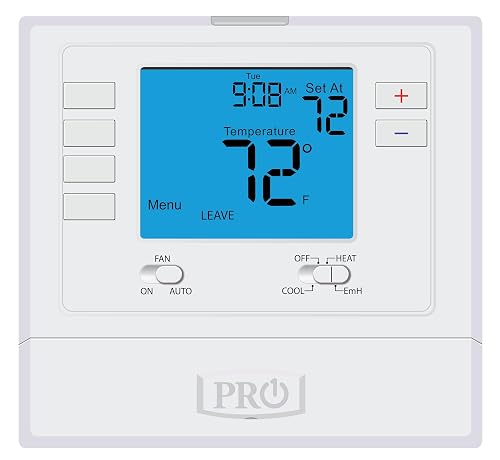
PRO1 T725 Programmable Wall Thermostat 2 Heat/1 Cool

PRO1 T771 Non-Programmable Wall Thermostat 1H/1C

SunTouch SunStat ConnectPlus Wi-Fi Floor Heating Thermostat 4.3″
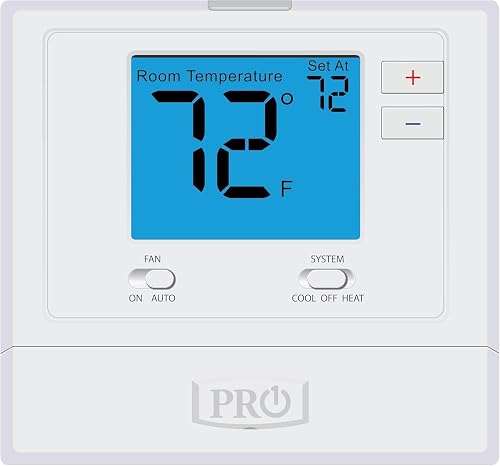
PRO1 T701 Non-Programmable Wall Thermostat 1H/1C

PRO1 T715 Multi-Stage Programmable Gas Thermostat 2 Heat/2 Cool
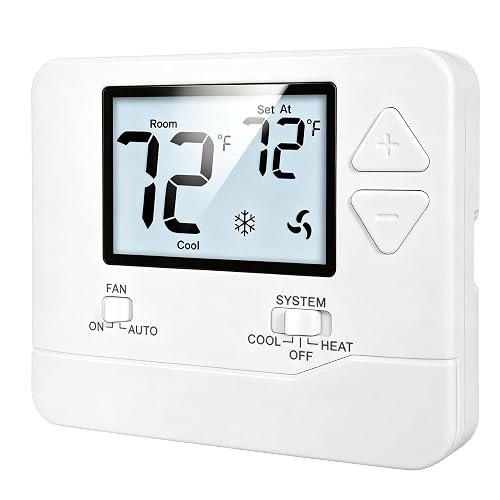
Heagstat Non-Programmable Thermostat 1 Heat/1 Cool

Honeywell Home X2P Programmable Thermostat Single-Stage
PRO1 T721 Non-Programmable Wall Thermostat 2H/1C

PRO1 T805 Programmable Wall Thermostat 1H/1C
Google Nest Learning Thermostat (4th gen) + Sensor
Meet The Standout Selections
The PRO1 T725 is the kind of wall thermostat that does more than hold a setpoint. It speaks both heat pump and conventional HVAC fluently, covering 2 heat/1 cool heat pump systems alongside 1 heat/1 cool conventional setups, so households with mixed equipment don’t have to choose the wrong unit and live with it. The blue backlit display measures roughly 4 square inches, which sounds modest until you stand back from a hallway and the room temperature still reads clearly.
Where this pick pulls ahead of the PRO1 T701 below is the schedule depth. You get 7-day or 5/1/1 programming, meaning weekdays, Saturday, and Sunday can each run their own temperature pattern. For a working household that warms up before school, drops while everyone is gone, then returns to comfort at five, that flexibility is the whole point of swapping a manual dial. Owners commonly wire it to common C-wire setups or run it on battery power when a neutral isn’t present, which keeps retrofit installs honest.
What Helps Most
- Dual compatibility with heat pump and conventional systems in one unit.
- 7-day and 5/1/1 schedule options for genuinely different weekday and weekend routines.
- 4 sq. in. blue backlit screen is easy to read from across a room.
- Battery or hardwire power, useful when no common wire is at the wall.
Things To Consider
- Lacks Wi-Fi, so remote adjustments mean walking back to the hallway.
- Programming takes a few minutes to learn the first time through.
Feature Card
Right Fit For
Heat pump households that want real weekday/weekend scheduling without paying smart-home prices.
Consider Something Else When
The Honeywell Home X2P Programmable Thermostat fits you better if you want a single-stage system with a slightly friendlier setup flow.
The PRO1 T771 is what you reach for when “the house” isn’t really a house. Garages, workshops, detached sheds, and three-season rooms all run simple single-stage heating and cooling, and a $200 smart thermostat in that space is overkill. The wide 25°F to 90°F setpoint range is the headline here, because most living-room thermostats bottom out around 50°F and quietly refuse to keep a workshop above freezing on a January night.
It’s a no-frills unit, intentionally so. The 4 sq. in. blue backlit display is easy to read at a workbench, and swing adjustment plus calibration let a careful installer dial the room reading closer to a reliable thermometer. You won’t get Wi-Fi or app control, which most shop owners would call a feature rather than a miss. Touchscreen use centers on simple up and down setpoint changes.
Real Benefits
- 25°F to 90°F setpoint range handles unheated garages and sheds.
- Swing and calibration controls let you match a separate thermometer.
- Low complexity means fewer things to break in a dusty shop.
Honest Caveats
- No scheduling, so the temp stays where you left it until you change it.
- Single-stage only, which excludes heat pump and multi-stage systems.
- Basic interface that doesn’t suit a primary living space.
Right Fit For
Workshop and garage owners who need a wide low-temp range without paying for smart features they won’t touch.
Consider Something Else When
The PRO1 T701 Non-Programmable Wall Thermostat is a better fit for indoor living spaces where you want simple, single-stage control in a more residential form factor.
The SunTouch ConnectPlus lives in a different world than the rest of this list, and that’s the appeal. Where every other pick here talks to a furnace or air handler, this one talks to electric radiant floor heating, the kind of system that warms tile underfoot in a master bath or basement rec room. The 4.3-inch touchscreen gives you real estate the smaller 4 sq. in. PRO1 displays can’t match, and the Wi-Fi radio pulls outdoor temperature and weather forecasts to help the system decide when to skip a heating cycle.
You also get warm weather shut-down, which prevents the floor from running in summer when no one wants a heated tile bath, plus compatibility with voice assistants so you can nudge the floor temperature up before stepping out of bed. Setups like this pay off most in cold-climate homes where a warm bathroom floor in January changes the entire morning.
A Few Highlights
- 4.3-inch color touchscreen that’s noticeably larger than typical wall stats.
- Wi-Fi enables remote control, weather-aware scheduling, and outdoor temp display.
- Warm weather shut-down protects the system in off-season months.
- Voice assistant compatibility for hands-free nudges.
Worth Noting
- Built for radiant floor heat, not whole-home forced air.
- Installation expects a floor sensor probe already in the mat.
Right Fit For
Homeowners with electric radiant floor heating who want smartphone control and a real touchscreen rather than a small LCD.
Look Elsewhere When
The Google Nest Learning Thermostat is a smarter pick for whole-home forced-air HVAC where you want learning behavior rather than dedicated floor heating control.
The PRO1 T701 is the dependable cousin in this lineup, and the right answer more often than people expect. It’s built for the most common residential setup: a single-stage conventional system, one heating circuit, one cooling circuit, and nothing fancy. The blue backlit 4 sq. in. display is shared with the T725 above, but the T701 keeps the experience strictly manual. You walk up, tap, and the room is what you set it to.
That simplicity pays off in rentals, in-law suites, and guest rooms where a learning curve isn’t welcome. The glow-in-the-dark light button is a small but telling detail, since it shows the engineers thought about the 2 a.m. hallway trip when a baby is asleep. Gas or electric configuration is selectable at install, which broadens the homes it drops into without forcing a rewiring decision.
Practical Pluses
- 4 sq. in. backlit display is large enough for older eyes.
- Glow-in-the-dark button for low-light adjustments.
- Gas or electric configurable at install.
- Minimal learning curve for occasional users.
Room For Improvement
- No scheduling, so the temperature stays put between manual changes.
- Single-stage only, ruling out heat pump and multi-stage homes.
Right Fit For
Landlords and homeowners with single-stage conventional HVAC who want the simplest reliable wall control they can hand to anyone.
Consider Something Else When
The Honeywell Home X2P Programmable Thermostat is a better match for owner-occupied homes where weekday and weekend scheduling is worth the small step up in price.
The PRO1 T715 is the unit you buy when your furnace and air conditioner are more capable than your old thermostat, and that mismatch is finally getting annoying. It supports 2 heat/2 cool gas systems, which means a two-stage furnace and a two-stage compressor can both run at their lower settings on mild days and ramp up only when the weather actually demands it. The comfort difference is subtle on a spring morning and obvious on the first real cold snap of the year.
Schedule flexibility is the deepest in this roundup. 7-day, 5/1/1, or fully non-programmable, which means a homeowner who wants schedules can have them and a homeowner who doesn’t can ignore the menu entirely. The 4 sq. in. blue backlit display is shared with the rest of the T700 line, plus that same glow-in-the-dark light button for late-night checks.
A Strong Showing
- 2 heat/2 cool support lets two-stage equipment actually stage down on mild days.
- Three schedule modes cover full programming and full manual.
- Battery or hardwire install options for retrofit flexibility.
Trade Offs
- Overkill for a single-stage system, where the T701 already does the job.
- More configuration menus than a basic non-programmable stat.
Right Fit For
Two-stage gas furnace households who want scheduled comfort that takes advantage of low-stage operation most of the year.
Consider Something Else When
The PRO1 T725 Programmable Wall Thermostat makes more sense for heat pump homes that don’t need two-stage gas control.
The Heagstat 1H/1C thermostat exists for a specific shopper: someone replacing a worn-out mechanical dial who wants a digital wall unit that does the obvious job without a learning curve or a learning premium. Compatibility is strictly conventional single-stage, covering 24VAC forced-air systems paired with a separate outdoor condensing unit. The hard ceiling here is wire count, since the base accepts 2 to 5 wires and 6 to 8 wire systems aren’t a fit.
It’s a no-nonsense wall stat with a white backlight that holds up to dim hallways, and a simple on-screen setpoint change. Where this unit pulls value is in homes that already run the right system and just want a clean replacement without paying for features that would never be touched.
The Upside
- Simple digital control at a wallet-friendly tier.
- White backlight keeps the display visible in dim rooms.
- 24VAC compatibility covers most common gas, oil, and electric furnaces.
Worth Noting
- Maximum 5-wire base, so 6 to 8 wire installs are out.
- Not compatible with heat pump or multi-stage systems.
- No scheduling or app connectivity.
Right Fit For
Cost-conscious owners with straightforward single-stage conventional HVAC who want a clean digital upgrade from an old dial.
Consider Something Else When
The PRO1 T701 Non-Programmable Wall Thermostat fits better if you want a similar simple stat with a glow-in-the-dark light button and a slightly broader feature profile.
The Honeywell Home X2P sits in the comfortable middle of the programmable category, where it pulls from a long Honeywell pedigree without drifting into the smart-home price band. It’s optimized for single-stage 1 heat/1 cool systems, which is the most common residential setup in the country, and gives you four schedule options: 5-1-1 day, 5-2 day, 7-day, or 1 week, plus a non-programmable mode for anyone who wants to ignore the calendar entirely.
What makes this stat feel finished rather than stripped-down is the small set of quality-of-life touches. Filter change reminders nudge you when the HVAC filter is overdue, and the display can be adjusted to blend with the wall color. You can also pick between a few schedule shapes depending on how your week actually runs, which matters more than it sounds once you start programming.
Positive Points
- Four schedule modes cover nearly any weekday/weekend pattern.
- Filter change reminders reduce the chance of a forgotten HVAC filter.
- Display customization helps the stat blend with paint and trim.
A Few Limitations
- Single-stage only, so heat pump and multi-stage homes need a different stat.
- No app or voice control at this tier.
Feature Card
Right Fit For
Single-stage family homes that want flexible scheduling and a familiar Honeywell name without smart-home pricing.
Look Elsewhere When
The Google Nest Learning Thermostat is a better match for households that want learning behavior and app control rather than manual programming.
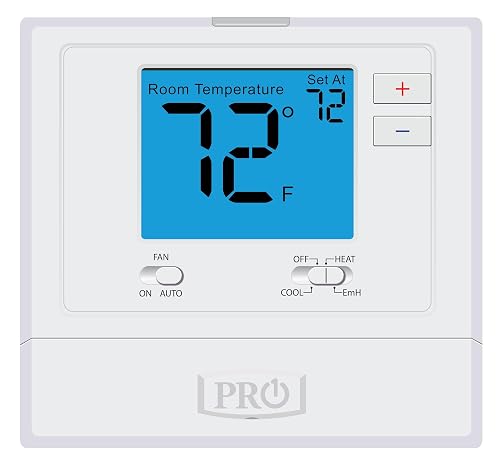
The PRO1 T721 is the bridge between two system types, and that flexibility is the whole reason to pick it. It supports 2 heat/1 cool heat pump systems and 1 heat/1 cool conventional systems, so the same wall unit works whether your home runs a heat pump or a traditional furnace-and-air setup. Useful, for example, if a homeowner is unsure which system will be installed in a renovation, or if a single stat needs to cover an addition built later on different equipment.
It’s a non-programmable stat, which keeps the experience as simple as the T701 above. The 4 sq. in. blue backlit display and glow-in-the-dark light button show up again, and power can come from AA batteries or a hardwire. For a household that values the choice between system types more than a schedule, this is the right shelf in the catalog.
The Practical Payoff
- Works with both heat pump and conventional systems.
- Battery or hardwire power options.
- Glow-in-the-dark button for low-light adjustments.
Trade Offs
- No scheduling, which may frustrate owners used to programmable stats.
- Single-stage conventional only, not multi-stage.
Right Fit For
Homeowners who want one simple stat that fits either a heat pump or a conventional system without reprogramming or rewiring.
Consider Something Else When
The PRO1 T725 Programmable Wall Thermostat is the better call if you want 7-day scheduling alongside the same dual-system flexibility.
The PRO1 T805 is the largest display in this roundup, and that single fact tends to settle a lot of household debates. At roughly 7 square inches, the blue backlit screen is roomy enough to read from a couch or a walker, which is a real quality-of-life gain for anyone whose eyes don’t love tiny digits at 10 feet. The T800 platform also brings the glow-in-the-dark light button forward, useful at 2 a.m. when a thermostat is the only thing glowing in the hallway.
Underneath, it’s a programmable 1 heat/1 cool conventional stat with 7-day, 5/1/1, or non-programmable modes, which is the same scheduling flexibility the Honeywell X2P offers. Where it differentiates is the screen real estate, not the feature set. The honest read is that this is a stat for people who care a lot about readability and a little less about smart features.
Notable Upsides
- Extra-large 7 sq. in. display is easy to read across a room.
- Three schedule modes including a fully non-programmable option.
- Glow-in-the-dark light button for nighttime checks.
Trade Offs
- No Wi-Fi or app control at this tier.
- Single-stage only, so heat pump and multi-stage homes need a different stat.
Right Fit For
Single-stage conventional households that prioritize a big readable display and a flexible schedule over smart connectivity.
Consider Something Else When
The Honeywell Home X2P Programmable Thermostat is a smarter pick if you want comparable scheduling in a more compact housing.
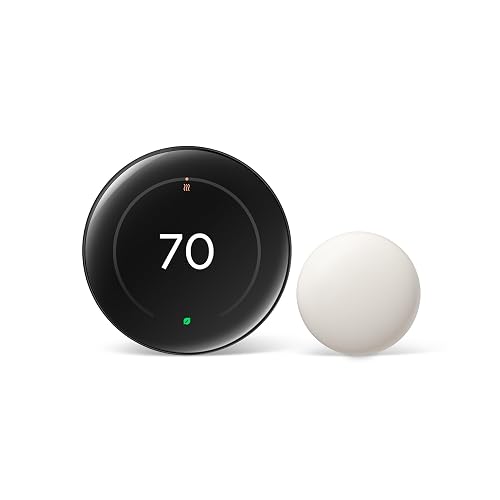
The Google Nest Learning Thermostat (4th gen) is the flagship of this list, and the only pick here that genuinely rewrites how a wall stat works. Instead of asking you to program a schedule, it watches the temperatures you choose, the times you choose them, and the way your routine shifts, and quietly builds a schedule around you. Over a few weeks, you stop touching the dial entirely, which is the point. The included 2nd-gen Nest Temperature Sensor adds another room’s reading to the mix, useful in homes where one thermostat controls a hallway that doesn’t represent the rest of the house.
The Obsidian finish is a small thing until you see it mounted on a light-colored wall, and the bezel rotates to a satisfying click. The bundle also helps the heating and cooling system run more smoothly by coordinating staging and runtime. This is the stat to consider if you want learning behavior, app control, and a temperature sensor in the same package, and you don’t mind paying for it.
Notable Gains
- Learns your routine and builds a schedule without manual programming.
- Includes a 2nd-gen Temperature Sensor for balanced multi-room readings.
- App and voice control for adjustments from a phone.
- Obsidian finish and rotating bezel give it a premium look on the wall.
Practical Considerations
- Pricier than every other stat on this list.
- Learning behavior takes a couple of weeks to settle.
- Wi-Fi dependent for the smart features to function.
Feature Card
Right Fit For
Smart-home households that want a learning thermostat, app control, and a temperature sensor all in one bundle.
Consider Something Else When
The PRO1 T715 Multi-Stage Programmable Gas Thermostat is the better fit for a two-stage gas furnace home that values scheduling depth over learning behavior.
What Matters Most Before Choosing a Touch Screen Thermostat
System compatibility is the first thing to confirm, and it should be settled before the box is even opened. A single-stage conventional stat won’t talk to a two-stage furnace properly, and a multi-stage stat installed on a single-stage system will show options that go nowhere. Look at the equipment label on your furnace or air handler first, count the wires in the wall (commonly labeled R, W, Y, G, and C), and match those to the stat’s stated system support. The PRO1 T715 and Honeywell X2P both lean into specific system types, so the right match depends on the wires, not the wishlist.
Power source is the second decision most people underestimate. Many modern touch screen thermostats pull continuous current from a common wire (the C-wire), and homes without one will need either a battery-powered unit or a power adapter kit. The PRO1 T701 and T721 are comfortable running on AA batteries, which makes retrofit installs in older homes much simpler. Smart stats like the Nest generally want the C-wire or its power accessory, which adds a small project to the install.
Third, decide whether scheduling, learning, or just manual control is the actual goal. A homeowner who is gone nine to five every weekday has different needs than a retiree who is home most of the day, and that single answer usually narrows the list to two or three options. Learning thermostats are best for unpredictable schedules, programmable stats are best for predictable weeks, and non-programmable units are best for spaces where one temperature all day is genuinely fine, like a workshop or in-law suite.
Key Considerations Across These Picks
Pitfalls Shoppers Hit
The most common mistake is choosing a stat by feature list instead of by system type. A two-stage gas household buying a single-stage stat loses staging and ends up with louder, less efficient heating. A heat pump household buying a conventional-only stat loses compressor-friendly behavior and can end up with auxiliary heat running when it shouldn’t. Always match the system, then match the schedule.
Another trap is overlooking the C-wire. Smart thermostats like the Nest often expect continuous power, and skipping that step can lead to flickering displays or constant battery swaps. The non-programmable PRO1 units sidestep this with battery power, but learning and Wi-Fi stats usually need a hardwire solution or an add-on kit.
Where The Extra Money Goes
A higher-tier stat like the Nest Learning Thermostat earns its price with three things the basic units don’t offer: learning behavior, app and voice control, and a temperature sensor that reads another room. None of those matter to a workshop, and all of them matter to a family home with a hot upstairs and a cold nursery. The “premium” label means features, not bragging rights, so the upgrade is worth it when the use case actually calls for it.
Frequently Asked Questions
Do touch screen thermostats work without a C-wire?
Several do, including the PRO1 T701 and T721, which run on AA batteries. Smart Wi-Fi units like the Nest typically need a C-wire for continuous power, or a power accessory kit if the wall doesn’t have one. Always check the wall wiring before choosing a smart model.
Can I install one of these thermostats myself?
Most homeowners comfortable with a screwdriver and a voltage tester can swap a like-for-like stat in under an hour. Always turn off the HVAC breaker first, label the wires, and snap a photo of the original wiring. New system types, like adding a C-wire or upgrading from single-stage to multi-stage, are better left to a pro.
How do I know if my system is single-stage or multi-stage?
The furnace or air handler nameplate usually lists stages, and the equipment manual will say “single-stage” or “two-stage” outright. A single-stage system has one heating and one cooling output, while a multi-stage system has two, which the T715 and similar stats are designed to control.
Will a learning thermostat actually save money?
Learning thermostats reduce wasted heating and cooling by tightening the schedule around your real routine, which can trim utility bills over a year. The savings depend heavily on how often the system was running unnecessarily before, and on whether the home has good insulation and sealed ductwork.
What’s the difference between a heat pump thermostat and a conventional one?
A heat pump thermostat understands reversing valve operation and auxiliary heat, while a conventional thermostat treats heating and cooling as separate one-way functions. Installing the wrong type can cause the heat pump to short-cycle or run the auxiliary heat strip when it isn’t needed.
The Takeaway
The best touch screen thermostat is the one that matches the wires in your wall and the way you actually live, not the one with the longest feature list. Run a quick inventory of your system type, decide how much scheduling or learning you genuinely want, and the right pick from this list tends to make itself obvious. From there, the upgrade pays off quietly, room by room, season by season.