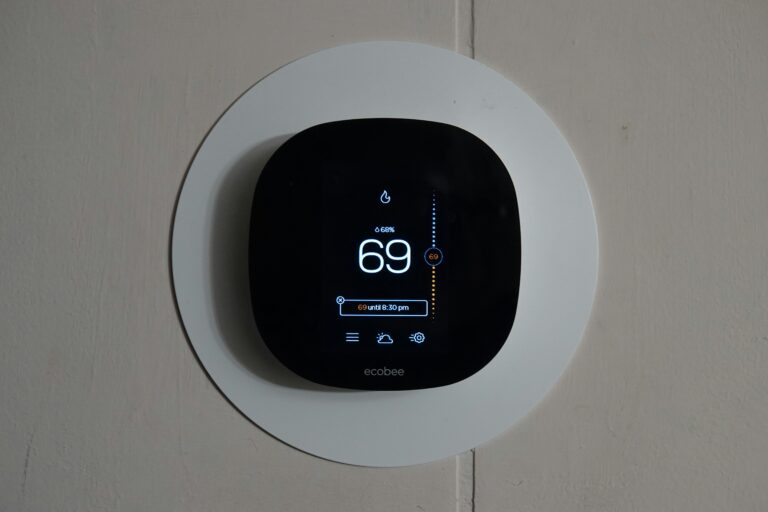

The answer to whether thermostats fail open or closed depends on what the equipment downstream needs to stay safe. A heating thermostat typically fails open, breaking the circuit so current never reaches the furnace. A cooling thermostat often fails closed, keeping the circuit made so the compressor keeps running rather than letting a room overheat unnoticed.
You’ll see how a thermostat decides which way to break, what each failure mode actually does to your equipment, and how to tell which one you’re dealing with before spending money on the wrong part.
What Fail-Open and Fail-Closed Mean in a Thermostat Circuit
A thermostat is a switch. Its job is to close an electrical circuit when the room needs conditioning and open that circuit when the room has reached the setpoint. The words “fail open” and “fail closed” describe what happens to that switch when something breaks.
The Two Failure States in Plain Language
Fail open means the contact separates and stops current flow, the same way flipping a wall switch to OFF does. Fail closed means the contact welds or sticks so current keeps moving, as if the switch were frozen in the ON position.
Most home thermostats that control a furnace are built to fail open. If the bimetallic strip warps past its travel limit, the heating circuit simply stops calling for heat. The boiler or furnace goes quiet, and the room drifts toward room temperature instead of climbing.
Why HVAC Techs Say “Open” to Mean “Off”
Electricians and HVAC technicians use the same vocabulary for opposite-sounding things, which trips people up. An open contact is a broken circuit, no current, equipment off. A closed contact is a completed circuit, current flowing, equipment running.
If your thermostat stops calling for heat, the safest direction is the one that leaves the heating circuit open. The room stays cool; the furnace stays safe.
The Physical Mechanism Behind the Default
A bimetallic coil or mercury switch is a moving part held under spring tension against a fixed contact. Wear, vibration, or a bent strip eventually pushes the moving contact past the fixed one, and gravity or spring force decides which side wins. Engineers choose spring tension with one specific outcome in mind: what should happen to the equipment when the thermostat can no longer control it.
| Term | What the Contact Does | Result on the Equipment |
|---|---|---|
| Fail open | Separates, breaks the circuit | Heating or cooling stops on its own |
| Fail closed | Stays welded or stuck in contact | Equipment keeps running until something else stops it |
| Normally open (NO) | Open at rest, closes when calling | Default position when power is removed |
| Normally closed (NC) | Closed at rest, opens when calling | Default position when power is removed |
Why the Default Failure Mode Depends on the Application
A Honeywell heating thermostat fails one way and a cooling thermostat fails the other because each application carries a different worst-case outcome. Engineers pick the safer of the two failure modes for the job the thermostat actually does.
Heating Thermostats Fail Open to Prevent Runaway Heat
Continuous heating without a working thermostat can scorch drywall, ignite dust inside a duct, or warp a heat exchanger. Letting the furnace run forever is the worst-case outcome, so the thermostat is designed to default to a broken circuit when it can’t control the equipment. No call for heat means a cold room, not a house fire.
High-limit safety switches follow the same logic. A temperature limit switch on a furnace or boiler is hard-wired fail-open as a last line of defense. If the plenum overheats, the switch pops, the relay drops out, and the burners shut down.
Cooling Thermostats Often Fail Closed for Compressor Protection
Air conditioners are more complicated because a short cooling cycle doesn’t destroy anything. Letting the compressor keep running when the thermostat has lost control won’t burn down a house, but it can short-cycle a compressor in winter if the contacts stick closed during a cold snap. The contact failure direction here protects the most expensive component.
Automotive Thermostats Use Fail-Open by Default
Automotive coolant thermostats use the same principle for engine protection. If the wax element or bimetallic spring inside the thermostat seizes, it defaults to the open position so coolant keeps flowing through the radiator. A stuck-closed automotive thermostat would cook an engine in minutes, so engineers spec fail-open there too. A stuck-open one just makes the cabin heater take longer on cold mornings.
How Different Thermostat Designs Actually Break
Not every thermostat breaks the same way. The mechanism inside decides how the part ages, what makes it fail, and which direction it ends up in when it finally gives out.
Mechanical Bimetallic Strips Warp Until Contacts Separate
A bimetallic strip is two metals bonded back-to-back that bend at different rates when heated. After thousands of cycles, the strip can develop a set, a permanent bend that doesn’t recover, and the contact gap grows past the point where it can bridge again. Power is removed, the furnace idles, and you call a technician.
Heat anticipator resistors inside older electromechanical thermostats also drift. A misadjusted anticipator shortens or lengthens each cycle, and a worn one can leave the contacts hovering in a deadband where neither open nor closed is reliable.
Mercury Switches Fail From Tilt, Age, and Vibration
Older Honeywell and White-Rodgers thermostats used a sealed glass vial of mercury that tilted to make or break contact. Drop the thermostat, mount it crooked on the wall, or watch the vial lose its hermetic seal after 20 years, and the switch stops making reliable contact. Some go open, some go closed, depending on the tilt at the moment of failure.
Pneumatic Thermostats Drift With System Pressure
Pre-1960s commercial buildings often run pneumatic thermostats that modulate a control loop by bleeding air through a nozzle. A leak in the supply line or a failed diaphragm sends the actuator to its default end, which depends entirely on how the air handler was piped. Pneumatic systems can be field-configured, but they’re also the hardest to predict without a wiring diagram.
Smart Digital Thermostats Rarely Fail in a Simple Direction
A Nest Learning Thermostat, Ecobee, or any solid-state unit doesn’t have a mechanical contact to stick. It has a relay on the control board, a thermistor for sensing, and firmware that decides when to fire the relay. When a smart thermostat “fails,” it’s usually a sensor reading error, a dead Wi-Fi chip, or a welded relay. The end result can mimic an open or closed failure, but the part that broke is different.
| Thermostat Type | Common Failure Mechanism | Typical End Position |
|---|---|---|
| Bimetallic (heating) | Strip warps, contact gap widens | Fail open |
| Mercury switch | Vial tilt, broken seal | Either, depends on tilt |
| Pneumatic | Lost air pressure, diaphragm leak | Field-configurable |
| Digital / smart | Welded relay, sensor fault | Often closed (welded relay) |
| High-limit safety | Bi-metal disk snaps past threshold | Fail open (always) |
Reading the Warning Signs of a Failed Thermostat
A thermostat stuck open vs closed behaves very differently at the wall. The symptoms tell you which way the contact has failed before you crack open the cover.
No Call for Heat When the Setpoint Is High
Turn the temperature up 10 degrees on a cool morning and nothing happens. No click from the furnace, no warm air starting to move through the vents. That’s the signature of an open failure: the thermostat is asking for heat, but the circuit can’t close.
Check the thermostat face first. If the display is blank or the batteries are dead, the thermostat can’t close the circuit even if it’s healthy. Replace the batteries and retest before assuming the part is bad.
System Runs Non-Stop Despite a Satisfied Setpoint
The opposite symptom is the scary one. The furnace or air handler keeps blowing long after the room has passed the setpoint, and turning the thermostat down does nothing. The contact is welded closed, the relay is stuck, and you’re heading toward a frozen coil or a scorched heat exchanger if nobody intervenes.
Erratic Cycling From a Deadband Problem
Short cycling, the equipment turning on and off every few minutes, is usually a deadband or anticipator issue rather than a true fail-open or fail-closed event. The thermostat is technically working, but its calibration has drifted far enough that the swing between “call for heat” and “satisfied” has narrowed below what the equipment needs. Recalibrate or replace.
Diagnostic Indicators on Smart Thermostats
Ecobee and Nest units surface specific fault codes when their internal sensors or relays misbehave. A “relay welded” alert points straight to a closed failure on the control board. A “no temperature change detected” warning often means the thermostat is calling for heat but the system isn’t responding, which is the open-failure signature.
Safety Consequences and Field-Configurable Designs
Choosing the wrong default failure mode can mean a fire, a frozen pipe, or a dead compressor. Engineers and standards bodies spend real effort making sure the safer direction wins.
Fire Risk From a Heating Contact That Fails Closed
A heating thermostat stuck closed is one of the more dangerous HVAC faults. The furnace never shuts off, the heat exchanger soaks up thermal stress, and any dust or bird nest inside the duct becomes kindling. Limit switches on the furnace itself are the secondary guard, but they’re not infallible, especially on older equipment that hasn’t been inspected in years.
Freeze Risk From a Heating Thermostat That Fails Open
The reverse problem shows up in cold climates. A failed-open heating thermostat leaves the house unheated during a winter storm. Pipes in exterior walls can freeze and burst within hours, and the recovery cost dwarfs the price of a $40 thermostat.
Process-Control Thermostats With DIP-Switch Selection
Industrial and commercial thermostats often ship with a DIP switch or jumper that lets the installer choose fail-open or fail-closed behavior. A brewery glycol loop needs fail-closed cooling so a stuck contact doesn’t let temperature climb and spoil the batch. A building heat trace needs fail-open so a stuck contact doesn’t drive the cable past its rated temperature.
Codes and Standards That Shape Fail-Safe Direction
UL 873 covers temperature-indicating and regulating equipment, and it expects manufacturers to specify and test the failure mode of any safety-relevant contact. ANSI Z21.20 governs gas ignition controls, and ASME Boiler Code shapes how high-limit switches behave on boilers over a certain capacity. Together, these standards push every critical thermostat toward a documented, tested failure direction.
| Application | Preferred Fail Direction | Reason |
|---|---|---|
| Residential furnace | Fail open | Stops heating on fault, prevents fire |
| Central air conditioner | Fail closed | Protects compressor short-cycling |
| Boiler high-limit | Fail open | Last line of defense over-temperature cutoff |
| Heat trace / pipe freeze | Fail open | Prevents cable burnout in fault |
| Automotive coolant | Fail open | Keeps coolant flowing if seized |
Diagnosing the Failure and Choosing the Next Step
Once you suspect the thermostat has failed, working through a short checklist tells you whether you’re looking at an open fault, a closed fault, or something further down the control chain.
Step-by-Step Checks From the Wall to the Control Board
Start at the thermostat face. Confirm the display is lit, the setpoint is correct, and the system mode (heat, cool, off) is what you think it is. Then pull the cover and watch the contacts or relay while you call for a 5-degree swing.
- Verify power: Confirm 24 VAC between R and C at the thermostat terminals using a multimeter. No voltage means the transformer or fuse is upstream of your problem.
- Watch the call: Bridge R to W (heat) or R to Y (cool) with a short jumper wire. If the equipment fires, the thermostat contacts are the failure.
- Test the contact: With the thermostat removed, measure resistance between W and R, then Y and R. An open contact reads OL or infinite resistance. A closed contact reads near zero.
- Inspect the board: Look at the relay on the air handler or furnace control board. A pitted or welded relay contact is the closed-failure culprit.
- Check the wire run: A chewed thermostat wire from a mouse or a staple driven through low-voltage cable can mimic an open failure.
Using a Multimeter to Confirm the Contact Position
Set the meter to continuity mode and probe across the heating terminals while you raise the setpoint well above room temperature. A beep means the contact closed. Silence means it’s stuck open. Flip to voltage mode and measure between W and C while the system is calling; you should see roughly 24 VAC. Zero voltage on a call confirms an open failure upstream.
Deciding Between Cleaning, Recalibrating, or Replacing
Older mercury and bimetallic thermostats can sometimes be cleaned with contact cleaner and recalibrated against a known thermometer. Most modern digital units can’t be serviced at the component level; once the relay welds or the sensor drifts out of spec, replacement is the realistic option. A new Honeywell or Ecobee runs less than the labor charge to open up an old White-Rodgers.
When to Call an HVAC Technician Instead
Stop DIY troubleshooting the moment you smell burning insulation, see water pooling under the air handler, or watch the limit light blink more than twice in a row. Those symptoms point past the thermostat into the equipment itself. A licensed HVAC technician has the gauges, the combustion analyzer, and the liability coverage to chase those faults safely. Industrial heating vendors publish similar guidance for process loops: if the failure is in a control circuit carrying more than a few amps, hand it off.
Bottom Line
Thermostats fail in whichever direction protects the equipment they control. Heating circuits default to fail-open because a runaway furnace is the worse outcome. Cooling circuits often default to fail-closed because a stranded compressor costs more than a cold room. Smart thermostats sidestep the binary entirely with solid-state relays, but a welded relay on the control board can still mimic a closed failure. Diagnose first, then decide whether the contact, the wire run, or the board itself is the part that needs attention.
FAQ
What does it mean when a thermostat fails open or closed?
A thermostat that fails open breaks its own circuit and stops calling for heating or cooling, so the equipment idles until the part is replaced. A thermostat that fails closed keeps the circuit made and the equipment keeps running even after the setpoint is satisfied.
Why do heating thermostats fail open?
Heating thermostats fail open because the worst-case scenario is a furnace that runs continuously without shutting off. An open failure leaves you with a cold room; a closed failure can mean a scorched heat exchanger or a duct fire.
Can a failed thermostat cause a furnace to not turn on?
Yes. A bimetal strip warped past travel, a broken mercury vial, or a dead digital relay will all stop the call for heat from reaching the furnace. The thermostat is often the first place to check when the burners never light.
Do all thermostats have a default fail-safe position?
Mechanical and mercury-switch thermostats are designed with a default, but digital thermostats don’t have a true mechanical default. Their relays can fail in either direction depending on which component wore out first.
How do I tell if my thermostat has failed?
The clearest signs are no response to a setpoint change, a system that runs non-stop despite a satisfied room temperature, or a short-cycling pattern that didn’t exist before. A multimeter across the heat or cool terminals confirms which direction the contact has failed.