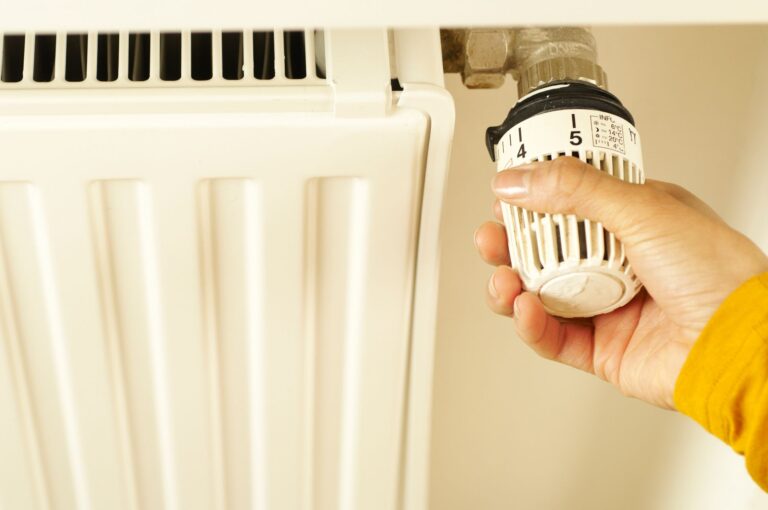

Replaceable AA or AAA alkalines, lithium primaries, or built-in rechargeable packs charged through HVAC activity power many wall-mounted climate controls, freeing them from dependence on a hardwired common wire. Many homes lack the dedicated C-wire, so battery power keeps schedules and clocks alive for one to two years on a fresh set, and the low-battery indicator usually flashes about three weeks before shutdown. Pick the right power source and your heating and cooling never misses a beat; pick the wrong one and you wake up to a cold house at 6 a.m.
This practical walkthrough explores how battery-powered thermostats work, which cell types fit different HVAC setups, and what to expect from install through replacement, helping homeowners without a C-wire keep their climate control reliable.
Why Some Thermostats Run on Batteries and Others Don’t
Modern HVAC boards typically deliver 24VAC through a step-down transformer, and the common (C-wire) provides the return path that keeps a thermostat continuously powered. Without that return path, the thermostat only wakes when the heating or cooling relay closes, which is why many older homes run perfectly fine on battery power alone.
Homes built before the mid-2000s often rely on a simple 4-wire run: red for power, white for heat, yellow for cooling, and green for the fan. That bundle lacks a dedicated return wire, so the thermostat borrows power through other conductors, which is workable for mechanical switches but flaky for Wi-Fi screens. Smart thermostats with rechargeable cells solve this by trickle-charging whenever the HVAC calls.
Three Power Strategies You Will Encounter
- Fully battery-operated: These units run entirely on AA or AAA cells, drawing microamps during standby. Common in entry-level programmable models and portable thermostat designs.
- Battery backup only: A rechargeable pack runs the screen during off-cycles, then tops up through the 24V transformer during active heating or cooling.
- Hardwired with battery backup: Common in Honeywell and Ecobee premium units, where C-wire power is primary but cells preserve settings during outages.
The category that fits your situation depends on what already sits inside your wall box, which is the decision the next section helps you make.
Mapping Your HVAC System to the Right Power Option
Pull the cover off your current thermostat and count the thin conductors tucked into the base plate, because that count tells you which models will work without rewiring. A 2-wire heat-only setup signals a millivolt or simple 24V furnace, while 4-wire and 5-wire bundles support cooling and fan control respectively.
Heat pump systems add orange conductors for the reversing valve and often need at least six wires for auxiliary heat staging. Knowing your wire count before shopping prevents buying a thermostat that simply will not power up in your wall box.
Quick Wire-Count Reference
| Wire Count | Typical Terminals | What It Supports |
|---|---|---|
| 2 wires | R, W | Heat-only furnace or millivolt system |
| 4 wires | R, W, Y, G | Standard forced-air heating and cooling |
| 5 wires | R, W, Y, G, C (or Rc/Rh split) | Cooling plus common or dual-transformer setups |
| 6+ wires | Adds O/B, AUX, E | Heat pump with auxiliary strips or multi-stage |
Heat-only boilers and cool-only window units often run on 2 wires, which is fine for fully battery-operated thermostats because there is no Wi-Fi radio to feed. Forced-air systems with air handlers want at least 4 wires plus a C-wire for stable smart-thermostat operation.
When a Power Extender Kit Beats a Retrofit
Skip the drywall surgery and let a Power Extender Kit (PEK) repurpose existing conductors to create a virtual C-wire, saving hours of fishing wire through closed walls.
PEK adapters work in most 4-wire and 5-wire setups and ship with many Honeywell and Ecobee models. If your system already has a C-wire, the PEK just sits unused in the box. If your system lacks one entirely, the adapter prevents the dreaded blank screen that plagues poorly matched Wi-Fi thermostats on older furnaces.
That adapter matters most in homes built before the 1990s, where original wiring often omits the continuous power feed entirely.
Battery Life Across Common Thermostat Types
A fresh pair of alkaline AA cells powers a basic programmable thermostat for roughly 12 to 24 months, depending on how often the screen wakes and how cleanly the relay contacts make. Lithium primaries stretch that window to about three years because they hold voltage better under the constant microamp draw of a sleeping thermostat.
Smart thermostats like Nest and Ecobee sidestep disposable cells with internal lithium-ion packs charged by the HVAC itself. Each call for heat or cool pushes a small current through the control board, replenishing what the Wi-Fi radio spent overnight.
Factors That Quietly Drain Cells Faster
- Direct sunlight on the wall plate: Heat above 100°F accelerates alkaline self-discharge and can halve battery life.
- Kitchen heat and steam: Moisture corrodes contacts, increasing resistance and forcing the radio to draw more current.
- Frequent Wi-Fi reconnections: Weak signal strength at the wall location forces the radio to boost power every few minutes.
- Old or mismatched cells: Mixing brands inside a single thermostat creates voltage imbalance and early failure.
Mounting the thermostat on an interior wall away from windows and cooking appliances is the single most effective way to extend battery life, and interior-wall placement can also reduce HVAC run-time by 2 to 5 percent as a side benefit.
Installing a Battery-Powered Thermostat Without a C-Wire
Most battery-powered thermostat installations finish in under 20 minutes, provided the breaker is off and the wires are labeled before you pull the old base plate. Photograph the existing wiring with your phone so terminal letters are unmistakable when you transfer each conductor to the new wall mount.
Shut the breaker for both the HVAC air handler and the furnace before touching any wire. Even at 24V, a miswire can short the transformer and brick the entire control board, which costs far more than a new thermostat.
Step-by-Step Swap
- Begin by switching off the breaker feeding the HVAC system before touching any thermostat wires. Flip the breaker for the air handler and furnace, then confirm the old thermostat is dark.
- Step 2: Label by terminal. Tag each wire with the letter printed beside its terminal, since wire color codes are not standardized across installers.
- Step 3: Mount the new base plate. Use the included anchors if the holes do not line up, and feed the conductors through the center opening.
- Step 4: Seat each wire. Press the release tab, insert the conductor fully, then tug gently to confirm it locks.
- Step 5: Insert batteries and power up. Restore the breaker only after the cells are seated and the screen asks for configuration.
Stop and Call a Pro When You See This
Multi-stage systems, zoned panels, and heat pumps with auxiliary strips can confuse any thermostat that assumes a simple R-W-Y-G layout. Miswiring those boards burns relays in minutes.
If your furnace control board has more than six screw terminals, or your home uses a zoning panel with dampers, treat the install as a service call rather than a DIY project. Most HVAC techs charge a flat diagnostic fee that runs far cheaper than replacing a scorched control board.
Replacing Batteries and Keeping Settings Intact
The low-battery indicator typically appears 2 to 3 weeks before failure, giving you a healthy warning window. A blinking battery icon, a dimmed backlight, or a message like “Replace Battery” all mean the same thing: schedule a swap within the next few days rather than waiting for the first cold snap.
Most thermostats retain programmed schedules and the internal clock for roughly 60 seconds without power, which is more than enough time to swap a pair of AAs. Pull the old cells out, drop in the fresh ones within that window, and your settings survive intact.
Choosing the Right Cell for Your Climate
- Alkaline AA: Inexpensive and widely available; best for interior-wall installs away from drafts.
- Lithium AA: Costs about three times more but lasts two to three times longer, making it the better pick for vacation homes and cold garages.
- Rechargeable NiMH: Eco-friendly for swap-heavy installs, though voltage drops faster below freezing.
Keep a small labeled drawer near the unit with two spare cells taped together, because nothing derails a winter morning faster than discovering the spare batteries are corroded and the store is closed.
That habit protects against more than dead cells, since aging alkaline leaks quietly corrode terminals and trigger the very power faults the next section warns about.
Power-Stealing, Short Cycling, and Other Hazards to Watch For
Power-stealing thermostats borrow a tiny current through the HVAC relay coil to keep their rechargeable cells topped up, and on healthy systems this draw is invisible. On aging control boards or low-voltage relays, the parasitic draw can hold the relay open just enough to buzz, hum, or short-cycle the system every few minutes.
Short cycling shows up as the furnace kicking on for 90 seconds and shutting off, then repeating every three to five minutes. That pattern wastes energy, stresses the heat exchanger, and signals that the thermostat and board are arguing over current that does not exist.
Troubleshooting Sequence
| Symptom | Likely Cause | First Fix |
|---|---|---|
| Batteries die in weeks | Weak Wi-Fi signal or heat exposure | Relocate router or move the thermostat to an interior wall |
| Blank screen after install | Missing C-wire on a Wi-Fi model | Install the included Power Extender Kit |
| Erratic temperature readings | Loose terminal or draft through the wall cavity | Seal the penetration with foam and re-seat each conductor |
| Heat pump runs auxiliary when not needed | Misconfigured O/B terminal | Switch the reversing-valve setting in the installer menu |
Persistent relay buzzing usually means the board is too old to tolerate power-stealing, and the cleanest fix is to add a dedicated C-wire or accept a battery-only thermostat instead. Forcing the system to keep working around a flaky board costs more in HVAC repairs than the savings on the original install.
Choosing the Right Model for Your Wiring Situation
Honeywell’s basic programmable lineup tolerates missing C-wires gracefully because it draws almost no standby current, and the included AA cells run for 18 to 24 months on a wall mount with stable climate control. Ecobee’s smart models lean on a PEK for 4-wire installs and ship with a rechargeable pack that tops up on every call for heating or cooling, making them reliable for homes without rewiring.
Nest thermostats recharge similarly but handle missing C-wires less gracefully on heat-only systems, because there is no cooling call to top up the battery during mild weather. For a vacation cabin or guesthouse that runs heat only, a battery-only Honeywell keeps things simple and predictable.
Fully Battery-Operated Versus Hybrid Models
Battery powered thermostat for home installs in older houses tend to favor fully battery-operated units because they avoid the Wi-Fi radio entirely, which is the largest power draw in any smart thermostat. Hybrid models like the Sensi strike a balance by using batteries as backup while relying on the C-wire for primary power, which gives you Wi-Fi without the short-cycling risk of pure power-stealing designs.
Price Versus Complexity Trade-Offs
- Retrofit the C-wire: Roughly $150 to $400 for an electrician, but enables any smart thermostat on the market without adapters.
- Add a PEK: Usually free in the box, takes 10 minutes, and works for most 4-wire forced-air systems.
- Buy a battery-friendly unit: Costs less up front and avoids wiring changes, though you sacrifice Wi-Fi features.
Three-Line Decision Rule
Count the conductors behind your existing thermostat. If you have four or fewer and no cooling, buy a battery-operated Honeywell and skip the adapters. If you have four wires plus cooling, add the PEK and install a hybrid Ecobee or Sensi for full app control. If you already see five or more conductors including a C-wire, choose any premium smart thermostat that matches your heating and cooling stages.
Reliable Wi-Fi at the wall location matters as much as the wire count, because a smart thermostat that drops offline every hour burns through its backup cells in weeks. Aim for at least two bars of signal where the wall mount will sit, and consider a mesh repeater if the router lives across the house.
Signal strength is the last practical hurdle, and getting it wrong leaves every other decision you’ve made working against you.
Bottom Line
Your wiring decides the thermostat, not the other way around. A four-wire forced-air system without a C-wire runs happily on a PEK-equipped hybrid model, while a two-wire boiler or garage needs nothing more than a battery-operated programmable unit. Match the wire count first, pick the cell chemistry for your climate second, and your heating and cooling schedule survives every swap without losing settings.
FAQ
Do thermostats need batteries?
Only some do. Hardwired models with a C-wire draw continuous 24VAC from the HVAC transformer, while battery-powered and hybrid units rely on AA cells, lithium primaries, or rechargeable packs for primary or backup power. The wire count behind your wall plate decides which category fits your install.
How long do thermostat batteries last?
Alkaline AA cells typically power a basic programmable thermostat for 12 to 24 months. Lithium primaries stretch that to roughly three years, and rechargeable packs in smart thermostats cycle continuously through the HVAC activity without ever needing a swap.
Can a thermostat work without a C wire?
Yes. Battery-only thermostats ignore the C-wire entirely, and most smart thermostats include a Power Extender Kit that creates a virtual common wire from the existing 4-wire bundle. Multi-stage heat pumps and zoned panels sometimes need a true C-wire retrofit instead.
What type of batteries do thermostats use?
Most use AA or AAA alkaline cells, with lithium primaries as a longer-lasting upgrade. Rechargeable lithium-ion packs appear inside Nest and Ecobee units and never need replacement under normal use, because the HVAC system tops them up on every call.
How do I know if my thermostat battery is low?
A blinking battery icon, a dimmed backlight, or an on-screen message like “Replace Battery” all signal a low cell. Most thermostats flash this warning two to three weeks before the screen actually goes dark, giving you time to swap cells without losing heating and cooling.