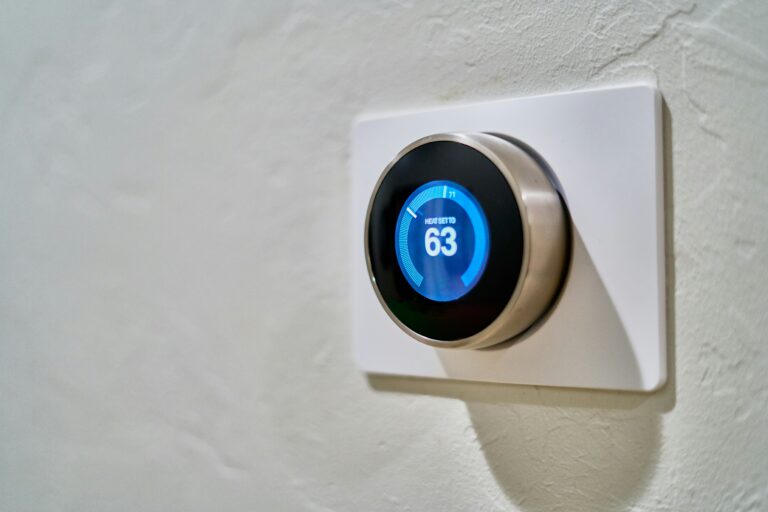

A smart thermostat is a Wi-Fi–connected temperature controller that adds internal sensors, an on-device learning algorithm, and app access to the basic scheduling of a programmable unit, cutting heating and cooling costs by roughly 8% to 15% per year, the range ENERGY STAR cites for certified models. A programmable box runs only the script you typed in last January; a connected one watches your patterns, talks to your phone, and adjusts on the fly.
This guide covers the practical advantages that set smart thermostats apart, from real energy savings and learning algorithms to app controls and HVAC compatibility, helping homeowners decide if an upgrade is worth the upfront cost.
The Core Difference Between Smart and Programmable Thermostats
A programmable unit is a timer with a temperature dial. You set four or six daily periods once, and the box runs that script every weekday plus a separate weekend script. The moment your life changes (a late meeting, a sick kid, a two-week vacation), the schedule keeps firing and either overheats an empty house or wakes you up shivering.
A smart thermostat layers connectivity and software on top of that same scheduling capability. The device joins your home Wi-Fi, pairs with a phone app, and uses internal sensors plus optional remote room sensors to make continuous micro-adjustments the old hardware cannot make. That connection drives every benefit covered below, from remote control to utility rebates that often require Wi-Fi reporting.
Why the Gap Matters for Real Households
Fixed schedules work well for two adults who leave at 8 a.m. and return at 6 p.m. every day. The moment that routine shifts, the old schedule wastes energy. Remote workers bouncing between a home office and the living room, shift workers on rotating schedules, and families whose school-age activities change weekly feel the difference most. A learning algorithm builds a personalized schedule within about a week of use by watching when you walk past the wall and tweaking the temperature, which removes the most common complaint about programmable units: nobody bothers to keep them programmed.
| Capability | Programmable Thermostat | Smart Thermostat (Nest, Ecobee, Honeywell Home T9) |
|---|---|---|
| Scheduling | Manual, fixed (4–6 daily periods) | Manual plus auto-learning that adapts to presence and habits |
| Remote control | None | App from anywhere with internet |
| Sensors | One, at the wall | Main unit plus optional remote room sensors |
| Voice control | None | Works with Amazon Alexa, Google Home, Apple HomeKit (varies by model) |
| Energy reports | None | Hourly, daily, and monthly usage history on most brands |
| Utility rebate eligibility | Limited | Common, often $50 to $150 for ENERGY STAR certified models |
Realistic Energy Savings and What Drives Them
ENERGY STAR’s 8% to 15% range on heating and cooling comes from field studies across climates and home types, which is why it is the most cited figure. Actual results vary, sometimes sharply, based on where you live, how tight your building envelope is, and how much your old schedule over- or under-heated the house.
Three Mechanisms That Produce the Savings
Automated setbacks fire the moment a connected thermostat notices no one is home, through phone geofencing, internal motion sensors, or a learned pattern. A traditional programmable unit only knows what you told it last January. Learning algorithms avoid heating rooms you are not using, which matters most in homes with a finished basement, a bonus room, or a sun-soaked upstairs that runs hot in summer. Usage reports surface waste the monthly bill hides: a heat pump short-cycling at 2 a.m., a window left open during a setback, an auxiliary strip that ran twelve hours on a single day.
Climate and Payback Realities
Heating-dominant climates (Northeast, Midwest, Mountain West) see the larger dollar savings because heating fuel costs more per BTU and the heating season runs longer. A mild-climate home in coastal California that runs the air conditioner for three months a year still saves, but the absolute dollar number comes in lower. Add typical utility rebates and the upgrade usually pays for itself in one to three years, faster than almost any other home improvement short of sealing air leaks. Run the math against your last twelve months of utility bills before assuming your savings will hit the high end of the range.
Features That Make Daily Life Easier
Energy savings get attention, but most owners cite day-to-day convenience when explaining why they would not go back. The features below all build on the same foundation (Wi-Fi, sensors, and an app), and each solves a specific complaint about the thermostat that used to be on the wall.
Geofencing and Learning Schedules
Geofencing uses your phone’s location to cool or heat the house as you approach the door, no manual programming required. Leave work at 5 p.m., and the house starts recovering at 4:40. Drive to a different city for the weekend, and the system drops to a deep setback automatically. Learning algorithms handle the rest: a device like the Nest Learning Thermostat builds a personalized schedule within about a week by watching your manual adjustments and the times you are home, so the daily tap-tap-tap on the wall fades fast.
Remote Sensors and Voice Control
The classic complaint in a two-story home is that the hallway thermostat reads 70 while the upstairs bedroom hits 78. Remote sensors, sold as accessories for the Ecobee SmartThermostat and the Honeywell Home T9, average temperature across the rooms you actually use, or prioritize the room you are in. Voice control through Amazon Alexa, Google Assistant, or Siri turns a temperature change into a spoken sentence rather than a phone unlock, an app open, and a slider drag. The whole feature set is what homeowners mean by advantages of smart home temperature control: less fiddling, fewer hot and cold rooms, more time spent not thinking about the thermostat.
HVAC Compatibility and Installation Self-Check
A quick five-minute compatibility check before purchase prevents the HVAC mismatch that sends most smart thermostats straight back to the retailer. Most modern homes in the United States use a 24V low-voltage system that works with any mainstream smart thermostat out of the box. Older homes, homes with high-voltage baseboard heat, and a small number of proprietary systems need specific models or professional help.
The Five-Minute Compatibility Check
- Turn off the breaker that powers the HVAC system. The label inside the panel will say “Furnace” or “Air Handler.” Flip it to off before touching any wires.
- Remove the existing faceplate by gently pulling it off the wall. Most faceplates snap on with no screws.
- Photograph the wire labels on each terminal (R, C, W, Y, G, and so on). Match the wire colors to the letters printed on the backplate.
- Check for a C-wire, usually blue or black, plugged into the “C” terminal. A C-wire delivers continuous power and is what most smart thermostats need to stay connected to Wi-Fi.
- Run the manufacturer’s compatibility tool with your photo in hand. Nest, Ecobee, and Honeywell all offer free online checkers that take about a minute.
If the C-wire is missing, a power adapter kit (about $25) or a thermostat that steals power from the control board (the Ecobee includes one) solves the problem without running new wire through the wall. Renters should ask the landlord before changing the wiring.
High-voltage baseboard or electric-resistance heaters (usually 120V or 240V) require thermostats rated for line voltage, and smart options in that category are limited. A few proprietary systems from carriers, including some older Lennox setups, also need brand-specific controls. When in doubt, a licensed HVAC technician can identify the system in under fifteen minutes for a typical service-call fee, and the answer is worth knowing before you spend $200 on hardware.
Privacy, Ecosystem Lock-In, and Total Cost of Ownership
Sticker price is the first number shoppers look at, and total cost over five years is the one that decides whether the upgrade actually saves money. Three line items get overlooked: optional remote sensors, a C-wire adapter if one is needed, and the occasional subscription tier for advanced energy reporting on a few brands. Add utility rebates and the math usually still works, but the honest version is the one that includes every line.
Data, Privacy, and Ecosystem Lock-In
Reputable manufacturers process occupancy data on-device or anonymize aggregate usage before sending it to the cloud, and the privacy policy on the manufacturer’s site spells out exactly what leaves your home. Read it before you scan the QR code on the back of the box. Lock-in is a smaller concern now than it was five years ago, because Matter and Thread support lets a single thermostat work across Amazon Alexa, Google Home, and Apple HomeKit without picking sides at install time. If your home already runs a mix of ecosystems, that cross-platform support matters more than the brand on the front of the device.
| Line Item | Typical Cost | Notes |
|---|---|---|
| Thermostat unit | $130 to $280 | ENERGY STAR certified models from Nest, Ecobee, Honeywell |
| Remote room sensors (optional) | $20 to $80 for a 2-pack | Most useful in multi-story or zoned homes |
| C-wire adapter (if needed) | $20 to $30 | Often included in the box by Ecobee |
| Professional installation | $80 to $200 | Required for line-voltage or proprietary systems |
| Utility rebate | -$50 to -$150 | Available in over 40 states for ENERGY STAR models |
When a Smart Thermostat Is Not Worth Buying
Smart thermostats are not a universal upgrade. Some homes will not benefit enough to justify the cost, and in a few cases the install is not even allowed without a landlord’s permission. Knowing the no-go zones saves you from a return and a restocking fee.
Skip the Upgrade in These Situations
Renters with restrictive leases. Many leases require landlord approval for any wiring change, and some landlords ban cloud-connected devices outright. Confirm before you buy, or stick with a non-invasive plug-in alternative like a smart space heater with its own schedule.
Aging single-stage HVAC nearing replacement. A learning thermostat shines when it can modulate compressor stages, run a heat pump efficiently, and coordinate with a multi-speed fan. Pairing a $250 smart thermostat with a 20-year-old single-stage furnace is like putting a modern transmission in a car with a worn engine. Wait for the system upgrade.
Unreliable or metered Wi-Fi. Remote control, learning, and usage reports all require a stable connection. If your home Wi-Fi drops several times a day, or your data plan charges per gigabyte, the connected features that justify the price premium over a basic programmable will simply not work.
Privacy-first households with no off-ramp. Anyone uncomfortable with cloud-connected devices, or whose utility offers no time-of-use rate that rewards automated setbacks, will see longer payback periods. A simple upgrade like sealing duct leaks or adding attic insulation often beats a smart thermostat on pure return in that case.
Bottom Line
A smart thermostat is a stronger upgrade than a programmable unit for any household with a variable schedule, a modern 24V HVAC system, a stable Wi-Fi network, and the patience to spend ten minutes on the compatibility check before buying. The combination of automated setbacks, learning algorithms, remote room sensors, and utility rebates makes this one of the few home improvements that pays for itself in under three years. Skip it only if the lease forbids it, the HVAC system is on its last leg, or reliable Wi-Fi is not part of your home.
FAQ
Do smart thermostats actually reduce energy bills?
Yes. ENERGY STAR estimates that ENERGY STAR certified smart thermostats reduce heating and cooling costs by roughly 8% to 15% per year, with the largest dollar savings in heating-dominant climates. The savings come from automated setbacks, learning schedules, and usage reports that surface waste you would never see on a monthly bill.
What is the difference between a smart thermostat and a programmable one?
A programmable thermostat runs the same fixed schedule every weekday and a separate one on weekends, with no remote access and no learning. A smart thermostat adds Wi-Fi, internal sensors, optional remote room sensors, mobile app control, and software that adapts the schedule to your actual presence. The two devices look similar on a wall but behave very differently in real homes.
Can a smart thermostat work without Wi-Fi?
It will still control your heating and cooling on a basic manual schedule, but every connected feature stops: app control, learning, voice control through Alexa or Google Assistant, energy reports, and utility rebate reporting. If your home Wi-Fi is unreliable, the upgrade loses most of its value and a basic programmable is the better fit.
How do smart thermostats learn your schedule?
Most learning models, including the Nest Learning Thermostat, watch for two signals during the first week: the times you manually adjust the temperature and the times your phone is home versus away. The device builds a personalized schedule from those patterns and refines it as your routine changes. Remote sensors on models like the Ecobee SmartThermostat add room-by-room awareness on top of that pattern.
Are smart thermostats worth the upfront cost?
For most homeowners with a modern 24V HVAC system and stable Wi-Fi, yes. After utility rebates of $50 to $150 in over 40 states, the upgrade usually pays for itself in one to three years, faster than most home improvements. Renters and owners of aging single-stage HVAC should wait or skip the upgrade, since the connected features will not deliver their full value.